Standards basis
The standards behindthe numbers
For each standard, what it covers and exactly how ProtectionAI relates to it — implemented mathematics, a file format it reads, or a reference frame for an assessment. Referencing a standard is not certification.
Why this page exists
A test result is only as good as its stated basis
If a report says a relay passed, the next question is: passed against what?
ProtectionAI computes expected values from published standard equations rather than from internal lookup tables, and it names the basis on the page where the assessment happens. This page collects those relationships so a reviewer can check them without opening the application.
Three different kinds of relationship appear below, and they are not equivalent. Some standards are implemented as mathematics inside a module. Some are file formats the application reads or writes. Some are frameworks the software produces records for without claiming to satisfy them. Each entry says which.
Implemented mathematics
Inverse-time characteristics
- IEC 60255-151
- The measuring-relay standard defining the standard inverse, very inverse, extremely inverse and long-time inverse characteristics and their equations. ProtectionAI evaluates these equations directly to produce the expected operate time at each test current, given the configured curve and time multiplier. It is the basis for the plotted expected curve in the 50/51 module and for the relay characteristics drawn in TCC Coordination Studio.
- IEEE C37.112
- The IEEE inverse-time characteristic equations, the North American counterpart to the IEC set, including the moderately, very and extremely inverse forms. Implemented on the same footing: select an IEEE characteristic and the expected times and plotted curves come from these equations.
- What this does not mean
- Implementing a standard's equations is not a conformance assessment of your relay against that standard, and it is not a statement that any particular relay implements the curve the same way. It means the expected value in the verdict column has a published, checkable origin.
File formats
Transient records and configuration files
- IEEE C37.111 (COMTRADE)
- The common format for transient data exchange. ProtectionAI reads COMTRADE records, plots their analog and digital channels, and plays them back through the driver layer — which today terminates at the built-in simulator. It also writes COMTRADE for captures produced by the simulator, so a simulated event can be exchanged with other tools in the same format as a real one.
- IEC 61850 SCL (SCD, ICD, CID)
- Substation Configuration Language files. ProtectionAI imports them to read the IEDs, datasets and control blocks a substation actually declares, which is the reference point for any GOOSE or Sampled Values work, and writes SCL back out under a preserve-verbatim-or-refuse contract: a section it cannot round-trip faithfully is refused rather than reformatted.
- OMICRON XRIO and RIO
- Not standards, but the parameter-file formats most protection teams already have. Both import into ProtectionAI's normalised settings model. The formats belong to OMICRON; importing them implies no relationship with or endorsement by OMICRON.
Standards in use
Coordination against published curve models
Assessment references
Differential, damage and fuse curve models
- IEC 60255-187-1 and IEEE C37.91
- The differential-relay measuring standard and the IEEE guide for protecting power transformers. The 87T module states on its own page that results are assessed to ±5% with reference to these documents, so the tolerance in the verdict column has a named source rather than a house convention.
- IEEE C57.109
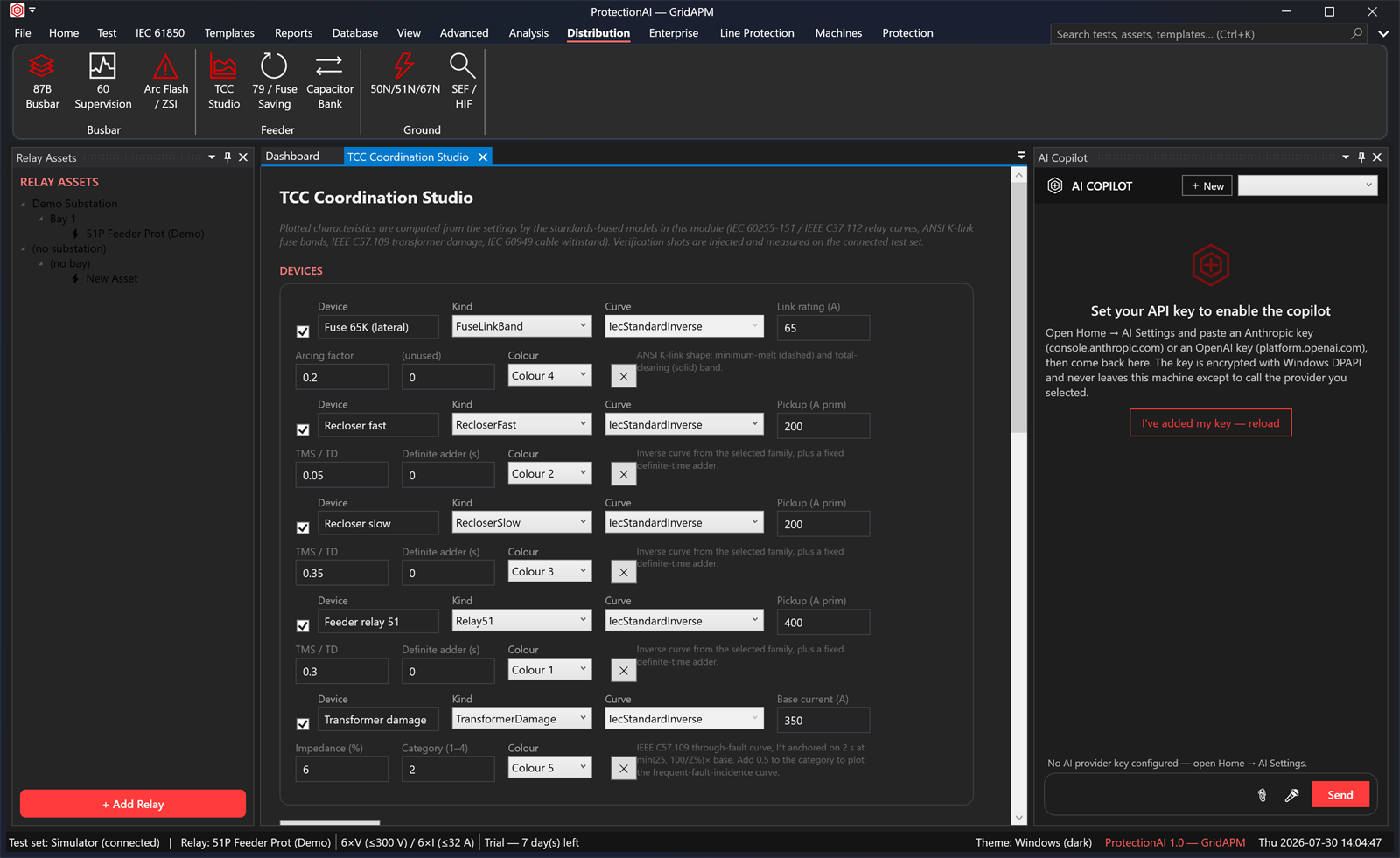
- The IEEE guide for transformer through-fault current duration. Used to draw the transformer damage curve in TCC Coordination Studio from the transformer data you enter, so a feeder element can be checked against it visually.
- IEC 60949
- Calculation of thermally permissible short-circuit currents in cables. Used to compute cable damage curves in the coordination workspace on the same axes as the protective device characteristics.
- ANSI K-link fuse bands
- The ANSI K-rated fuse link classes. TCC Coordination Studio models the minimum-melt and total-clear band for a selected K link — the 65K lateral fuse in the capture above — from the class data rather than from a scanned manufacturer curve.
IEC 61850
The digital substation standards, and the loopback limit
Read this section twice if process bus is in your scope. The limit is significant.
- IEC 61850-8-1 (GOOSE)
- ProtectionAI encodes, publishes and monitors GOOSE messages, over either its deterministic loopback or a physical interface selected by name through SharpPcap/Npcap, with no silent fallback between the two. Live use requires the packet runtime, appropriate permissions and site qualification; the UI reports capture-interface and timestamp provenance.
- IEC 61850-9-2LE (Sampled Values)
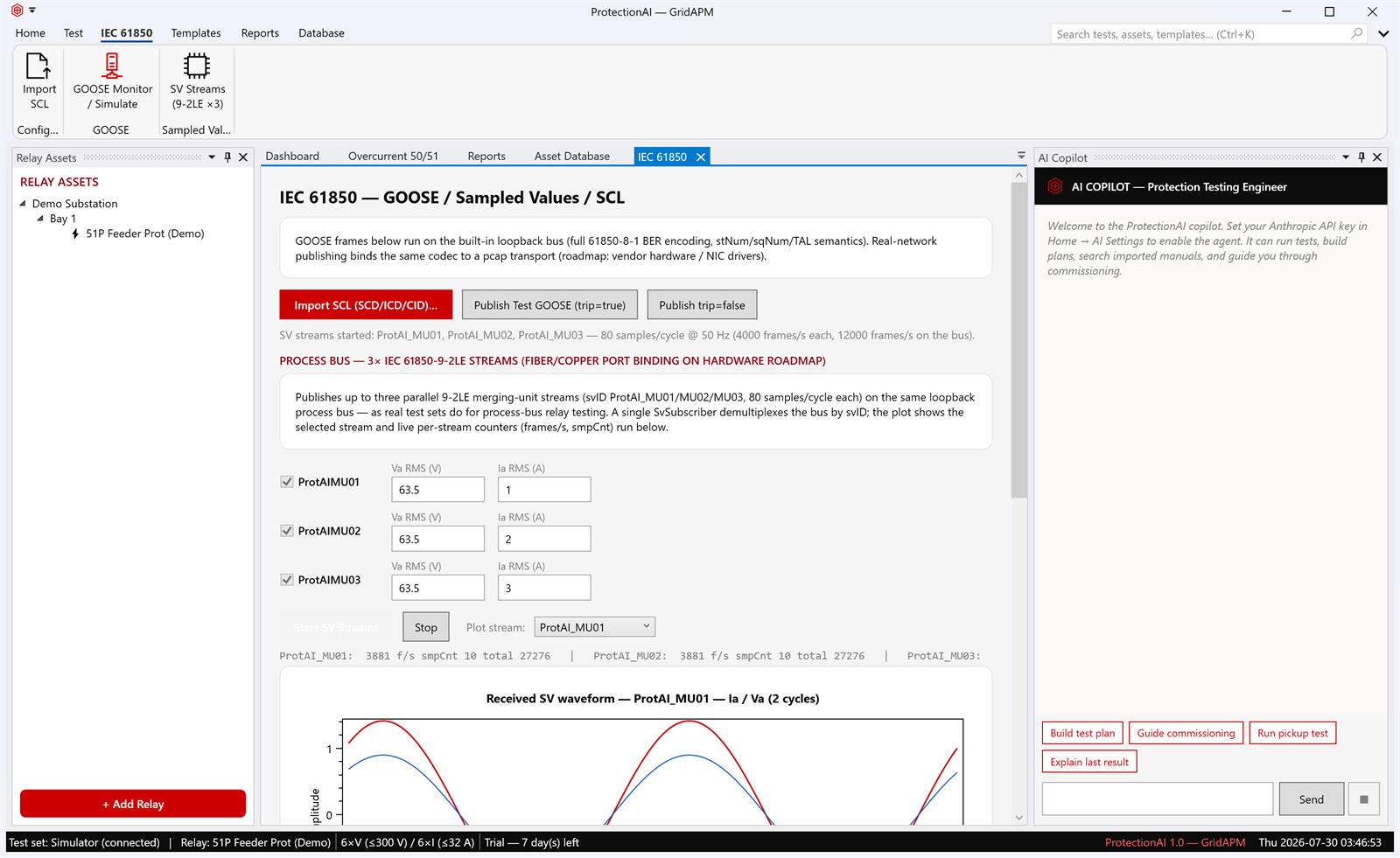
- The implementation guideline for sampled-value streams. ProtectionAI publishes 9-2LE streams — the capture below shows three merging-unit streams at 80 samples per cycle on 50 Hz — again on the built-in loopback process bus, with a subscriber inside the same application displaying the received waveform. The application itself says so on that page.
- What loopback is good for
- Learning the protocols, validating message content and dataset mapping against an imported SCL file, developing and rehearsing a procedure, and training. It is genuinely useful and it is genuinely not a substation network test.
- What is not built
- Live NIC/IED qualification, subscription-to-test-I/O mapping, the Sampled Values scope-analysis view, MMS client or server testing, Sim and Test-flag virtual isolation workflows, merging-unit and process-bus acceptance procedures, and IEC 61869-9 stream rates. The raw SharpPcap/Npcap capture-and-injection path is implemented in the shipping build; these broader workflows are not.
Captured loopback example
Sampled Values with explicit transport selection
Compliance frameworks
NERC PRC-005: evidence packages now, approval routing later
This one is easy to overstate, so here is the careful version.
NERC PRC-005 is a reliability standard governing protection system maintenance programmes: it obliges registered entities to maintain their protection systems on defined intervals and to be able to produce evidence that they did. Audit findings in this area are frequently about missing or unretrievable records rather than about tests never performed.
ProtectionAI provides the record layer. Completed test sessions are filed against a specific relay asset, with the settings version they were run on, the operator, the test set used, the measured and expected values and the per-point verdicts, plus whatever documents you attach. Those are the artefacts an evidence request asks for, and they are retrievable by asset rather than by filename.
It also provides the compliance-tracking layer on top of that database: per-asset maintenance programmes, NERC interval defaults you can edit per component type and monitoring level, a Compliant, Due Soon and Overdue status per asset, a KPI dashboard over the programme, and exportable evidence packages with a manifest. Multi-user approval routing is the remaining roadmap item.
What no software is or can be, however, is NERC-certified. Compliance is a property of your programme and your evidence, assessed by your regional entity — a tool can make the evidence complete and retrievable, and that is the whole of what this one claims to do.
At a glance
Standard, relationship, status
The relationship column is the important one. Implemented mathematics, a format read or written, and a reference frame are three different things.
| Standard | How ProtectionAI relates to it | Status |
|---|---|---|
| IEC 60255-151 | Inverse-time curve equations evaluated to produce expected operate times and plotted characteristics. | Implemented |
| IEEE C37.112 | IEEE inverse-time curve equations, on the same footing as the IEC set. | Implemented |
| IEEE C37.111 (COMTRADE) | Records read and plotted, played back through the driver layer, and written for simulator captures. | Implemented |
| IEC 61850 SCL (SCD, ICD, CID) | Configuration files imported to read IEDs, datasets and control blocks, and written back under a preserve-verbatim-or-refuse contract. | Implemented (import and export) |
| IEC 60255-187-1 | Named assessment reference for differential results, at the ±5% tolerance stated in the 87T module. | Referenced |
| IEEE C37.91 | Named alongside IEC 60255-187-1 as the transformer-protection reference for 87T assessment. | Referenced |
| IEEE C57.109 | Transformer through-fault damage curves computed for coordination plots. | Implemented |
| IEC 60949 | Cable thermal short-circuit damage curves computed for coordination plots. | Implemented |
| ANSI K-link fuse classes | Minimum-melt and total-clear fuse bands modelled from class data. | Implemented |
| IEC 61850-8-1 (GOOSE) | Encoding, publishing and monitoring on deterministic loopback or a selected SharpPcap/Npcap interface. | Implemented; live NIC/IED qualification pending |
| IEC 61850-9-2LE (Sampled Values) | Stream publishing with an in-application subscriber, on loopback or a selected SharpPcap/Npcap interface. | Implemented; user-mode timing is not merging-unit-grade, and live NIC/IED qualification pending |
| IEC 61869-9 | Higher process-bus stream rates. | Roadmap |
| IEEE C37.118 (PMU) | TVE, FE and RFE computed as the standard defines; the PMU-reported phasor is entered or imported, and an unreported case is not verifiable. | Partial; a native C37.118 client and a time reference remain roadmap |
| NERC PRC-005 | Asset-stamped test records, settings versions and attachments, plus per-asset maintenance programmes, editable interval defaults, compliance status and exportable evidence packages. | Implemented; approval routing is roadmap. No certification claim. |
| NERC PRC-027 | Coordination review support. | Roadmap |
Boundaries
Context, not certification
The same framing GridAPM uses on every standards page on this site.
Naming a standard on this page describes how ProtectionAI relates to that document. It is not a claim of certification, conformance assessment, accreditation or endorsement, by IEC, IEEE, ANSI, NERC or any other body. No standards organisation has reviewed, approved or certified ProtectionAI, and GridAPM does not claim otherwise here or anywhere else.
Standard designations and vendor product names are used descriptively, to say what the software reads, computes or references. They do not imply any partnership, affiliation or approval relationship with the standards bodies or with the instrument manufacturers named on this site.
Engineering judgement stays with the engineer. ProtectionAI computes expected values, applies the tolerance you configure and records a verdict; deciding whether a protection scheme is fit to be put in service is your decision, made on your authority, against your organisation's procedures.
Related
Standards context across the site
The other GridAPM product
GridAPM also builds AgenticGrid Pro
AgenticGrid Pro
A local-first transformer APM workbench: diagnostic evidence in, an engineer-signed work package out.
Try it for seven days and check the claims yourself
Install ProtectionAI on a Windows machine, import your own XRIO or RIO settings, run the plans you would really run against the built-in simulator and export a report on your own letterhead. No key is needed for the trial, and no internet connection is needed to run it. When you want a per-computer licence, email sales@gridapm.com.