Relay testing software
Relay testing, settings andevidence in one workspace
ProtectionAI plans, runs and documents protective-relay tests on Windows. The built-in simulator is the fully qualified path; optional hardware and IEC 61850 network integrations report their prerequisites and qualification level explicitly.
What it is
A test bench, a settings register and a report writer, in one application
ProtectionAI is enterprise relay-testing software for the people who have to prove a protection scheme behaves as designed, and then produce the paperwork that says so.
It is a single Windows desktop application built on .NET 9 WPF. The installer is self-contained: there is no runtime or framework to stage first, and it targets Windows 10 and Windows 11 on x64. Everything it needs to plan a test, execute it, judge the result and file the evidence lives on the machine in front of you.
The working set is familiar to anyone who tests relays for a living. Version 1.10.0 registers 102 test modules across 17 ribbon tabs, spanning overcurrent, distance, differential, machine, line, distribution, voltage, frequency, commissioning, emerging protection and analysis. Settings arrive as OMICRON XRIO or RIO parameter files, as native SEL ASCII, DIGSI 5 XML or name/value CSV settings files, or as JSON templates. Results are captured measured against expected, point by point, with a tolerance verdict on each. Assets, settings versions, attachments and completed test records sit in a local database, so the report and the record are the same act rather than two.
It is written for protection engineers, test technicians, commissioning teams and the asset owners who inherit the records afterwards. It assumes you will read the numbers and disagree with them.
Where it stands
Simulator-qualified, with bounded optional integrations
This is the first thing to know, and we would rather you read it here than discover it in a trial.
The built-in simulator remains the only fully qualified end-to-end test-set path. The shipping build includes a real late-bound OMICRON CM Engine adapter for device discovery, locking, static voltage and current phasors, output control and software-paced ramps. It drives an OMICRON CMC through the customer's own licensed CM Engine installation, and physical-CMC hardware-in-the-loop qualification is still pending. A generic SCPI-1999 source driver speaks to a programmable AC source over TCP — analogue sources only, with no binary sensing and therefore no trip detection, and not qualified against any specific instrument. Doble, Megger, ISA/Altanova and EuroSMC drivers remain explicit stubs that refuse to connect.
What does run, end to end, is the built-in simulator: a virtual test set paired with a configurable simulated relay, including realistic contact timing. Every ramp, sweep, sequence and playback contract in the application is exercised through that path. So you can build a complete test programme, run it, watch it fail for the right reasons, fix the plan and produce the report, all before anyone lifts a lead.
We treat that limit as a trust asset. If we were prepared to blur it on a product page, you would have no reason to believe the rest of the page. The hardware-driver work and its current status are listed further down, in the roadmap block.
The workspace
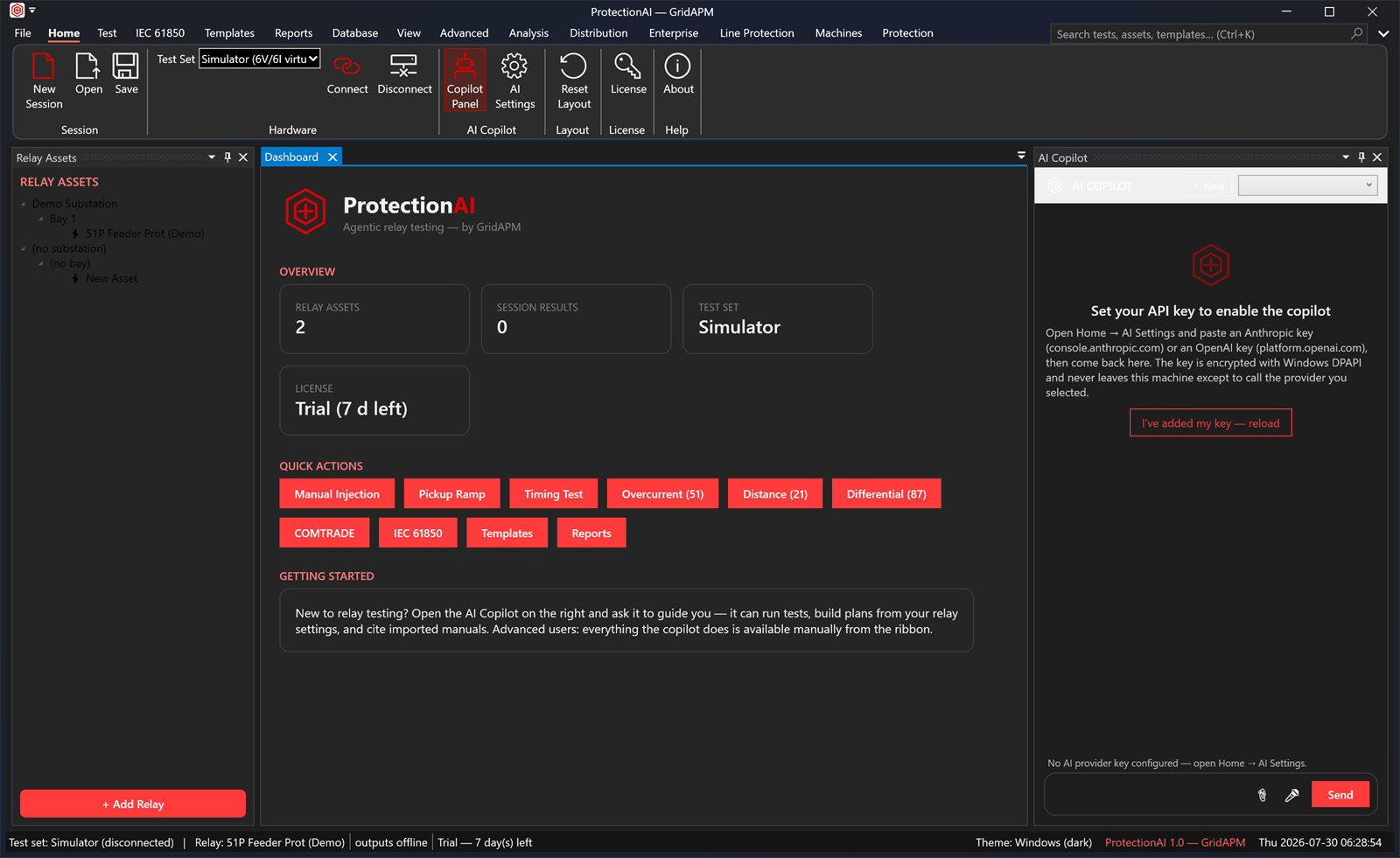
Dashboard, asset tree and copilot
Available now
What the shipping build already does
Each of these is exercised end to end against the built-in simulator.
- Element testing
- Overcurrent (50/51) I–t characteristic sweeps, distance (21) mho zone boundary searches in the R–X plane, differential (87) operate-point searches across the bias and differential plane, and pickup or dropout ramps that calculate the reset ratio.
- Dynamic testing
- A multi-state sequencer stepping prefault, fault and postfault states, with expected-transition checking on the binaries so a missed trip or an unexpected reclose shows up as a failed transition rather than a shrug.
- Curve mathematics
- Inverse-time characteristics computed from the IEC 60255-151 and IEEE C37.112 equations, so expected operate times come from the standard rather than from a lookup table of somebody's earlier results.
- Power-system simulation
- A network model with an IEC single-line editor and a symmetrical-component short-circuit solver, plus transient generation covering DC offset with X/R decay, CT saturation, CVT subsidence and inrush. Playback is closed-loop: the breaker opens at the next current zero after the contacts part and the simulation continues, so autoreclose and breaker-failure sequences behave as they would in service. The solver is unit-tested against hand-computed reference cases.
- Commissioning
- As-found and as-left settings verification, a settings diff that never reports identical unless the comparison was genuinely like for like and always states how many parameters were compared, an importer for legacy Excel and CSV test sheets, a report attachment bundle, a PRC-005 R3 evidence assistant and an offline job pack you can take to site and merge back.
- Emerging protection
- Modules for the elements that arrive with inverter-based resources and changing network behaviour, including IBR and DER interconnection work referenced to IEEE 1547 and IEEE 2800, anti-islanding, adaptive setting-group switching, cold-load pickup and broken-conductor detection.
- Transient records
- COMTRADE (IEEE C37.111) records read, plotted channel by channel and played back through the driver layer — the same path a fault record would take toward a test set's amplifiers.
- IEC 61850 tooling
- SCL import (SCD, ICD, CID), GOOSE encode/publish/monitor and IEC 61850-9-2LE Sampled Values publishing. A real Layer-2 interface can be bound by name through SharpPcap/Npcap alongside the deterministic loopback default, with no silent fallback between the two; Npcap licensing, permissions and live NIC/IED qualification remain deployment gates, and software timestamps are labelled as such.
- Settings and templates
- XRIO and RIO parameter files imported into one normalised settings model, plus a JSON template library you can read, diff and keep under your own version control.
- Asset and settings records
- A local SQLite database of relay assets with lifecycle states, full settings version history, document attachments and the test records themselves, filed against the asset they belong to.
- Reporting
- Branded Word, Excel and PDF exports carrying your own logo, CSV export, and session reports tabulating measured against expected with a pass or fail verdict per row.
The copilot
A tool-using agent, not a chat box bolted to the side
The AI copilot is optional. Everything it does, you can do by hand.
The copilot holds 30 real tools. It can start a test, read and edit the working settings model, drive output phasors, generate a template or import one, search the PDF relay manuals you have ingested, draft a report, and — read-only — diagnose a failure with ranked causes, explain a chart, analyse a COMTRADE record, check coordination margins, sanity-check settings, report PRC-005 status, assemble a commissioning checklist or trend history. Tools that can energize test outputs are centrally refused until the operator explicitly confirms isolation. AI output remains advisory and deterministic application code owns every verdict. Responses stream, attachments are accepted, and dictation through the microphone is there if your hands are busy.
You supply the API key — Anthropic, OpenAI, xAI/Grok or Google/Gemini, whichever you have a contract with. The key is encrypted at rest with Windows DPAPI on your own machine and is used only to call the provider you configured. If you never configure one, the copilot panel stays dormant and the rest of the application behaves exactly as it would otherwise.
One dated positioning note, since engineers ask: in GridAPM research across the OMICRON, Doble, Megger, ISA and Altanova, and SMC and EuroSMC protection portfolios as of July 2026, we found no AI-branded capability in their published protection-testing product material. That is our reading of public vendor sources on that date, not a permanent statement about anybody's roadmap.
Licensing
Offline activation, because substations are not well connected
ProtectionAI runs for 7 days without a key. After that it needs a per-computer licence key, which you request by emailing sales@gridapm.com. Activation is RSA-signed and offline, bound to the machine.
There is no cloud service to reach, no seat server to check in with and no online step required to run a test or to activate a licence. A basement with no signal is a normal working environment for this software. Prices are quoted on request; the licensing page describes the model and what to ask for.
Not yet shipping
On the roadmap
Labelled deliberately. None of the following is in the shipping build, and none of it should influence a purchase decision except as a statement of direction.
On the roadmap
The items below are planned and in active development. They are not shipping today, and nothing on this site should be read as claiming otherwise.
-
Vendor hardware drivers
Physical-CMC HIL qualification and native CM Engine segment/synchronized sequencing, waveform playback and measurement readback, followed by Doble, Megger, ISA/Altanova and EuroSMC partner integrations. The bounded OMICRON adapter in the shipping build is protocol-tested only; it is not advertised as hardware-qualified.
-
Live-network IEC 61850 qualification
The shipping build implements physical-interface GOOSE/SV capture and injection through SharpPcap/Npcap with explicit timestamp provenance. Remaining work is licensed Npcap deployment plus live NIC/IED qualification; there is no silent loopback fallback.
-
Hardware-disciplined end-to-end timing
The shipping build includes NTP offset/uncertainty measurement and synchronized GOOSE trigger evidence. GPS/PTP/IRIG-B hardware-clock qualification for line differential and teleprotection accuracy remains outstanding.
-
PRC-005 multi-user approval routing
Routing a completed maintenance record through a reviewer and an approver before it counts as closed. Per-asset programmes, editable NERC interval defaults, Compliant, Due Soon and Overdue status, the KPI dashboard and exportable evidence packages all ship today; the approval workflow on top of them does not.
-
Relay-model template library
Twenty-one curated relay packs with per-parameter provenance and a 379-entry identity-verified model catalog ship today; the roadmap work is bringing catalog entries up to curated, per-parameter quality across major relay manufacturers.
-
Meter, transducer and power-quality testing
Signal generation and assessment for meters, transducers and power-quality work is outside the near-term scope and is not in the shipping build.
-
Traveling-wave and time-domain testing
At research stage. Conventional amplifier bandwidth does not reproduce traveling-wave signatures, so this depends on hardware paths that do not exist in the product today.
Go deeper
Read the detail before you decide
Each page is written to be checked rather than skimmed.
Capabilities
Family by family, with an Implemented, Partial and Roadmap status table.
How it works
One real workflow, from settings import to a filed report.
Standards
Which standards the software implements, references or merely reads.
Integrations
Formats in and out, the driver abstraction, and the AI provider link.
Security and data handling
Local-first deployment, key storage, and what leaves the machine.
Licensing
The 7-day trial, per-computer keys, and offline activation.
Download
Installer, SHA-256, system requirements and release notes.
AgenticGrid Pro
GridAPM's power-transformer asset performance management software — the sibling product to ProtectionAI.
The other GridAPM product
GridAPM also builds AgenticGrid Pro
AgenticGrid Pro
A local-first transformer APM workbench: diagnostic evidence in, an engineer-signed work package out.
Try it for seven days and check the claims yourself
Install ProtectionAI on a Windows machine, import your own XRIO or RIO settings, run the plans you would really run against the built-in simulator and export a report on your own letterhead. No key is needed for the trial, and no internet connection is needed to run it. When you want a per-computer licence, email sales@gridapm.com.