Auto-Reclose and Synchronism-Check Relay Testing
A practical guide to testing autoreclose sequences, synchronism check, dead-line and dead-bus logic, blocking conditions, breaker states, and restoration.
On this page
Auto-reclose and synchronism-check functions are often documented as settings and timers. In service, they behave as a sequence that links a protection trip, breaker status, voltage selection, timing, communications, and a controlled close. The test plan should prove the sequence and its blocking conditions.
Define the sequence
Record the initiating protection element, trip output, breaker auxiliary contacts, dead-line or dead-bus logic, synchronism-check inputs, close output, reclaim or lockout behavior, remote signals, and alarms. Identify whether the sequence is single-shot, multi-shot, selective by phase, or blocked by a scheme condition.
Use the approved design and operating procedure for the expected sequence. Do not infer behavior from a relay menu label alone.
Test the permissive conditions
Create cases for the voltage and frequency relationships that should permit or block a close. Include the relevant phase-angle, slip, magnitude, dead-line, dead-bus, live-line, and live-bus conditions defined by the scheme. Record the source assumptions and expected decision.
Synchronism check is a protection and control function, not only a phase-angle number. The selected sources, VT fuses or supervision, phase mapping, frequency difference, and voltage quality all matter.
Test breaker feedback and timing
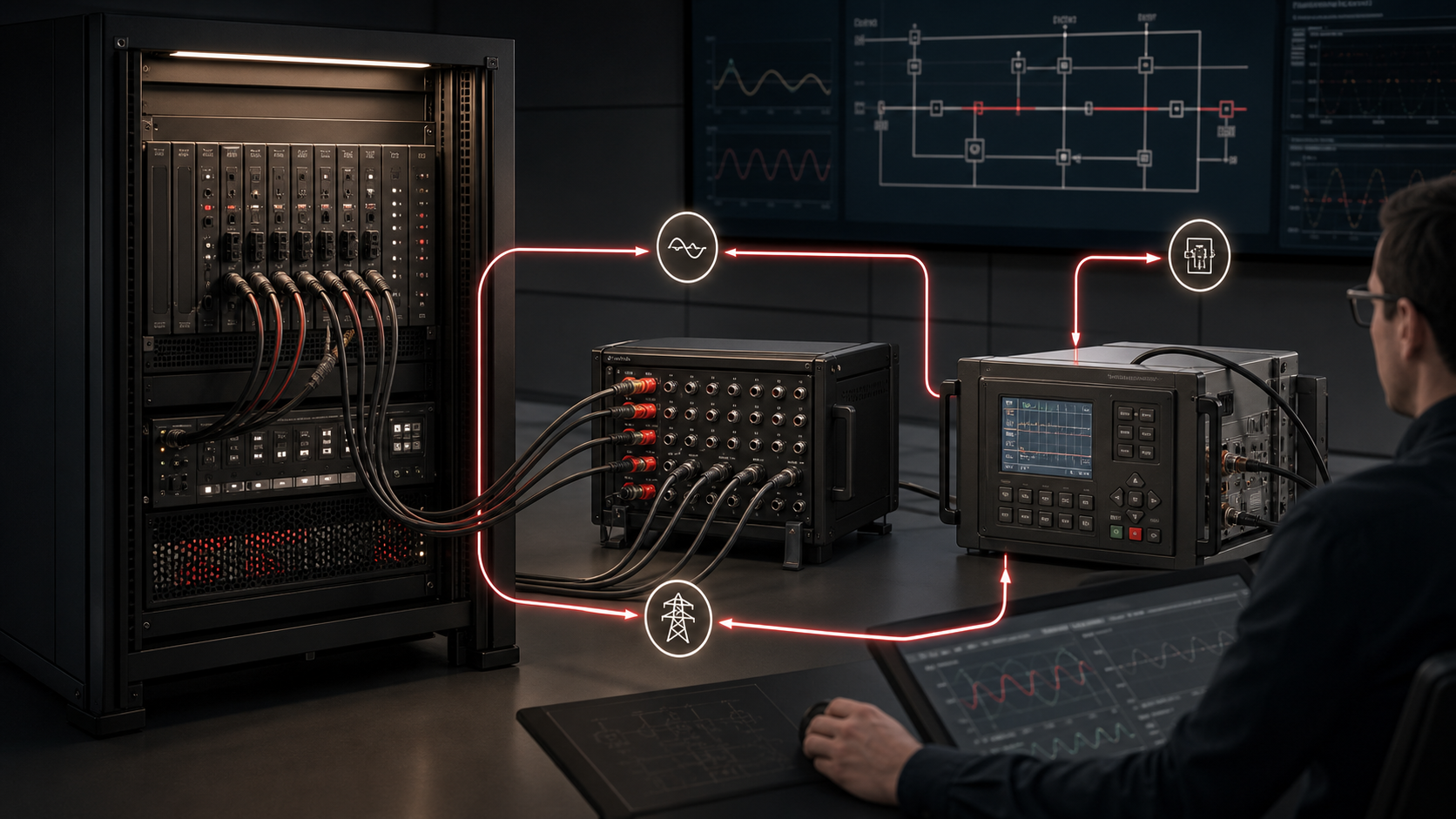
Exercise the expected 52a and 52b states, breaker trip and close outputs, trip-coil or close-coil supervision, and timeout or failure behavior. Capture the sequence timing, binary transitions, relay targets, event record, and final breaker state.
If the breaker mechanism is simulated, mark the case as simulated. A simulator can validate relay sequence logic within its boundary; it cannot prove a physical mechanism or field wiring without the corresponding evidence.
Test blocking and recovery
Include blocking by manual trip, lockout, breaker failure, protection target, communications loss, synchronism failure, voltage supervision, interlock, or operating mode where applicable. Confirm that the block is removed only by the approved reset or recovery condition.
After a successful close or a blocked attempt, verify the reclaim and restoration state. A scheme that works once but leaves a stale block, wrong setting group, or incorrect alarm is not ready for handover.
Evidence and AI assistance
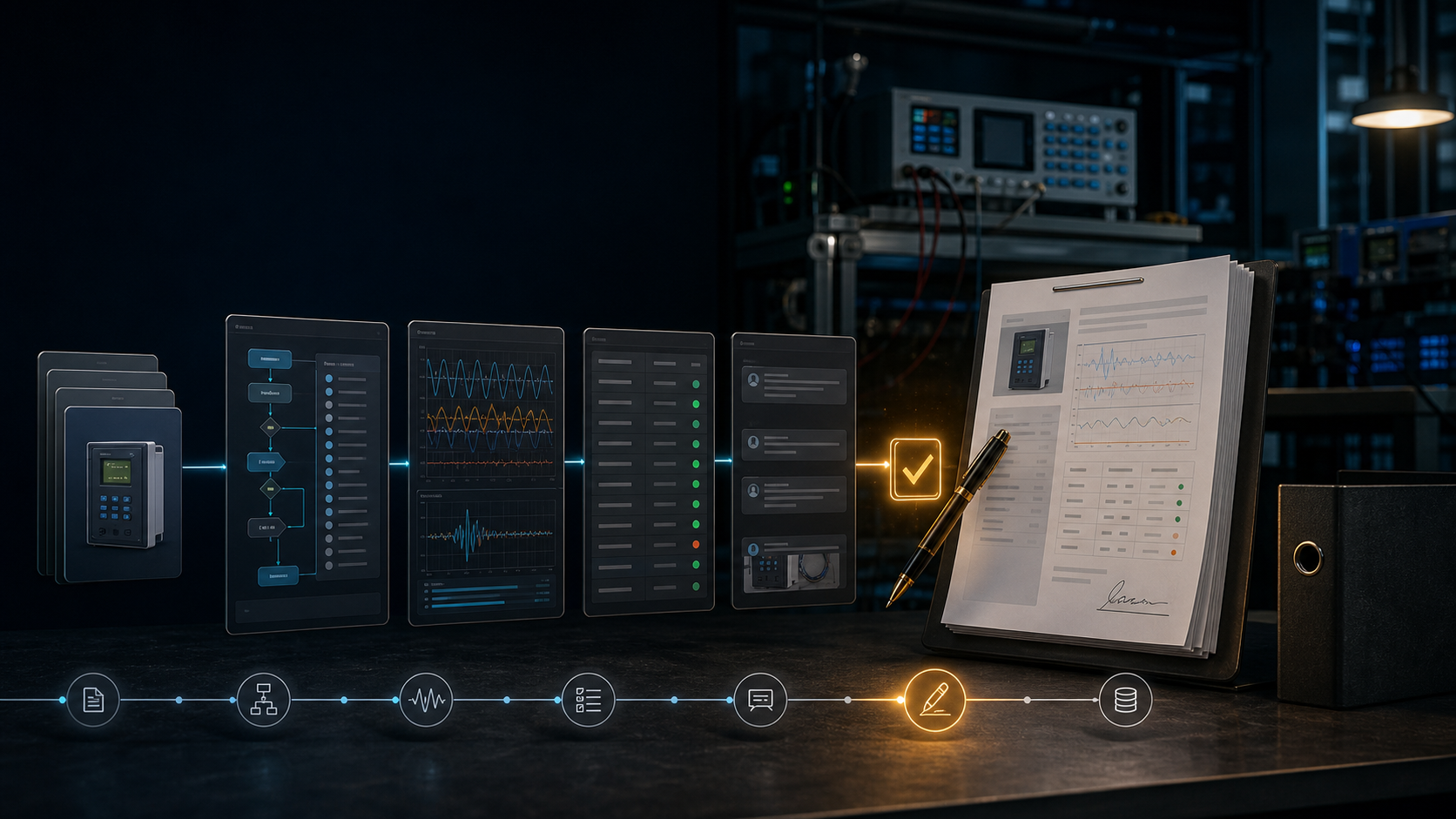
Retain the sequence diagram, settings, source waveforms or phasors, binary traces, breaker feedback, event record, expected and measured timing, deviations, and final review. ProtectionAI can turn the sequence into a case matrix, highlight an untested block, and organize the evidence. It should not issue a close command or accept a timing result without the defined tolerance and engineer approval.
References
- Institute of Electrical and Electronics Engineers. (2023). IEEE guide for power system protection testing (IEEE Std C37.233-2023). https://standards.ieee.org/ieee/C37.233/6676/
- Institute of Electrical and Electronics Engineers. (n.d.). Relay testing. IEEE TechRxiv topic page. https://technav.ieee.org/topic/relay-testing/
- CIGRE Working Group B5.45. (2015). Acceptance, commissioning and field testing techniques for protection and automation systems (Technical Brochure No. 637). https://www.e-cigre.org/publications/detail/637-acceptance-commissioning-and-field-testing-techniques-for-protection-and-automation-systems.html
- Pacific Power. (2018). Relay testing and commissioning checklist. https://www.pacificorp.com/content/dam/pcorp/documents/en/pacificorp/suppliers/rfps/2018ocs-rfp-docs-and-appendices/A7.16_Relay_Testing_and_Commissioning_Checklist.pdf
References
Questions engineers ask
What is the most important autoreclose test?
There is no universal single case. The approved plan should cover initiation, breaker status, dead-line or dead-bus conditions, synchronism check where required, blocking, reclaim or lockout, and the complete output path.
Does a timer test prove an autoreclose scheme?
No. The timer is one part of the sequence. The scheme also depends on trip source, breaker feedback, voltage selection, synchronism logic, interlocks, communications, and restoration.
Can an AI assistant authorize a close command?
No. An assistant can organize the sequence and evidence, but physical operation and operating authority remain controlled by the station procedure and qualified personnel.