Protection Relay Testing and Substation Commissioning: An Evidence-Based Guide
A field-oriented guide to protection relay testing and substation commissioning, from approved settings and test planning through functional tests, communications, as-left records, and engineer sign-off.
On this page
Protection relay commissioning is often described as a sequence of tests. In practice, it is a controlled handoff from design intent to an energized protection scheme. The work has to prove more than whether a relay responds to an injected current. It has to show that the correct device, settings, wiring, logic, communications, trip path, and records belong to the same approved scope.
Start with the evidence boundary
Before a technician opens a test switch, define the asset and the function under test. Record the station, bay, relay identity, firmware, setting group, CT and VT sources, communication channels, breaker interfaces, and the drawings or models that define the scheme. IEEE C37.233 treats protection testing as an engineering activity that can span components, communications, and interconnected functions. That is why the test record needs a boundary that a later reviewer can understand.
The first quality gate should answer:
- Is this the issued settings package?
- Does the installed relay match the approved device and firmware context?
- Are the CT and VT ratios, polarities, grounding, and test points known?
- Which functions, logic equations, communications, and outputs are in scope?
- Which acceptance criteria and tolerance basis will be used?
- What evidence must be retained before the bay can be returned to service?
If any answer is unknown, the correct result is a review item—not an invented value.
Move from settings to a test plan
A commissioning plan should make every important setting and logic dependency testable. For each protection element, identify the expected pickup, timing or characteristic, directional behavior, blocking and permissive conditions, binary inputs, outputs, and associated alarm. For a scheme function, identify the system case that exercises the logic rather than relying only on an isolated element test.
The plan should also distinguish:
- tests of the relay’s numerical or logical function;
- tests of wiring and binary I/O;
- tests of communications and time synchronization;
- tests of the breaker and trip circuit;
- tests of the complete protection scheme under representative conditions.
This distinction prevents a common failure: a report marked complete because every relay menu item was visited even though the intertrip, breaker-failure, or lockout path was never proved.
Test the physical path as well as the algorithm
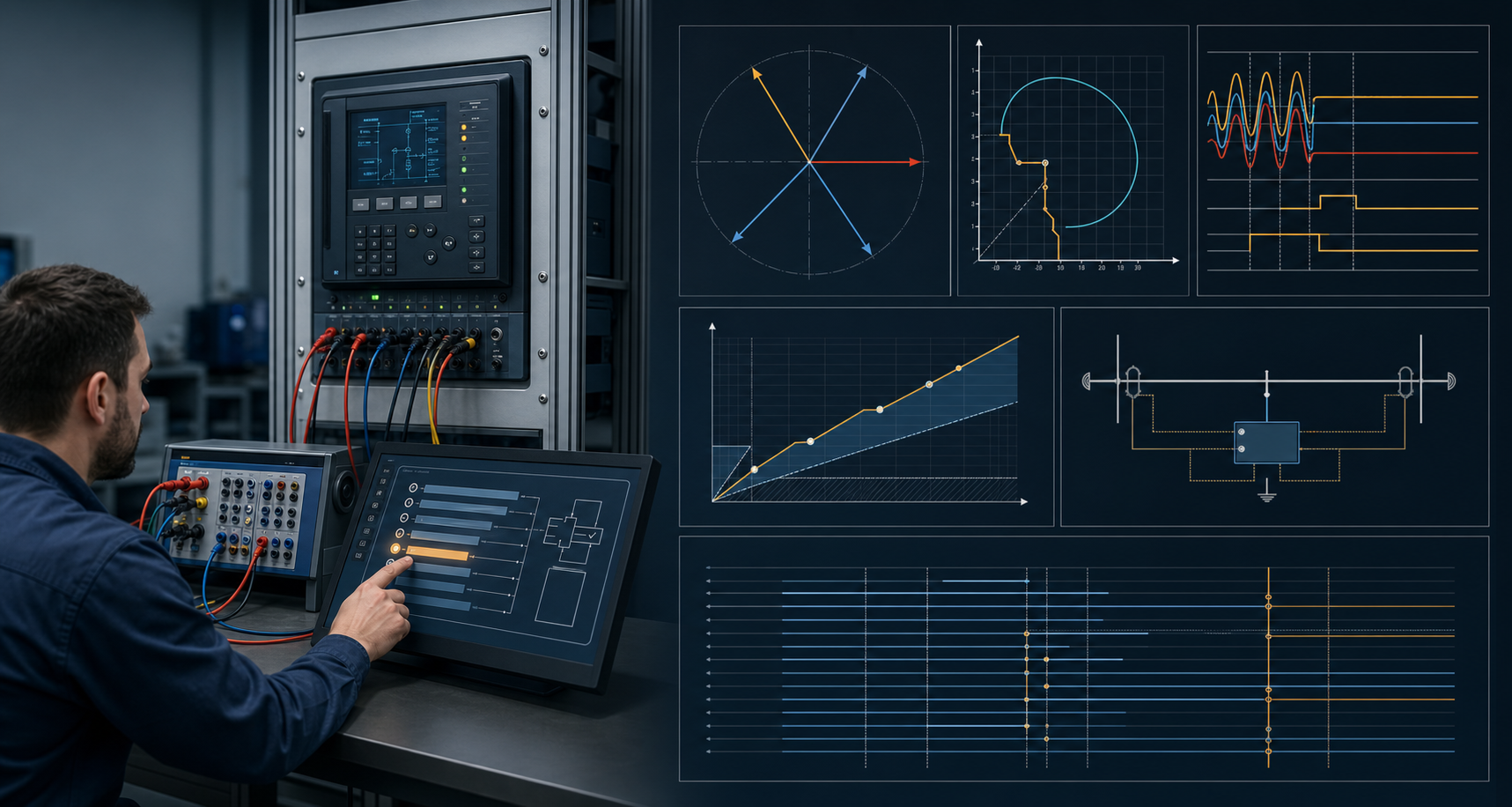
Secondary injection can demonstrate relay behavior at its terminals. It does not automatically prove CT polarity, VT wiring, test-switch operation, breaker coils, lockout contacts, communications-assisted logic, or the final trip path. Primary injection may establish a different part of the chain, but it is not a substitute for every functional or end-to-end case.
The commissioning scope should therefore include the relevant combination of:
- wiring and continuity checks;
- CT and VT ratio, polarity, and phasing checks;
- relay element and logic tests;
- binary input and output checks;
- breaker trip, close, lockout, and anti-pumping checks;
- transfer-trip, permissive, blocking, or teleprotection checks;
- time synchronization and event-record verification;
- restoration to the approved as-left state.
The Pacific Power checklist is a useful practical reminder that field commissioning extends from settings review and test switches to alarms, communications, in-service quantities, and restoration.
Capture as-found, as-left, and raw evidence
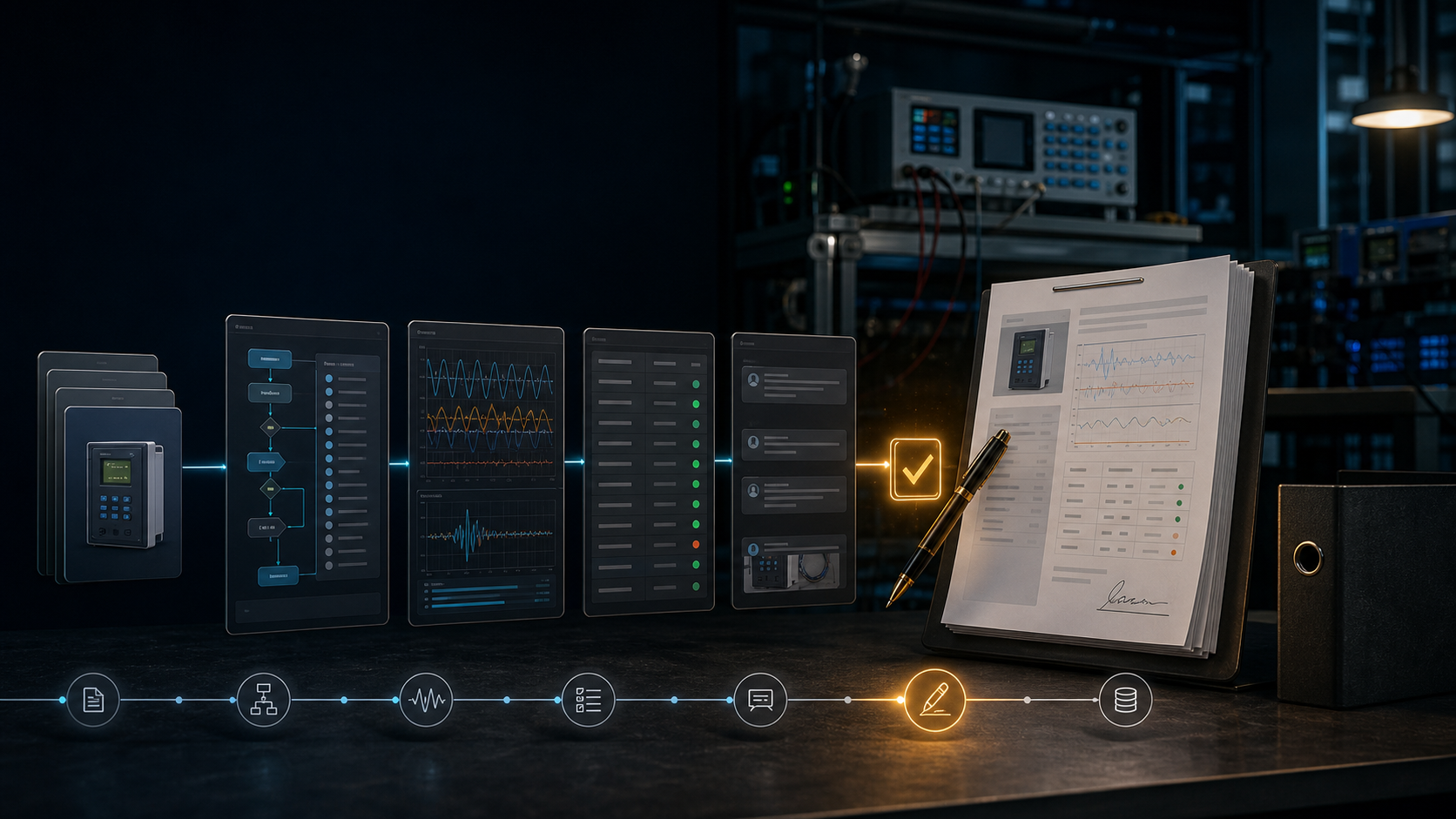
The final PDF is only one view of the record. Retain the settings exports, test-set files, raw traces, packet captures where applicable, calibration identity, expected-value calculations, deviations, photographs, reviewer comments, and approval. Link each result to the asset and settings version that produced it.
An as-found failure should not disappear when a correction produces a passing re-test. Keep both states, the reason for the change, and the person who approved it. That history is valuable for maintenance planning and future misoperation review even when the final scheme is correct.
Use AI as a review layer
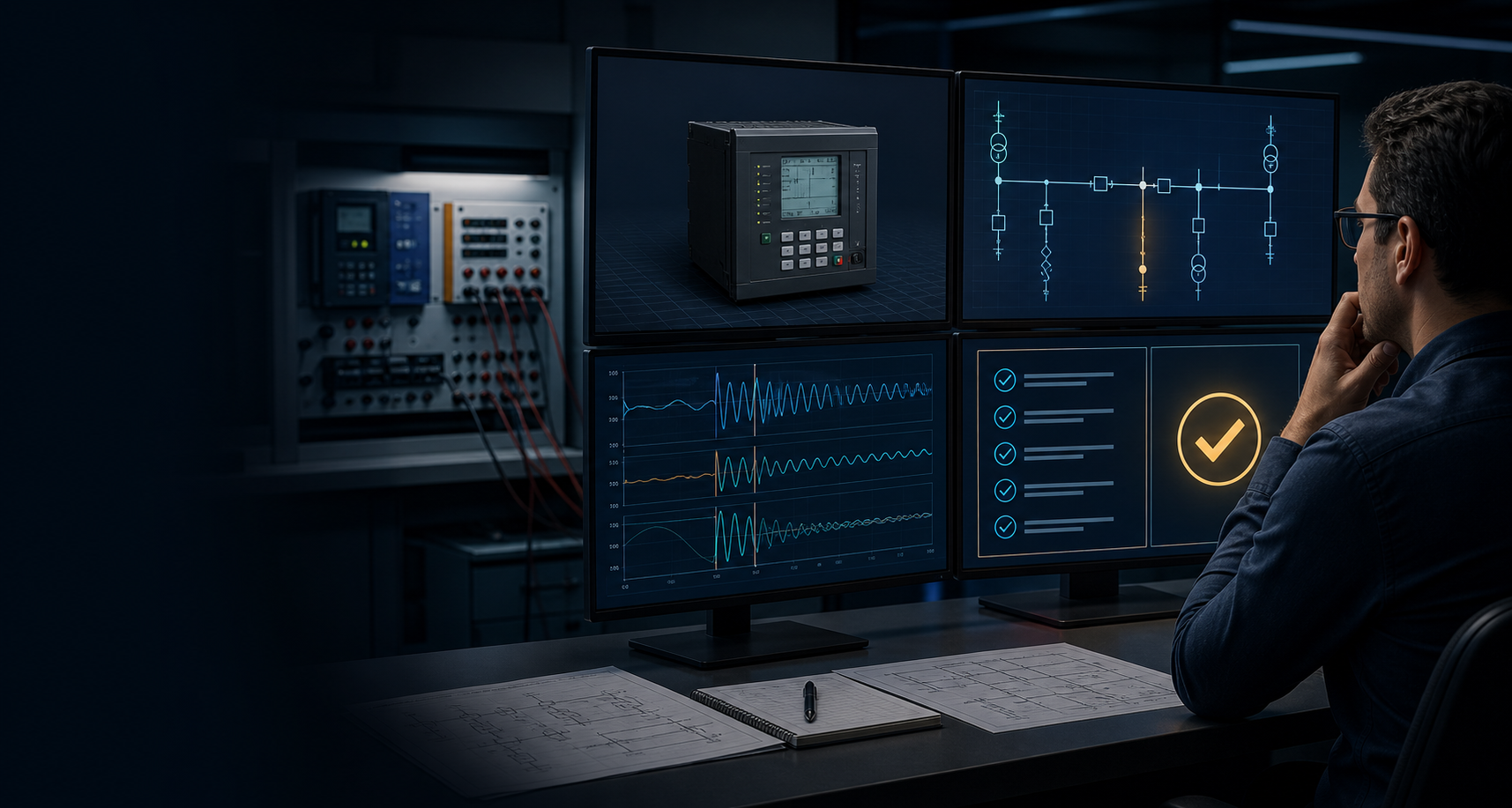
ProtectionAI can be positioned around this evidence chain: retrieving the right manual and settings package, checking plan coverage, highlighting missing or contradictory records, and drafting a cited report. The assistant should not write live settings, operate a breaker, or declare a scheme safe. Its output is a reviewable draft; deterministic engineering calculations and a named engineer remain the decision gates.
Commissioning close-out
A commissioning package is ready for handover when the reviewer can follow the chain from approved design to as-left device without relying on oral history. The package should identify open deviations, explain accepted limitations, preserve raw evidence, and state what maintenance interval or future test depends on the result.
That standard of traceability is the practical difference between a collection of test sheets and an evidence-based protection programme.
References
- CIGRE Working Group B5.45. (2015). Acceptance, commissioning and field testing techniques for protection and automation systems (Technical Brochure No. 637). https://www.e-cigre.org/publications/detail/637-acceptance-commissioning-and-field-testing-techniques-for-protection-and-automation-systems.html
- Institute of Electrical and Electronics Engineers. (2023). IEEE guide for power system protection testing (IEEE Std C37.233-2023). https://standards.ieee.org/ieee/C37.233/6676/
- IEEE Power & Energy Society. (n.d.). Relaying performance testing. https://resourcecenter.ieee-pes.org/publications/technical-reports/pestr4
- Pacific Power. (2018). Relay testing and commissioning checklist. https://www.pacificorp.com/content/dam/pcorp/documents/en/pacificorp/suppliers/rfps/2018ocs-rfp-docs-and-appendices/A7.16_Relay_Testing_and_Commissioning_Checklist.pdf
- North American Electric Reliability Corporation. (2025). Protection system, automatic reclosing, and sudden pressure relaying maintenance (PRC-005-6). https://prod.nerc.com/standards/reliability-standards/prc/prc-005-6
References
- IEEE C37.233 IEEE C37.233-2023 — Guide for Power System Protection Testing
- IEEE PES Relaying Performance Testing
- CIGRE Technical Brochure 637 — Acceptance, commissioning, and field testing
- Pacific Power Relay Testing and Commissioning Checklist
- NERC PRC-005 NERC PRC-005-6
- NIST AI RMF NIST AI Risk Management Framework
Questions engineers ask
What is the correct order for protection relay commissioning?
Start with scope, asset identity, approved settings, drawings, and safety controls; then verify wiring and instrument connections, execute element and scheme tests, test communications and trip paths, restore the approved as-left state, and complete an independent engineering review.
Does a relay test prove the whole protection scheme?
Only if the test scope includes the relevant inputs, logic, communications, outputs, breaker path, and system-level behavior. A single secondary-injection element test cannot prove every part of a complete scheme.
Where can AI assist in commissioning?
A bounded assistant can organize approved records, identify missing coverage, draft test cases, compare expected and measured results, and assemble a report. Deterministic calculations, field safety, physical testing, and engineer acceptance remain outside the AI authority.