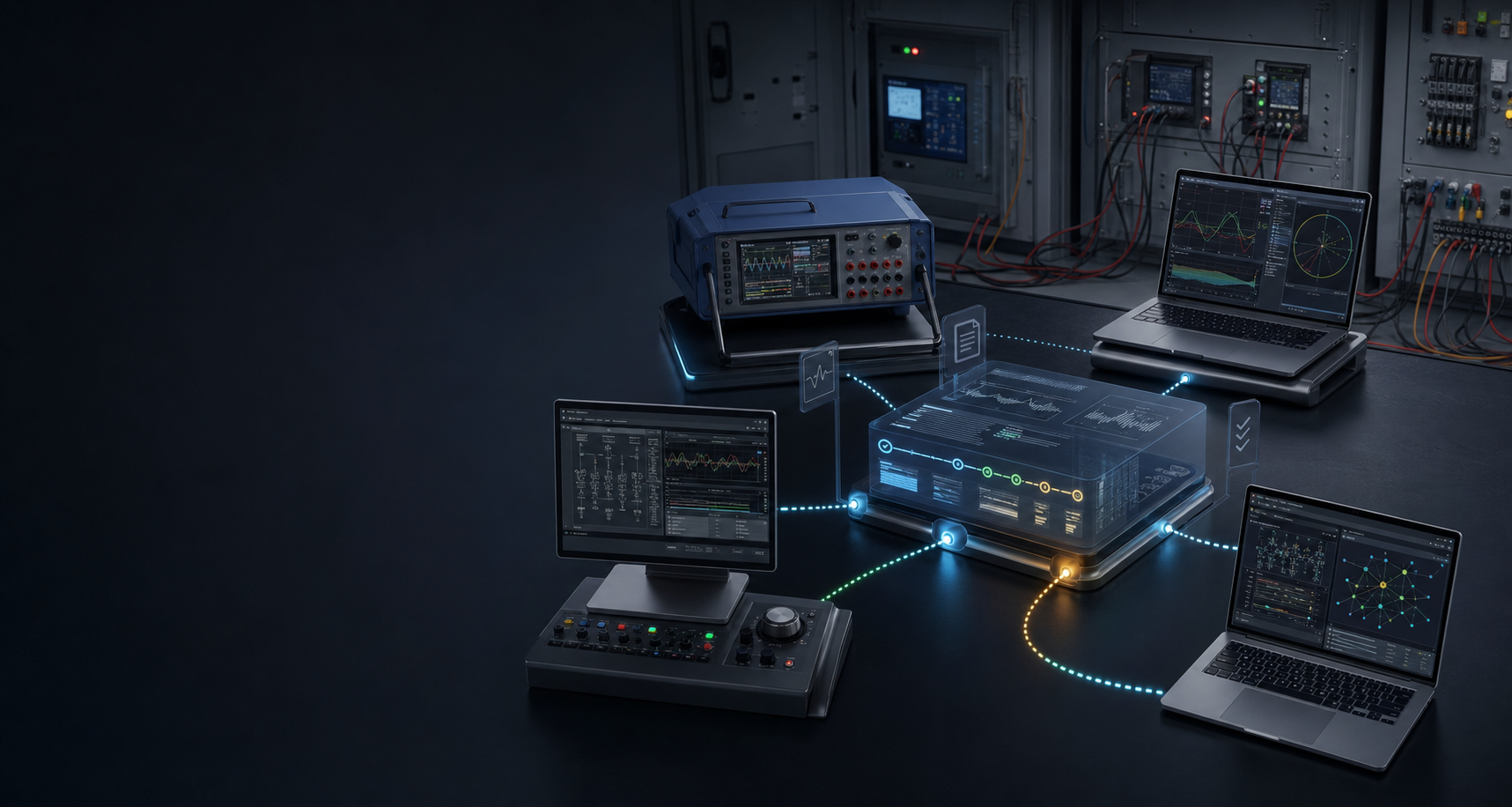
Megger RTMS and FREJA: Adding Agentic Evidence Management Around Relay Tests
A bounded workflow for linking Megger RTMS and FREJA results to relay identity, settings, calibration, raw traces, and engineer-reviewed evidence.
On this page
Megger documents RTMS as relay test and management software for SMRT and FREJA workflows, with automated tests, templates, reports, and historical records. The strongest AI opportunity is not to rebrand the test engine; it is to improve the context around the record.
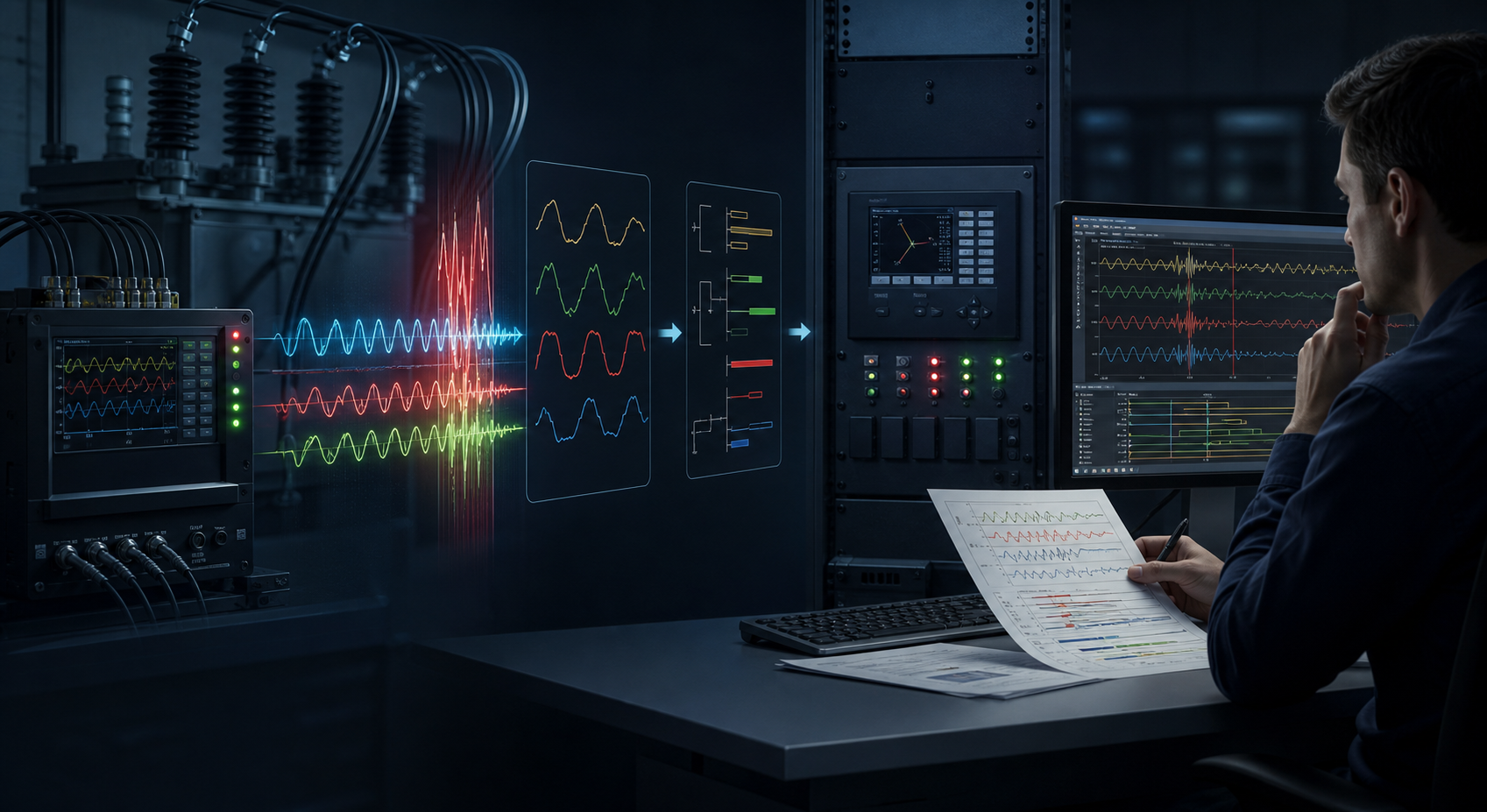
A technician’s handoff
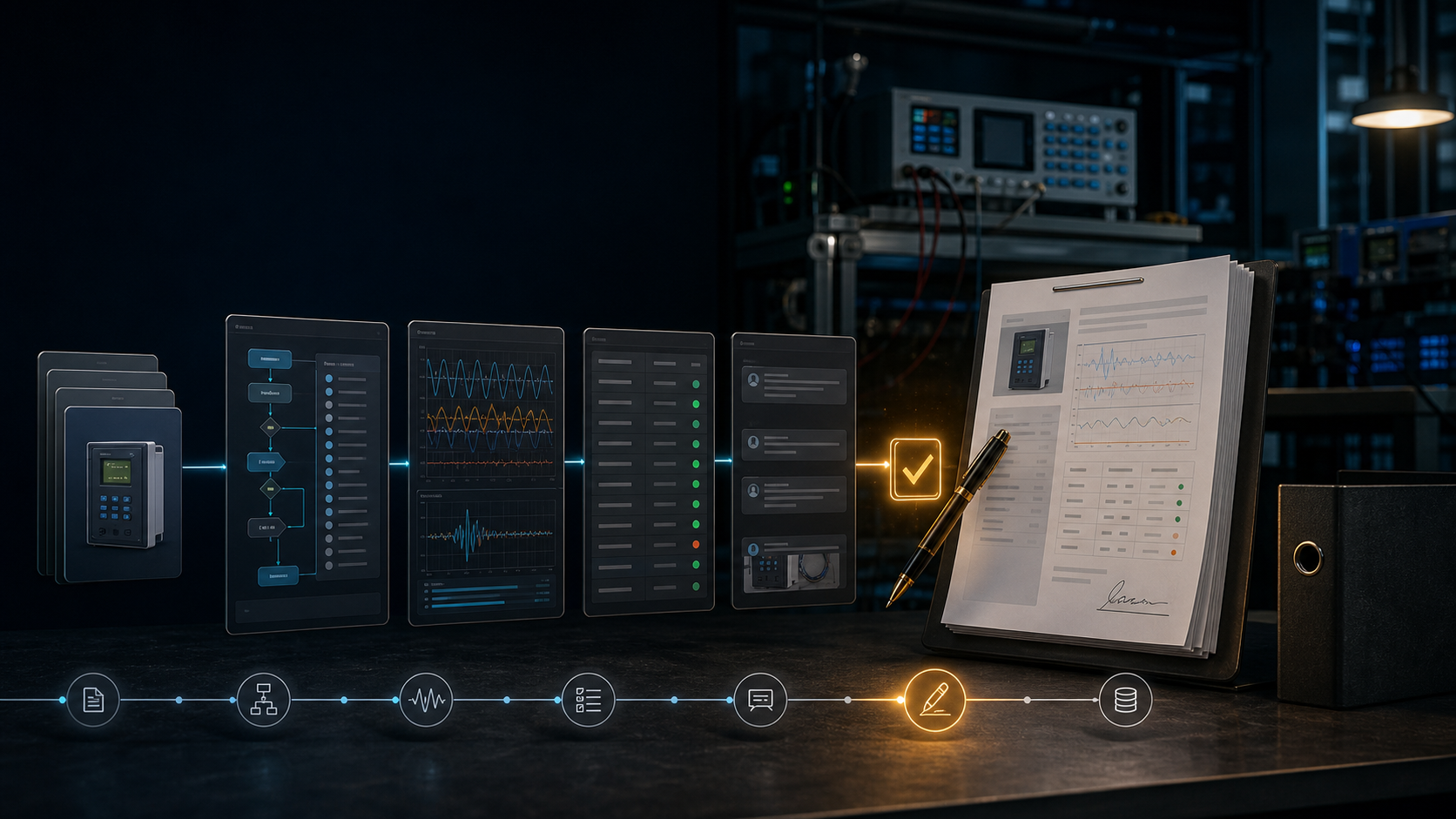
The evidence should connect the test-set file to the relay model, firmware, settings, procedure, calibration, actual values, raw trace, and final review. If the team also uses PowerDB or a maintenance system, preserve the link rather than creating a detached PDF.
What an AI assistant can flag
It can identify a report with no settings checksum, a re-test with no as-found result, a calibration date outside the procedure, a missing binary case, or a history entry that uses two asset identifiers. It can draft a comparison of old and new results. It should not assert that a test is compliant or that a missing record did not matter.
Megger’s FREJA and SMRT Digital Twin documentation is especially helpful for making the simulator boundary explicit: an open-loop or high-fidelity environment remains distinct from physical testing and site acceptance.
ProtectionAI’s role
ProtectionAI can be used as a plan and evidence workbench around an existing Megger workflow. The product should state the actual hardware qualification boundary instead of implying that an AI copilot drives every FREJA or SMRT function.
The handoff is the engineering problem
A test-set operator rarely needs another attractive report. The higher-value handoff is a chain that connects the work order to the relay identity, firmware, settings checksum, approved procedure, test-set configuration, calibration, measured result, raw trace, deviation, and reviewer. If the record moves from RTMS or PowerDB into a maintenance system, preserve the identifier and file relationship rather than exporting a detached PDF with no provenance.
The pre-flight review can be deterministic. Check that the setting group is present, the test plan matches the relay family, the calibration date is acceptable, every expected binary is mapped, and the planned cases cover the procedure. An AI assistant can explain the exception in plain language and retrieve the evidence, but the pass/fail rule should remain explicit and reproducible.
Digital Twin and physical test are different claims
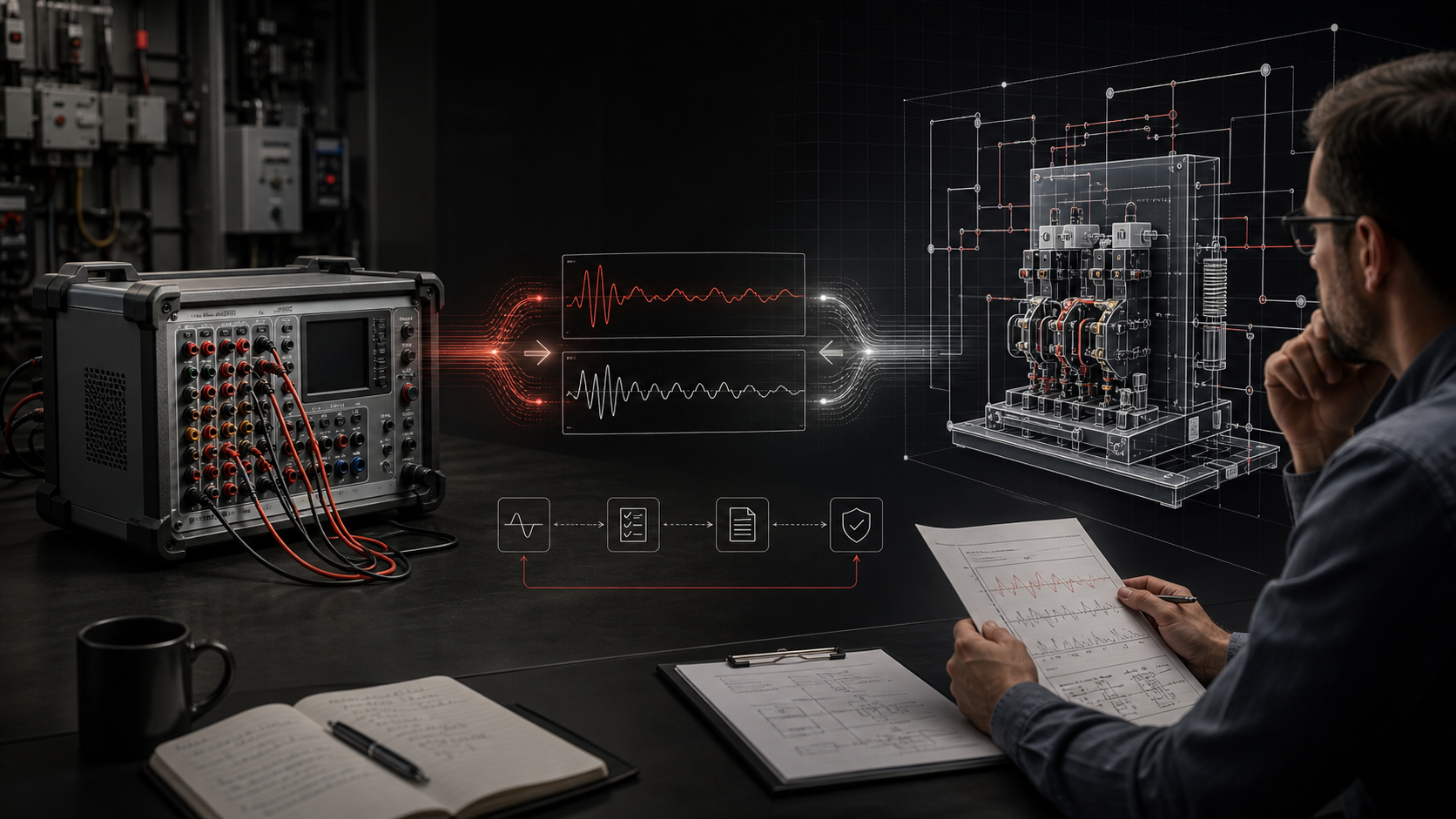
Megger’s Digital Twin materials are useful for communicating the difference between a high-fidelity simulator and a physical FREJA or SMRT connection. A simulator can expose model assumptions and let the team rehearse a sequence before an outage. It does not prove the accuracy of a current amplifier, the polarity of a field circuit, the behaviour of a breaker interface, or the safety of a live installation. The report should state which boundary was tested.
In a ProtectionAI pilot, compare the time needed to prepare and review the same RTMS-style records with and without the assistant. Include incomplete and contradictory samples. The result should show verification effort and false flags, not just generated text length.
References
- Megger. (n.d.). RTMS: Relay test and management software [Product page]. https://www.megger.com/en-us/products/rtms-relay-test-and-management-software
- Megger. (n.d.). FREJA and SMRT Digital Twin: High-fidelity simulator [Product page]. https://www.megger.com/en/products/freja-and-smrt-digital-twin-high-fidelity-simulator
- Megger. (n.d.). PowerDB Pro [Product page]. https://www.megger.com/en-us/products/powerdbtm-pro-asset-and-test-data-management-software
- NIST. (2023). Artificial intelligence risk management framework (AI RMF 1.0). https://doi.org/10.6028/NIST.AI.100-1
References
Questions engineers ask
What should travel with a Megger relay-test result?
Keep the relay model and firmware, settings revision, procedure, test-set identity, calibration status, expected and measured values, raw trace, deviations, and as-found/as-left state.
Can a digital twin replace physical testing?
No. A digital simulation can support rehearsal and reproducibility, but physical injection, wiring, instrument limits, and site acceptance are separate requirements.
How can AI assist without changing the vendor workflow?
It can index records, compare context, flag stale or missing evidence, retrieve approved manual passages, and draft a report outline while leaving the physical execution authoritative.