Protection Testing Software in 2026: OMICRON, Doble, Megger, EuroSMC, and ProtectionAI
A neutral comparison of the major protection-testing software workflows and the narrower role of an agentic AI workbench for utilities, commissioning teams, and relay-maintenance engineers.
On this page
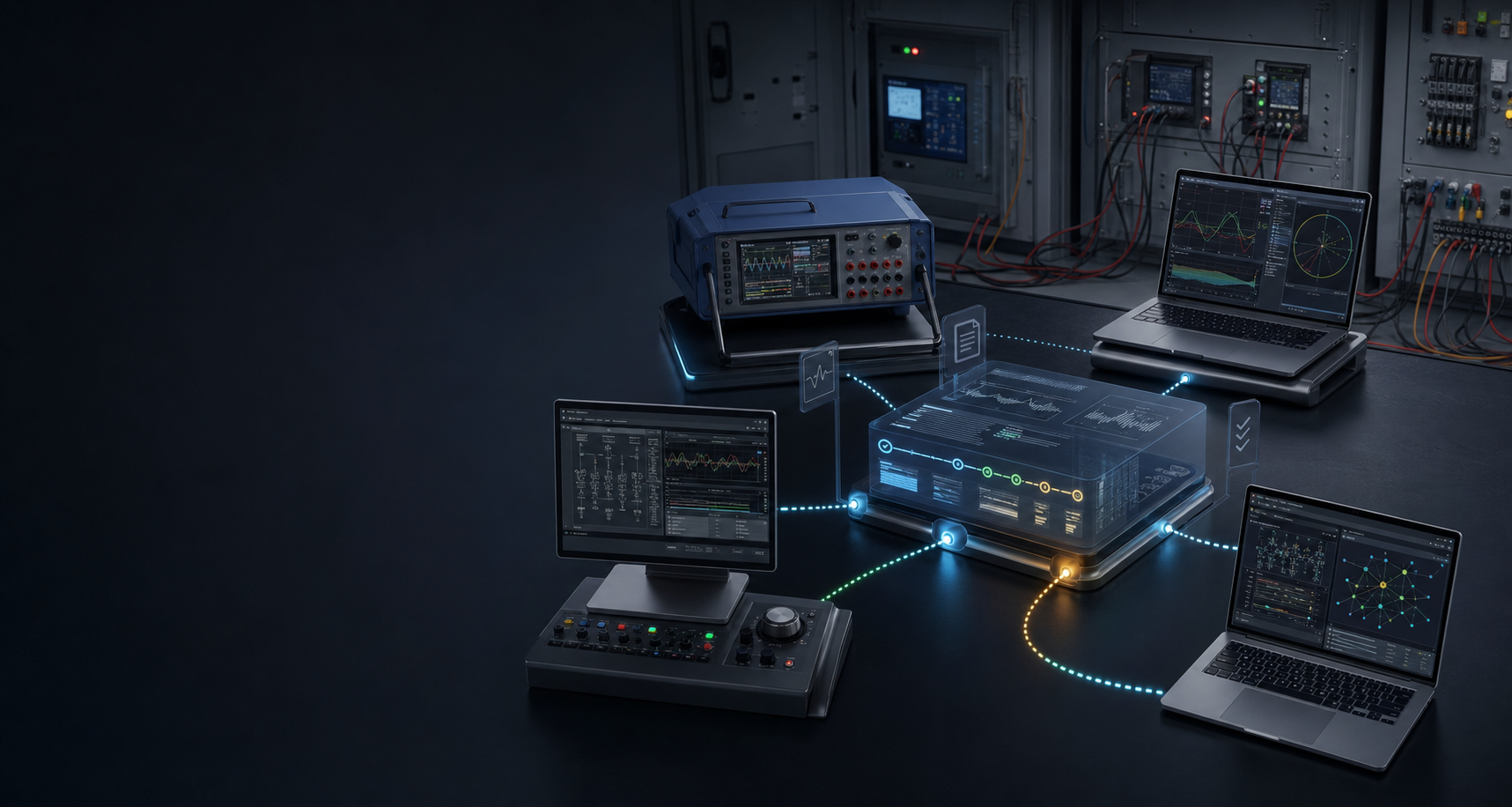
“Protection testing software” describes several different layers. A test-set manufacturer may provide the driver, signal-generation engine, test modules, relay templates, protocol tooling, and report format. A utility may add a maintenance database, work-order connector, settings repository, or engineering document system. An AI workbench adds yet another layer: it can help a human assemble context and review evidence across those systems.
The mistake is to compare every product as though it were trying to do the same job. The more useful question is: which part of the relay-testing lifecycle does each tool control, and what remains the engineer’s responsibility?
Four software ecosystems, described from their public documentation
OMICRON
OMICRON’s Test Universe is a modular PC suite for CMC test sets. Its public materials describe parameter-based tests, automated assessments, templates, reports, COMTRADE playback, and IEC 61850 modules for GOOSE, sampled values, and client/server workflows. RelaySimTest is a different system-oriented workflow: the engineer models the network and scenarios, and the tool calculates signals for system-based tests.
This is a mature, hardware-linked model. It is valuable when a team owns the relevant CMC equipment and has invested in the corresponding test library. It also means the test plan, hardware interface, licensing, training, and stored record have to be considered together. Marketing claims such as “up to 70% time reduction” should be treated as vendor claims unless the underlying study and baseline are available.
Doble
Doble’s RTS is documented as a universal relay-testing software environment with routines for acceptance, commissioning, maintenance, reporting, and more than one test-set family. The public Protection Suite and PowerBase materials emphasize reusable test plans, results, settings, reports, and asset records.
For a utility with a mixed hardware fleet, the practical evaluation question is how well the universal layer handles the exact test set, relay model, firmware, and procedure in the field. “Vendor-neutral” is useful only if the functions the team actually needs remain available across that fleet.
Megger
Megger’s RTMS is described around SMRT and FREJA relay-test workflows: automated and manual tests, templates, reports, databases, and integration with related measurement and IEC 61850 tools. PowerDB provides a broader asset and test-data layer for organizations that want relay, transformer, breaker, and other maintenance records in one environment.
The evaluation issue is not whether the software can produce a report. It is whether the report retains the settings identity, calibration status, test procedure, expected values, actual values, deviations, and raw evidence required by the utility’s maintenance and quality process.
EuroSMC / SMCint
The current manufacturer pages at SMCint describe software around relay objects, automatic tests, fault calculation, report generation, databases, settings import, and COMTRADE workflows. ROOTS and the related tools are best evaluated against the Mentor, Quasar, or other equipment and the exact relay models in scope.
The current SMCint site is the safer primary reference than an old distributor page. A product comparison should record the source date, version, supported equipment, and whether a capability is a current release, an option, or a historical brochure statement.
What the mature tools do well
The vendor platforms are strongest where physical testing needs reliable, repeatable signal generation and a known interface to the instrument. Common strengths include:
- three-phase and multi-channel injection;
- state sequencing, ramps, characteristic sweeps, and timing;
- binary inputs and outputs;
- COMTRADE recording and playback;
- IEC 61850 GOOSE and sampled-value analysis where the selected configuration supports it;
- model-specific settings or template import;
- automated assessment and report production;
- end-to-end or system-based scenarios when the product supports them.
Those are not small capabilities. They are the accumulated engineering work of the protection-testing industry. A new AI feature should complement them rather than pretend the test-set ecosystem is obsolete.
Where teams still lose time
The recurring bottlenecks are often around the test rather than inside the injection engine:
- The wrong settings revision is used because the issued, installed, and as-left versions are not clearly distinguished.
- A test plan is copied from a previous relay without checking firmware, wiring, CT/VT ratios, curve family, or tolerance basis.
- The team discovers during the outage that a binary mapping, GOOSE subscription, SCL file, or timing source is missing.
- The report says “pass” but does not retain the raw trace, calibration state, or deviations.
- A later reviewer cannot answer why the plan covered one scenario and not another.
These are evidence and context problems. They are good candidates for an assistant that can search, compare, flag, and draft. They are poor candidates for a model that silently invents a setting or turns a missing test into a pass.
Where ProtectionAI fits
ProtectionAI is positioned by GridAPM as a separate, simulator-first relay-testing workbench with an agentic copilot. It can be evaluated for plan preparation, manual retrieval, deterministic simulation, test evidence review, and report drafting. The current product boundary is important: the published v1.3 workflow is simulator-only, and any physical hardware path requires separate qualification, approved procedures, and customer validation.
That makes ProtectionAI complementary in a mixed fleet. A team could prepare and peer-review a plan before arriving with an OMICRON, Doble, Megger, or EuroSMC test set; use the simulator for training and what-if analysis; then attach the qualified physical record. The value proposition should be measured by fewer missing assumptions, less retyping, faster review, and stronger provenance—not by a blanket claim that one package replaces every other package.
A procurement scorecard
Ask for a live demonstration using your own representative relay and a deliberately imperfect evidence pack. Score:
- device and firmware coverage;
- test-set control and calibrated hardware support;
- settings and template import;
- IEC 61850, COMTRADE, and time-synchronization support;
- offline and simulator workflows;
- per-point expected/measured/tolerance record;
- as-found and as-left handling;
- raw-file retention and search;
- report versioning and reviewer changes;
- data export, API, and CMMS/EAM connection;
- permissions, audit trail, and OT network posture;
- documented limitations and validation evidence.
CIGRE Technical Brochure 637 frames acceptance, commissioning, and field testing as a process that must evolve with numerical relays, systems, and test equipment. That is a useful lens for procurement: buy a workflow that your engineers can defend across the asset lifecycle, not a demo that looks fast for one test case.
References
- CIGRE Working Group B5.45. (2015). Acceptance, commissioning and field testing techniques for protection and automation systems (Technical Brochure No. 637). https://www.e-cigre.org/publications/detail/637-acceptance-commissioning-and-field-testing-techniques-for-protection-and-automation-systems.html
- Doble Engineering Company. (n.d.). RTS [Product page]. Retrieved August 1, 2026, from https://www.doble.com/product/rts/
- EuroSMC/SMCint. (n.d.). Software de pruebas [Product catalog]. Retrieved August 1, 2026, from https://smcint.com/es/categoria-producto/software-de-pruebas/
- Megger. (n.d.). RTMS: Relay test and management software [Product page]. Retrieved August 1, 2026, from https://www.megger.com/en-us/products/rtms-relay-test-and-management-software
- OMICRON. (n.d.). Test Universe [Product page]. Retrieved August 1, 2026, from https://www.omicronenergy.com/en/products/test-universe/
- OMICRON. (n.d.). RelaySimTest [Product page]. Retrieved August 1, 2026, from https://www.omicronenergy.com/en/products/relaysimtest/
References
Questions engineers ask
Which relay testing software is best?
The best fit depends on the test sets, relay fleet, procedures, data model, and evidence obligations already in place. Compare the full workflow rather than a feature-count list.
Does ProtectionAI replace OMICRON, Doble, Megger, or EuroSMC equipment?
No. ProtectionAI is positioned as a separate software workbench for planning, simulation, evidence, and AI-assisted review; physical injection and vendor-specific qualification remain separate requirements.
What should a utility compare during procurement?
Compare device coverage, settings import, protocol support, test repeatability, report provenance, database integration, offline use, calibration records, training, and the exact physical tests the product is qualified to perform.
