COMTRADE and Agentic AI: A Safer Workflow for Relay Event Analysis
How COMTRADE records, relay targets, settings versions, and engineer-reviewed AI assistance can turn a disturbance file into a defensible protection-event analysis.
On this page
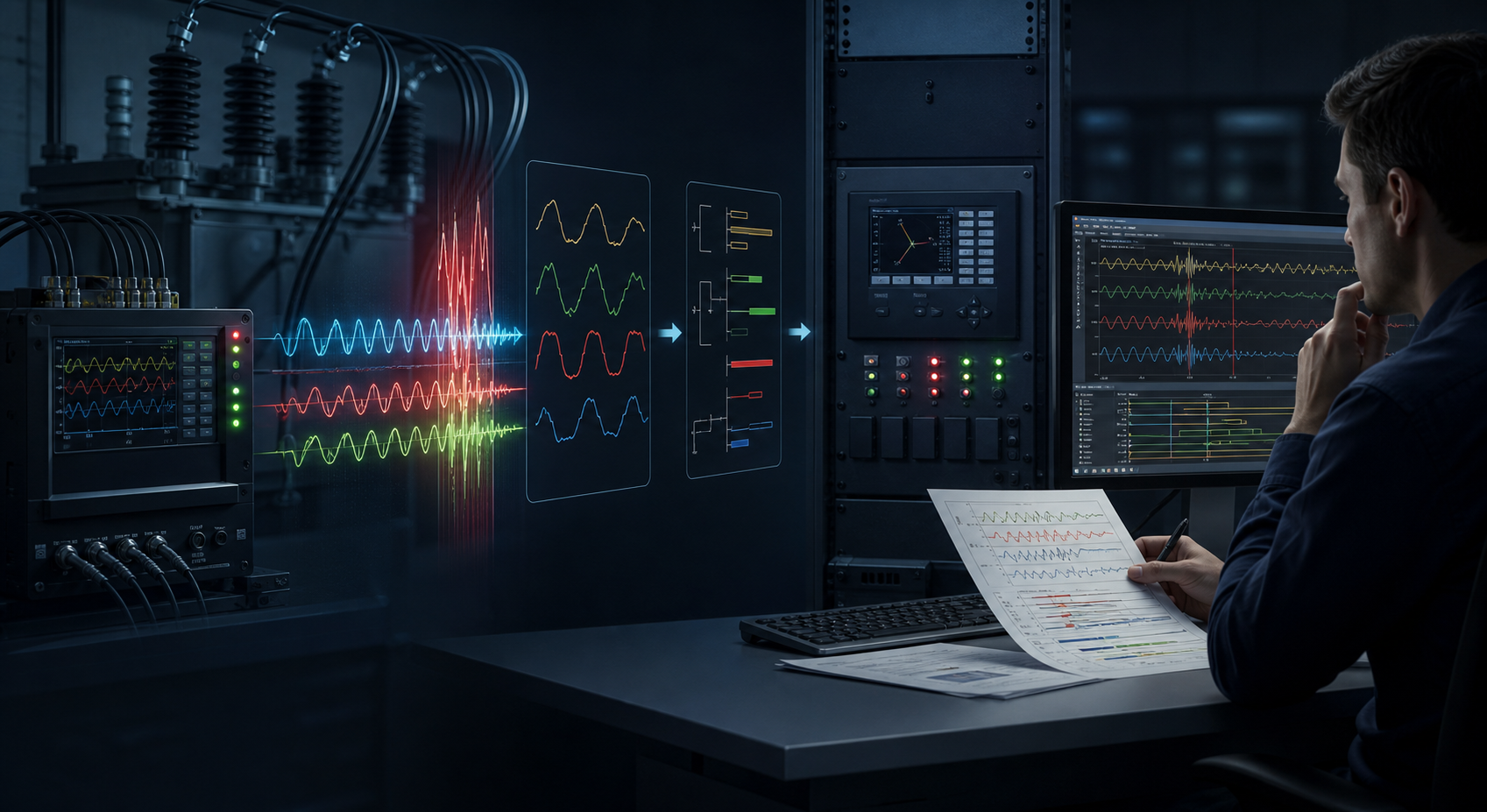
COMTRADE is one of the most useful formats in protection engineering because it gives different tools a common way to exchange transient data. It is not, by itself, an explanation of an event. A record can have a wrong channel map, stale settings context, incorrect scaling, a misleading trigger, missing prefault time, or a time source that was never checked.
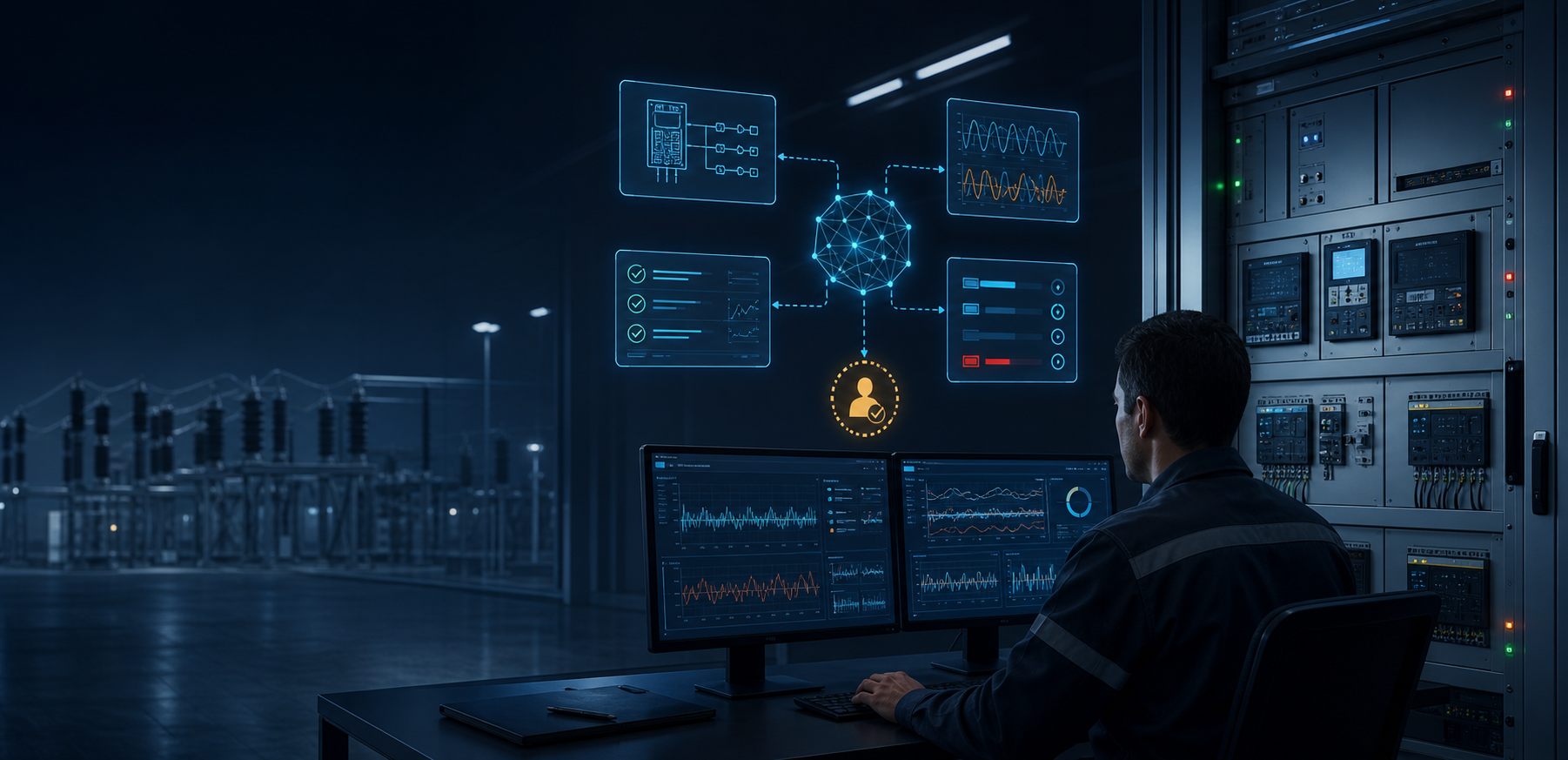
Agentic AI can help an event-analysis team navigate those records, but only if the workflow treats the waveform and metadata as evidence rather than as a prompt to generate a plausible story.
Start with the record, not the narrative
An event-analysis package should begin with the original files and a manifest:
- CFG and DAT files, plus any HDR, INF, or manufacturer-specific context;
- relay identity, firmware, station, bay, and settings group;
- acquisition device and time source;
- channel names, units, ratios, polarity, and sample rate;
- trigger time, prefault duration, and missing or clipped samples;
- relay targets, oscillography flags, breaker status, and communications evidence;
- the question being investigated and the applicable procedure.
IEEE C37.111 and IEC 60255-24 provide the common-format context. They do not make every record semantically complete. The engineer still has to determine what each channel means and whether the record is adequate for the question.
What to check deterministically
Before an AI model sees a summary, use deterministic validation for:
- file integrity and expected channel count;
- sample rate and time-axis monotonicity;
- analog and digital channel labels;
- scaling, nominal values, phase order, and polarity;
- missing, clipped, flat-lined, or saturated channels;
- trigger, prefault, fault, and postfault intervals;
- event duration and synchronization metadata;
- derived phasors, RMS values, sequence components, and calculated thresholds.
The purpose is not to force every record into a pass/fail box. It is to make the limits visible before a fluent model fills them with assumptions.
The questions an engineer actually needs answered
An event review rarely asks only “What happened?” It asks a chain of narrower questions:
- Did the relay see the fault quantities expected from the system condition?
- Did the element assert, start, trip, or block at the expected time?
- Were the settings and setting group the ones intended to be in service?
- Did a CT or VT issue distort the measurement?
- Did the breaker or communications channel behave as assumed?
- Was the target consistent with the waveform and logic?
- Was the operation correct for the fault, or was there a misoperation?
- What evidence would distinguish a relay problem from a wiring, model, or system problem?
An agentic assistant can make those questions explicit, retrieve the relevant manual section, and draft a comparison table. It should cite the source channel and time range for every material observation. “The waveform looks abnormal” is not enough; “phase B current clips at 0.014 s after the trigger and the channel metadata identifies a 5 A secondary” is reviewable.
COMTRADE replay is powerful and limited
Replay lets an engineer apply a recorded event to a relay or simulator under a controlled procedure. It can help reproduce a target, investigate a settings version, compare firmware, or test a hypothesis. The GridAPM CT saturation guide explains why a record that includes saturation can be more informative than ideal phasors.
Replay does not prove that the original field wiring, auxiliary supply, communication channel, breaker, or timing path was identical. It also tests one recorded waveform, not the whole scenario family. The event should be labeled as recorded, replayed, simulated, or field-observed, and the conclusion should respect that boundary.
Where AI helps—and where it misleads
Useful AI assistance includes:
- summarizing a validated event manifest;
- aligning a target with the likely element and setting group;
- finding prior events with the same relay or symptom;
- drafting a time-ordered hypothesis list;
- identifying contradictions between the waveform, relay target, and report;
- producing a cited handoff to operations, planning, or maintenance.
Dangerous shortcuts include:
- asking a model to infer a channel ratio from a screenshot;
- letting it decide that a missing waveform is irrelevant;
- accepting a generated explanation without checking the raw time range;
- using a “normal-looking” plot as proof that polarity or phase order is correct;
- turning a likely cause into a confirmed cause without a test or record.
Research on LLMs in the electric-energy sector identifies promise for tool use and diagnostics alongside hallucination, time-series, physics, data, and safety limitations. That is exactly the balance an event-analysis workflow needs: useful assistance surrounded by explicit verification.
ProtectionAI and event evidence
ProtectionAI can be positioned as a local workbench that brings event records, settings, manuals, test results, and reports into one review context. The assistant can draft a source-linked analysis; the engineer checks the parser output, calculations, time alignment, system model, and procedural conclusion. No AI-generated narrative should overwrite the original evidence.
The best pilot dataset is a set of historical events with known review outcomes and a few deliberately incomplete records. Measure whether the tool finds the missing context, how often its hypotheses are useful, how often it abstains, and how much time the engineer spends verifying it. Do not call a generated summary a diagnosis until the engineer has accepted the evidence and the procedure defines that decision.
References
- Institute of Electrical and Electronics Engineers. (2013). IEEE standard for common format for transient data exchange (COMTRADE) for power systems (IEEE Std C37.111-2013). https://standards.ieee.org/ieee/C37.111/10507/
- International Electrotechnical Commission. (2013). Measuring relays and protection equipment—Part 24: Common format for transient data exchange (COMTRADE) for power systems (IEC 60255-24:2013). https://webstore.iec.ch/en/publication/1251
- Majumder, S., Dong, L., Doudi, F., et al. (2024). Exploring the capabilities and limitations of large language models in the electric energy sector. Joule, 8(6), 1544–1549. https://doi.org/10.1016/j.joule.2024.05.009
- North American Electric Reliability Corporation. (2021). State of reliability: An assessment of 2020 [Report]. https://www.nerc.com/globalassets/programs/rapa/pa/nerc_sor_2021.pdf
- Institute of Electrical and Electronics Engineers. (2023). IEEE guide for power system protection testing (IEEE Std C37.233-2023). https://standards.ieee.org/ieee/C37.233/6676/
References
- IEEE Std C37.111 IEEE Std C37.111 — Common format for transient data exchange
- IEC 60255-24 IEC 60255-24 — Common format for transient data exchange
- NERC State of Reliability 2021
- Majumder et al. (2024) — LLM capabilities and limitations in the electric energy sector
- IEEE C37.233 IEEE C37.233-2023 — Guide for Power System Protection Testing
Questions engineers ask
Can an AI read a COMTRADE file reliably?
It can assist with a validated parser and explain results, but channel mapping, scaling, time base, trigger, missing samples, and relay context must be checked deterministically and by an engineer.
Does COMTRADE replay prove the original relay problem?
Replay can reproduce a recorded waveform under defined conditions; it does not prove that the record is complete, that the original wiring was identical, or that every related scenario behaves the same way.
What should be preserved in an AI-assisted event review?
Preserve the original CFG/DAT files, parser version, scaling, channel map, settings and firmware context, relay targets, generated observations, reviewer edits, and final decision.