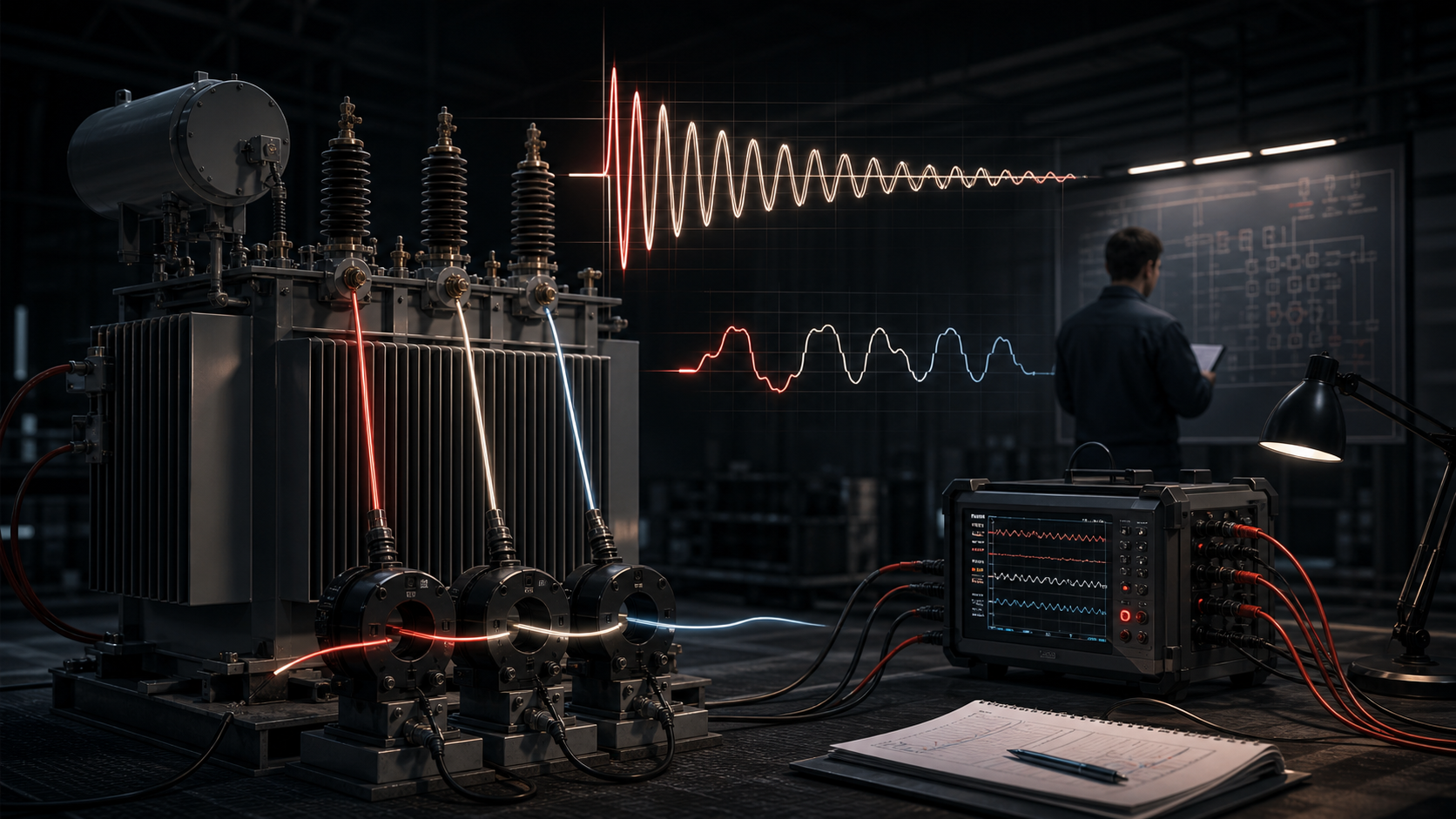
Transformer Differential Relay Commissioning: AI-Assisted Plan Review
A bounded plan-review workflow for transformer differential commissioning, covering CTs, vector group, restraint, inrush, saturation, trip logic, and evidence.
On this page
Transformer differential commissioning is a good test of whether an AI assistant understands engineering boundaries. The case matrix must cover ratio and phase compensation, vector group, restraint, minimum operate, internal faults, external faults, inrush, CT saturation, and trip logic where applicable.
What AI can review
An assistant can compare the relay manual, transformer nameplate, settings export, vector-group assumptions, and proposed cases. It can flag that an external-fault stability case or inrush case is absent. It can draft a table of evidence and unresolved questions.
It should not infer vector-group compensation from a partial screenshot or declare the differential scheme secure from one internal-fault point. Deterministic calculations and physical injection remain essential.
ProtectionAI positioning
ProtectionAI can support plan review and simulator-first rehearsal, with the final commissioning record created under the customer’s procedure. If the product later supports a physical instrument path, the qualification must name the relay, test set, firmware, cables, timing, and accepted cases.
Test the assumptions before the characteristic
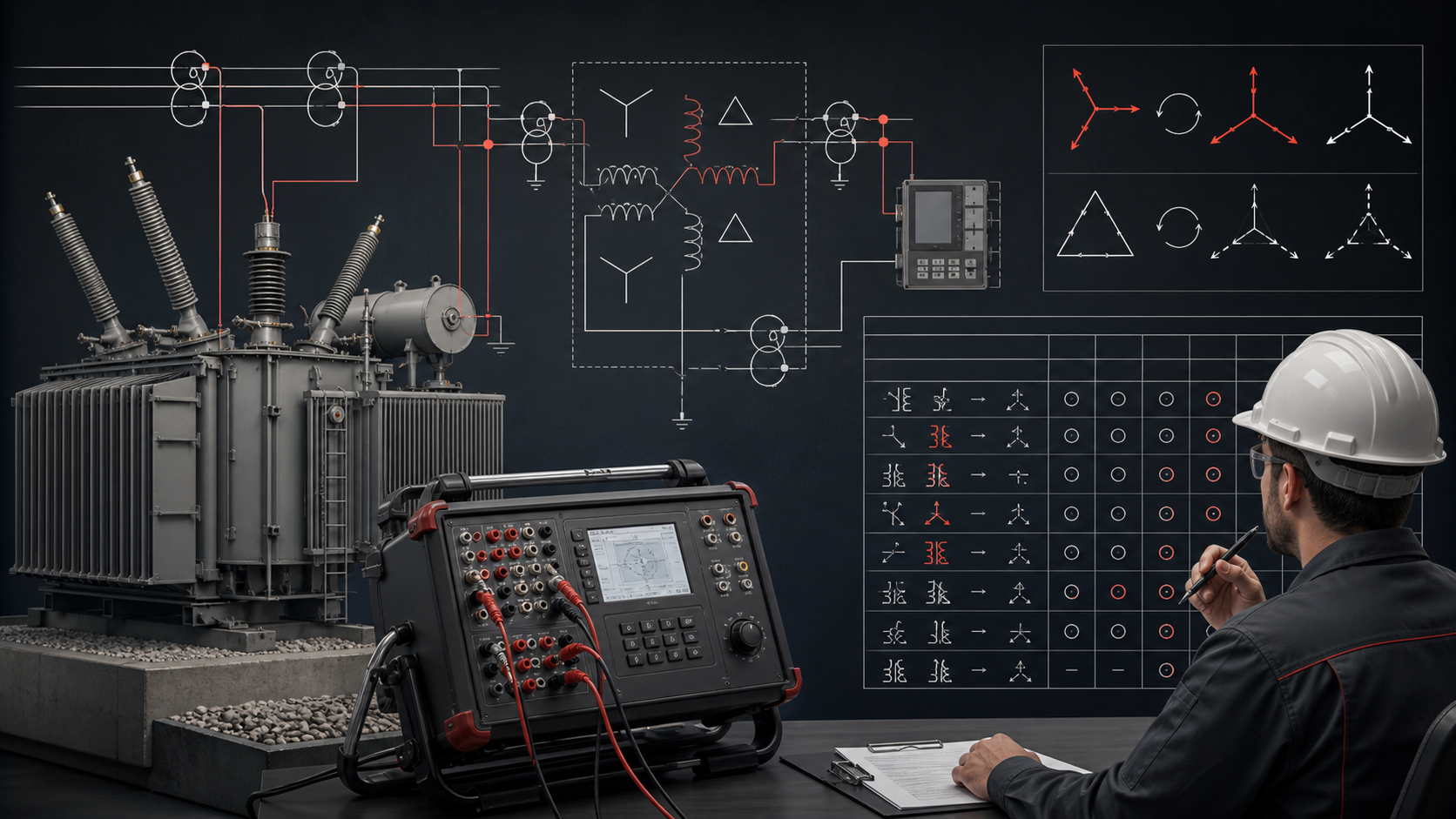
The differential characteristic is only one part of the scheme. Start by reconciling the transformer nameplate, CT ratios, polarity, vector group, tap range, grounding, relay compensation, and setting group. Then make the expected currents and restraint quantities explicit. An external-fault stability case should exercise the through-current and CT model; an internal-fault case should cover the intended operate region. Inrush and overexcitation require their own waveforms and blocking or restraint expectations.
The plan should also show the trip circuit, interposing relays, breaker simulation, alarms, lockouts, and any communications-assisted logic. If the work is only a relay-element test, label that boundary. If it is a scheme or end-to-end commissioning test, include the wiring and timing evidence that makes the claim defensible.
What the assistant should return
Given a bounded set of nameplate data, settings, manual sections, and approved procedure, an agent can produce a case matrix with source links and unresolved questions. It can flag that the vector group is present in the nameplate but absent from the settings export, or that an inrush case has no expected blocking time. It can compare the proposed matrix with a prior approved job while preserving the reason for any difference.
The assistant must not infer a missing vector group, fabricate a test point, or declare stability from a single result. ProtectionAI’s simulator-first workflow is therefore most useful as a rehearsal and plan-review layer. Physical injection, polarity checks, trip testing, and final sign-off remain qualified engineering work.
References
- IEC. (2022). Measuring relays and protection equipment—Part 1: Common requirements (IEC 60255-1:2022). https://webstore.iec.ch/en/publication/59762
- IEEE. (2023). IEEE guide for power system protection testing (IEEE Std C37.233-2023). https://standards.ieee.org/ieee/C37.233/6676/
- OMICRON. (n.d.). RelaySimTest [Product page]. https://www.omicronenergy.com/en/products/relaysimtest/
- CIGRE Working Group B5.45. (2015). Acceptance, commissioning and field testing techniques for protection and automation systems (Technical Brochure No. 637). https://www.e-cigre.org/publications/detail/637-acceptance-commissioning-and-field-testing-techniques-for-protection-and-automation-systems.html
References
Questions engineers ask
What should a transformer differential commissioning plan include?
At minimum, reconcile nameplate, CT ratios and polarity, vector group, compensation, tap range, grounding, restraint, internal and external fault cases, inrush, saturation, trip logic, and the approved procedure.
Can AI infer a missing vector group or declare stability?
No. Missing engineering inputs must be flagged for resolution; a single internal-fault result cannot establish complete differential stability or scheme acceptance.
Where can ProtectionAI help?
It can compare the approved manual, nameplate, settings, model, and procedure to draft a case matrix and evidence index for engineer review.