CT Saturation, Inrush, and Relay Test Evidence: What the Record Must Show
A practical evidence framework for CT saturation, transformer inrush, COMTRADE replay, and engineer-reviewed differential relay testing.
On this page
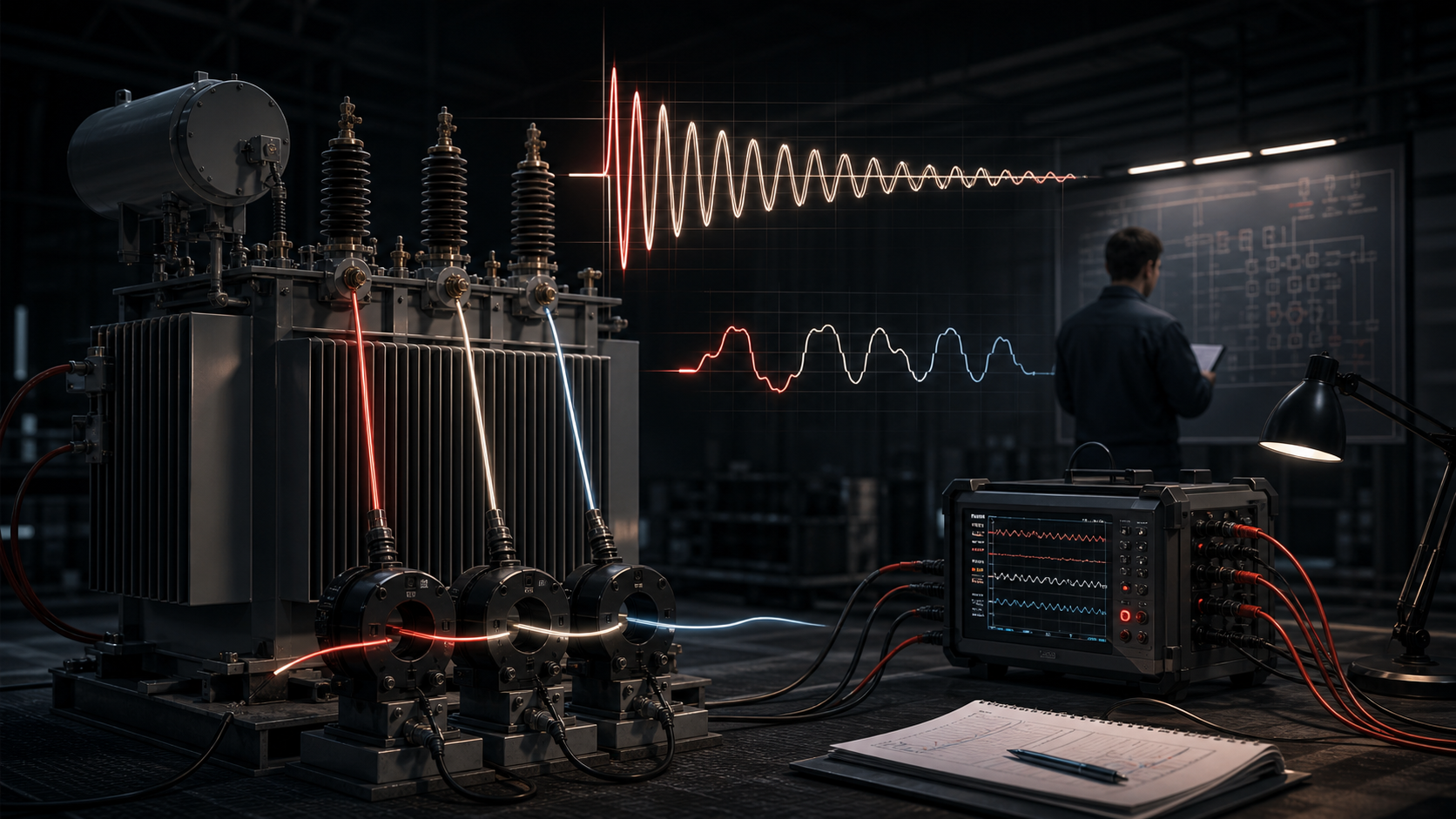
CT saturation and transformer inrush are useful reminders that a clean phasor test may not represent the waveform the relay sees during a severe event. The test plan should state whether it is checking steady-state characteristic, transient response, restraint, blocking, or complete scheme behavior.
Evidence for a transient case
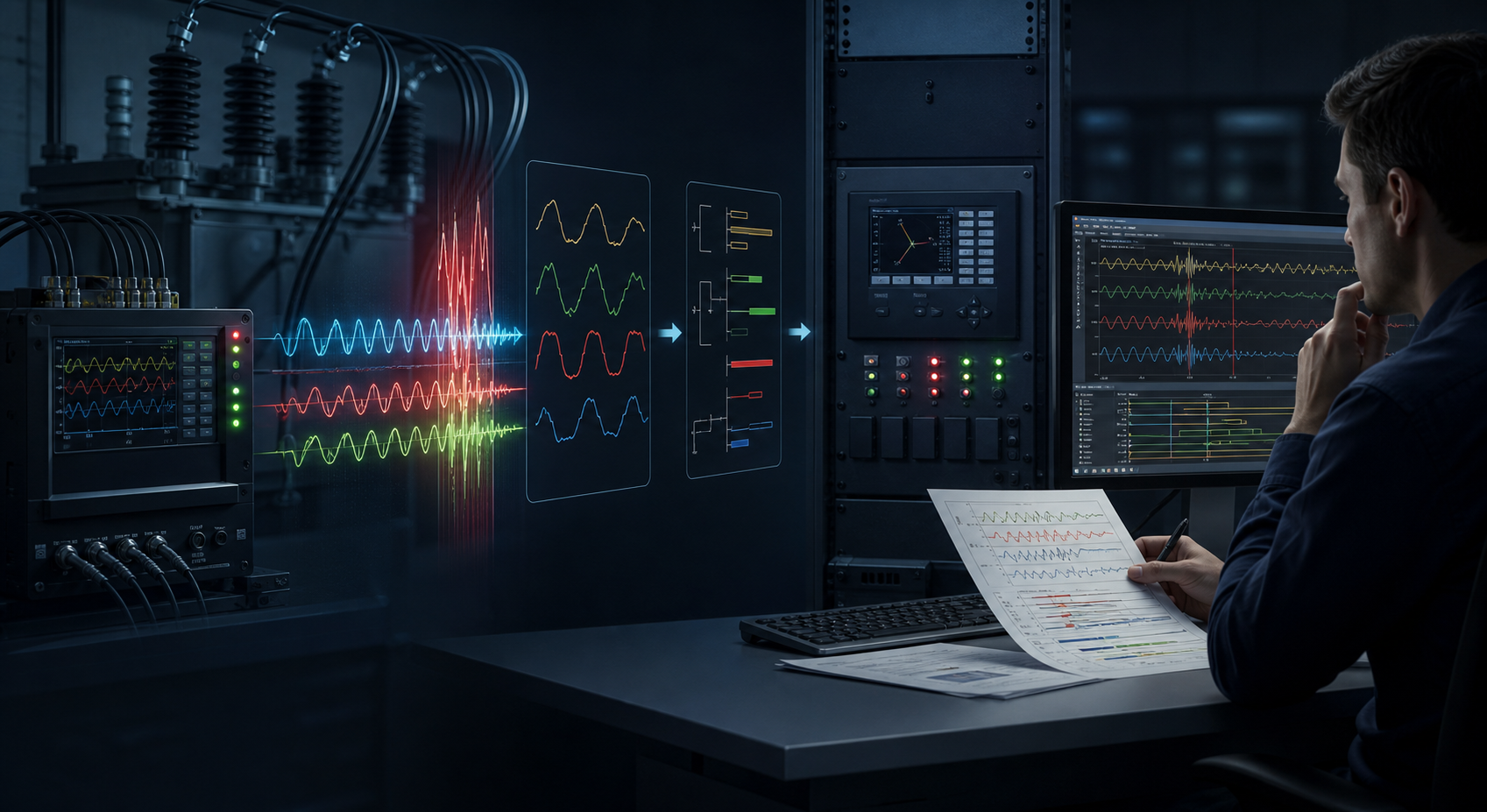
Retain the source waveform or simulation model, CT ratio and burden assumptions, phase and polarity, sample rate, time source, injected channels, relay target, and binary response. If a case is replayed from COMTRADE, preserve the original CFG/DAT files and the replay settings. If the case is synthetic, label it as synthetic and retain the model version.
An AI assistant can highlight that a test pack contains only steady-state points, find prior events with saturation, and draft a question for the engineer. It should not state that the relay is stable or secure solely because one result passed.
ProtectionAI positioning
ProtectionAI can help assemble the case matrix and explain waveform evidence in a simulator-first workflow. Physical transient injection, instrument accuracy, and site acceptance remain separate requirements.
Build the case matrix around the failure mode
The first question is not “which test module should be opened?” It is “what protection decision is being challenged?” For a transformer differential scheme, that normally produces different cases for an internal fault, an external fault with through-current, energisation inrush, overexcitation, CT saturation, and a breaker or trip-logic sequence. Each case should state the expected relay element, restraint or blocking behaviour, trip path, and the evidence that will be accepted.
A useful matrix records the source model, transformer vector group, CT ratios and polarity, relay compensation, sampled channels, fault inception angle, source impedance, and any communication or breaker timing assumptions. The matrix should also distinguish a steady-state characteristic point from a transient replay. A point on a differential slope can show pickup at one operating condition; it cannot by itself establish stability during a distorted external-fault waveform.
Treat COMTRADE as evidence, not as a magic replay button
When an event is replayed, preserve the original files, channel metadata, scaling, sample rate, time reference, and any conversion or filtering step. Record the test-set output limits and the actual channels sent to the relay. If a file came from a disturbance recorder, preserve its provenance and the reason it is representative. If the waveform was generated from a model, label it as synthetic and retain the model revision and parameter assumptions.
The report should show both the waveform and the relay response: operate and restraint quantities, trip contacts, time stamps, binary logic, and the expected-versus-measured comparison. A reviewer should be able to answer whether a failure came from the protection algorithm, a CT model, an output limitation, a wiring issue, or an incorrect expectation.
Where an agent helps—and where it must stop
An agentic assistant can compare the procedure with the case manifest, identify that a CT-saturation case has no burden assumption, retrieve the relevant relay-manual passage, and draft an evidence index. It can also detect when a test pack mixes units, channel names, or setting revisions. Those are valuable review tasks because the assistant can point to the source row or file rather than inventing a conclusion.
The stop condition is equally important. The assistant should not declare a transformer secure, rewrite a waveform to make a result pass, or turn one successful replay into a compliance statement. A named protection engineer should approve the case selection, the physical setup, the interpretation, and the final report.
References
- Institute of Electrical and Electronics Engineers. (2013). IEEE standard for common format for transient data exchange (COMTRADE) for power systems (IEEE Std C37.111-2013). https://standards.ieee.org/ieee/C37.111/10507/
- International Electrotechnical Commission. (2013). Measuring relays and protection equipment—Part 24: COMTRADE for power systems (IEC 60255-24:2013). https://webstore.iec.ch/en/publication/1251
- OMICRON. (n.d.). RelaySimTest [Product page]. https://www.omicronenergy.com/en/products/relaysimtest/
- IEEE. (2023). IEEE guide for power system protection testing (IEEE Std C37.233-2023). https://standards.ieee.org/ieee/C37.233/6676/
References
Questions engineers ask
Why is CT saturation important in differential relay testing?
CT saturation changes the waveform and can affect operate, restraint, blocking, and stability behavior; the case should be explicit rather than implied by a steady-state point.
Does COMTRADE replay prove a complete protection scheme?
No. Replay can reproduce a recorded or modeled signal path, but wiring, instrument limits, trip logic, and the acceptance procedure remain separate evidence.
Where can ProtectionAI help?
It can organize the case matrix, source files, assumptions, expected values, and review questions while leaving injection and engineering acceptance to qualified tools and people.