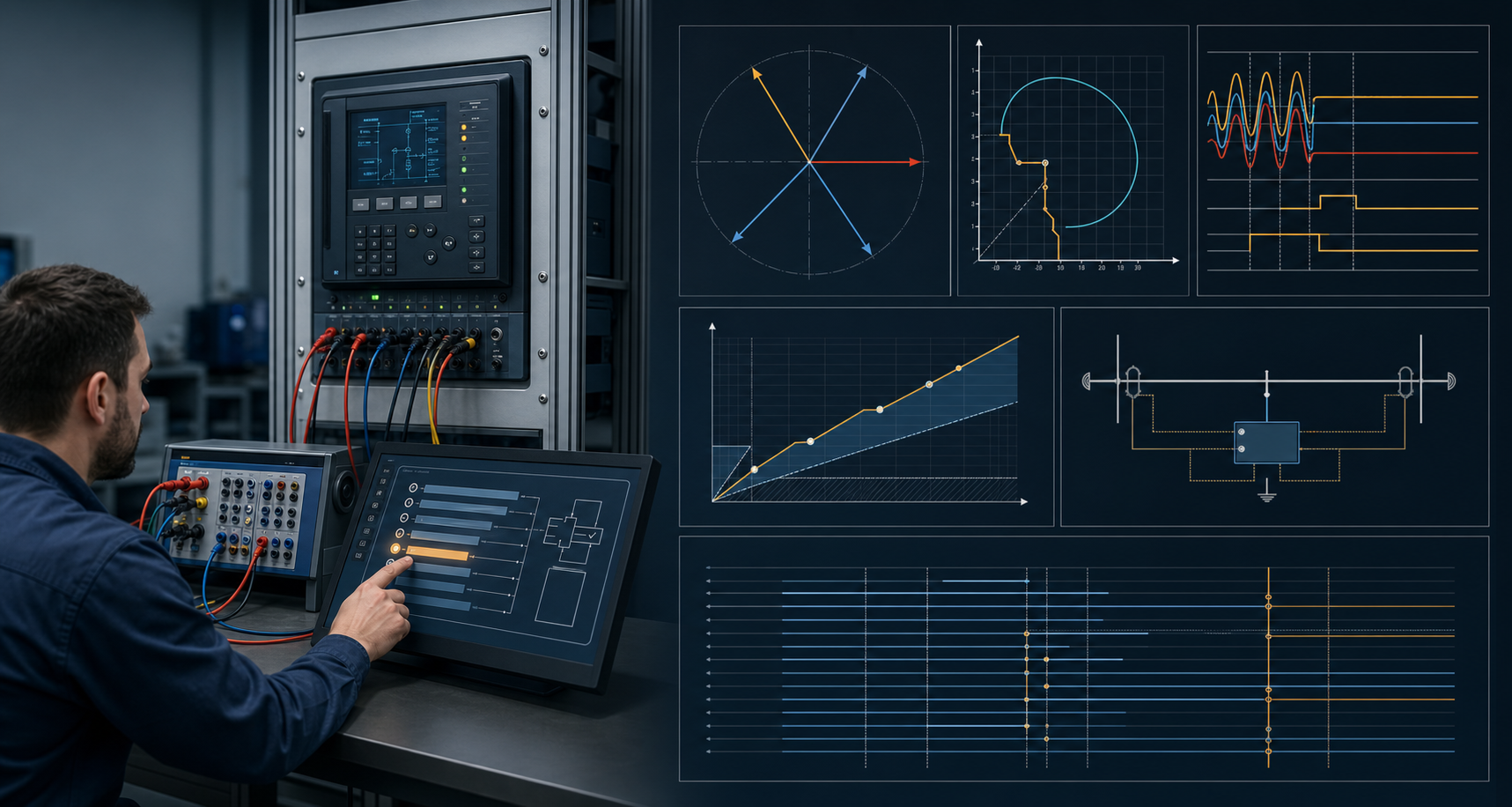
Relay Settings to Test-Point Traceability: How to Prove Coverage
A practical method for mapping approved relay settings and logic to test cases, expected results, raw evidence, deviations, and engineer approval.
On this page
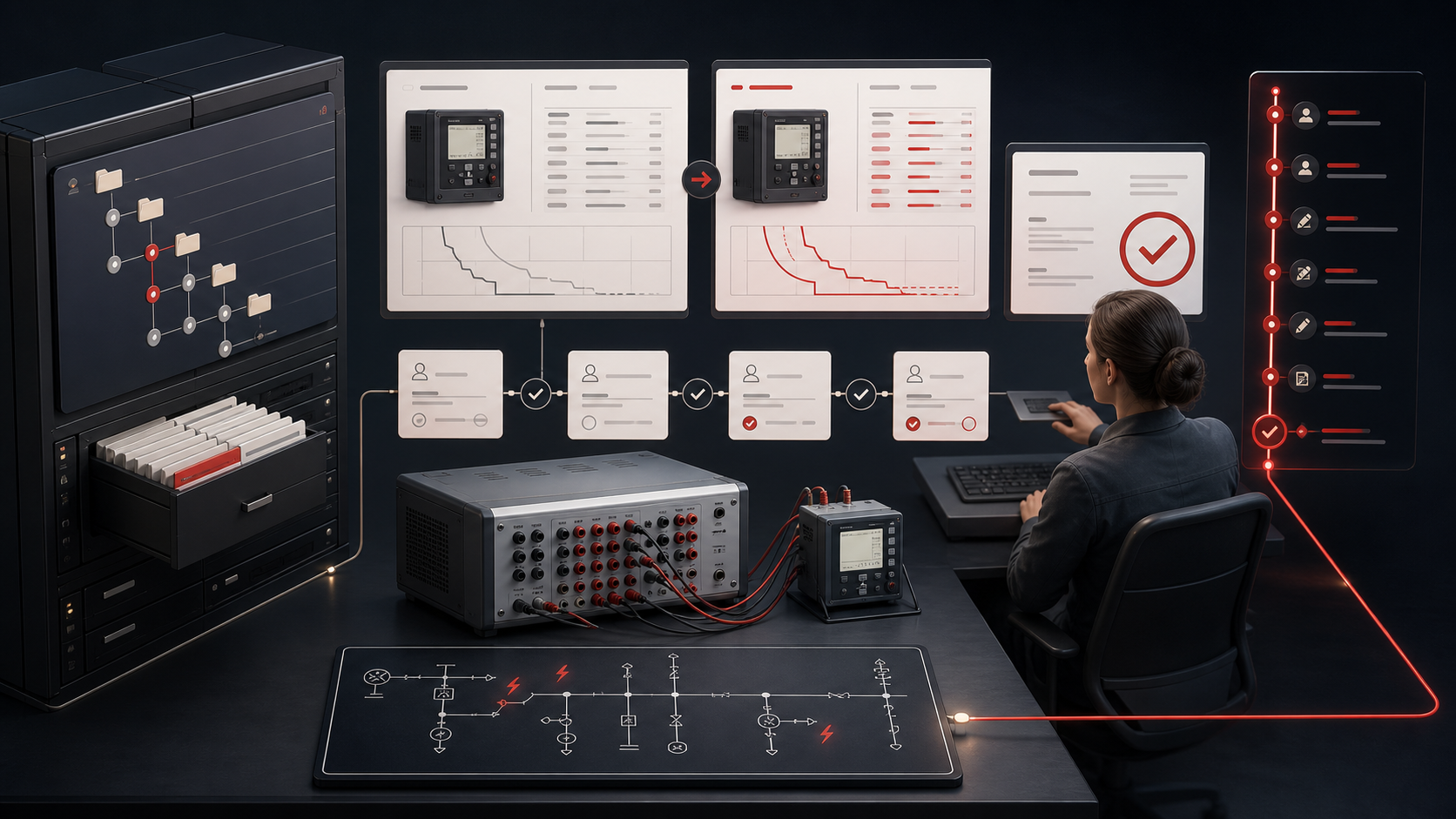
“All settings tested” is not a useful conclusion unless the record shows how settings became test cases. A relay may contain hundreds of values, but only some control the behavior in scope. Others interact through logic, supervision, measurement selection, or setting-group selection. Traceability makes that engineering relationship visible.
Start with the approved source
Register the issued settings package, calculation or coordination reference, drawing revision, firmware context, and setting group. Record the installed as-found export separately. If the source is a spreadsheet, RIO file, SCL file, vendor export, or hand-entered value, retain the original and its revision.
The first comparison should be identity and completeness, not numerical interpretation. A correct-looking value from the wrong relay or group is still wrong evidence.
Map settings to behaviors
Group settings by the protected behavior they influence:
- pickup, time, and curve settings for an overcurrent element;
- reach, characteristic shape, directional angle, and supervision for distance;
- ratios, compensation, slope, restraint, and blocking for differential;
- timers, binary inputs, outputs, interlocks, and permissives for scheme logic;
- data sets, quality, and time conditions for digital interfaces.
For each group, write the behavior in plain engineering language and link it to the source setting identifiers. This prevents a test report from becoming a list of menu labels with no explanation.
Build meaningful test cases
Each mapped behavior should point to one or more cases. A case includes input quantities or triggering conditions, the expected element or output, the acceptance criterion, the evidence file, and the reviewer. Boundary cases are often more informative than nominal points: just below and above pickup, directional boundaries, zone edges, blocking conditions, communication loss, and restoration.
The mapping should allow a reviewer to answer both directions:
- Given a setting, where is the test that exercises it?
- Given a failed test, which settings, logic, wiring, or assumptions could explain it?
That bidirectional relationship is much stronger than a single “coverage” percentage.
Handle exclusions explicitly
Some settings may be outside the project scope, unused in the installed scheme, or proved through another system test. Record the reason, approving engineer, and linked evidence. Silence looks like an omission; an explicit exclusion can be reviewed.
If the settings file contains a value that is not understood by the importer or test tool, preserve the original and create a manual review item. Do not silently discard it.
Preserve change history
When a test fails and a setting changes, retain the as-found value, the authorized reason, the new value, the re-test, and the as-left export. Link the change to the work order or engineering decision. This is essential for later misoperation analysis and maintenance evidence.
ProtectionAI can help diff settings, organize the map, and draft a review queue. It should surface an unresolved setting rather than infer the intended value. Numerical comparisons and acceptance remain deterministic and engineer-approved.
References
- Institute of Electrical and Electronics Engineers. (2023). IEEE guide for power system protection testing (IEEE Std C37.233-2023). https://standards.ieee.org/ieee/C37.233/6676/
- U.S. Department of the Interior, Bureau of Reclamation. (2022). Management of protective relay settings (FIST 6-4). https://www.usbr.gov/power/data/fist/FIST_6-4_%281-2022%29.pdf
- U.S. Department of the Interior, Bureau of Reclamation. (2011). Operation, maintenance, and field test procedures for protective relays and associated circuits (FIST 3-8). https://usbr.gov/power/data/fist/fist3_8/vol3-8.pdf
- North American Electric Reliability Corporation. (2025). Protection system, automatic reclosing, and sudden pressure relaying maintenance (PRC-005-6). https://prod.nerc.com/standards/reliability-standards/prc/prc-005-6
References
- IEEE C37.233 IEEE C37.233-2023 — Guide for Power System Protection Testing
- U.S. Bureau of Reclamation FIST 6-4 — Management of protective relay settings
- U.S. Bureau of Reclamation FIST 3-8 — Protective relay field test procedures
- NERC PRC-005 NERC PRC-005-6
- CIGRE Technical Brochure 637 — Acceptance, commissioning, and field testing
Questions engineers ask
Does a settings export prove the relay was tested?
No. It identifies a configuration. Testing requires a defined case, expected behavior, measured result, acceptance basis, and review.
How should a grouped setting be handled?
Trace the group to the behavior it controls and test the relevant boundaries, interactions, and selection logic. The engineer may approve a justified grouping, but it should not be invisible.
Can AI create a complete settings-to-test map?
AI can draft a map from structured settings and procedures, identify likely gaps, and retrieve supporting evidence. A qualified engineer must confirm the engineering meaning and accept the coverage.