Choosing a Power-System Simulator for Relay Testing: RMS, EMT, Real-Time, and HIL
How to choose among RMS, EMT, real-time simulation, software-in-the-loop, and hardware-in-the-loop for protection testing questions.
On this page
Power-system simulation is not one category. RMS studies, EMT simulation, real-time digital simulation, software-in-the-loop, and hardware-in-the-loop answer different questions. A relay-testing team should choose the least complex environment that faithfully represents the question it needs to answer.
Match the simulator to the test question
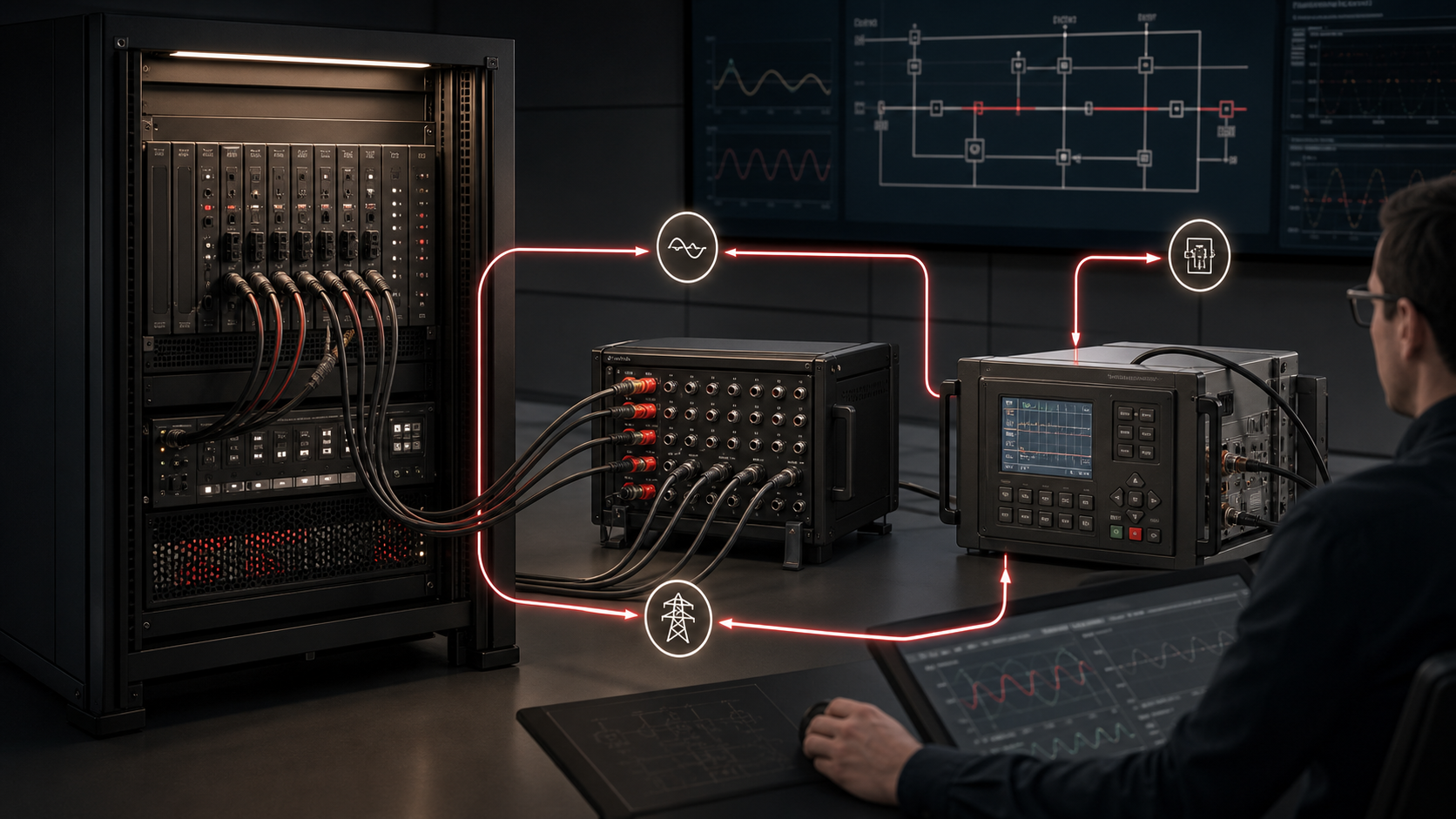
An RMS simulation may be appropriate for steady-state phasors, fault levels, coordination, and many characteristic checks. EMT becomes important when switching transients, converter controls, travelling-wave effects, saturation, or detailed waveform behavior matter. Real-time simulation adds a deterministic time base and I/O path. HIL adds a physical relay or controller to the loop, which makes the test more realistic but also more demanding to configure, calibrate, and govern.
The useful selection questions are:
- Is the question about a relay element, a protection scheme, or the entire network?
- Does the test depend on sub-cycle waveform detail or only phasors?
- Does it require a real relay, merging unit, or controller in the loop?
- What timing, I/O, synchronization, and communication behavior must be observed?
- What evidence will the commissioning or maintenance procedure accept?
Agentic assistance around HIL
A bounded AI assistant can help convert the approved test question into a model-and-evidence checklist. It can flag that the proposed study lacks a source impedance, CT model, time source, or expected binary response. It can draft a case matrix and link each case to a procedure section.
It should not select a model without an engineer or silently change a real-time configuration. A test that writes a simulator case or controls a physical relay needs the same approval discipline as any other engineering tool. The AI should remain read-only or operate through allow-listed functions whose inputs and outputs are recorded.
What the literature supports
Pashaei et al. (2024) demonstrate a controlled HIL approach for adaptive protection using clustering, IEC 61850-related infrastructure, and real-time models. That is useful evidence for a validation workflow, not evidence that a language model can control a live protection system. CIGRE lifecycle-testing guidance likewise makes the stage and purpose of the test explicit.
ProtectionAI positioning
ProtectionAI should be evaluated first as a simulator-first planning and review layer. A customer can compare its model assumptions, generated cases, and report traceability before considering any physical interface. Physical test-set or HIL support must be separately qualified by device, firmware, I/O, timing, network, and procedure.
A decision table prevents over-testing
Start with the smallest environment that can answer the engineering question. Use RMS for questions that are well represented by phasors and steady-state fault quantities. Use EMT when switching, power-electronic controls, travelling waves, saturation, inrush, or sub-cycle transients are material. Use real-time simulation when deterministic wall-clock interaction, protection timing, or a communication loop is part of the question. Use HIL when a physical relay, merging unit, controller, or other device must respond in the loop.
The complexity has a cost. More detailed models require more parameter evidence, time synchronisation, I/O validation, and configuration control. The test record should state the model solver, time step, interface, signal scaling, latency assumptions, and expected response. If those fields are missing, a polished plot is not enough to reproduce the result.
HIL governance is part of the test
Before connecting a relay, define the safe state, isolation boundary, test mode, trip-output handling, network segmentation, and rollback. Confirm how a failed real-time step or provider outage affects the device. Keep the simulator case, firmware, configuration, and measured response together. An agent may draft the checklist and compare it with the procedure, but it should not change a real-time model or send a control action without a separately approved and audited interface.
Pashaei et al. show why real-time HIL can be valuable for adaptive protection research; the work also reinforces that the model, communication path, and physical device form a controlled experiment. That is the standard a ProtectionAI pilot should adopt.
References
- CIGRE Working Group B5.62. (2021). Life cycle testing of synchrophasor based systems used for protection, monitoring and control (Technical Brochure No. 843). https://www.e-cigre.org/publications/detail/843-life-cycle-testing-of-synchrophasor-based-systems-used-for-protection-monitoring-and-control.html
- Pashaei, M., Rastegar, H., Zandrazavi, S. F., Kauhaniemi, K., & Laaksonen, H. (2024). Real-time hardware-in-the-loop approach for adaptive centralized protection schemes using clustering algorithms. Expert Systems with Applications, 255, Article 124707. https://doi.org/10.1016/j.eswa.2024.124707
- OMICRON. (n.d.). RelaySimTest [Product page]. https://www.omicronenergy.com/en/products/relaysimtest/
References
Questions engineers ask
When is RMS simulation enough?
RMS can be suitable for steady-state phasors, fault levels, coordination, and many characteristic checks when switching transients and detailed waveform effects are outside the question.
When should a team consider EMT or HIL?
Use EMT for detailed transient phenomena and real-time or HIL when deterministic time behavior, physical relay I/O, or closed-loop interaction is part of the acceptance question.
Can ProtectionAI choose the simulator automatically?
It can organize the test question, fidelity assumptions, case matrix, and evidence gaps; the protection team still selects and qualifies the simulator and physical interface.