Simulator-First Relay Testing for Outage and Commissioning Preparation
Why simulator-first relay testing is useful before an outage, what it can prove, what it cannot prove, and how an agentic assistant can prepare a better physical test window.
On this page
An outage window is a poor place to discover that a settings export uses a different CT ratio, that the binary map is incomplete, or that the test plan never exercised the reclose sequence. Simulator-first relay testing moves those discoveries earlier, when an engineer can still change the plan, ask the relay owner a question, or obtain a missing file.
Simulation is a rehearsal with a defined boundary
A simulator is valuable because it gives the team a controlled environment. The engineer can vary fault type, location, source strength, sequence timing, settings group, CT behavior, or breaker state without energizing a physical output. The team can train new engineers and produce a first evidence pack while the test set is still in another substation.
But a simulated result is a result of the model. It does not automatically validate the relay hardware, wiring, binary circuit, channel assignment, amplifier accuracy, time source, network path, or site conditions. A mature process labels the evidence clearly: simulated, bench, FAT, SAT, field, or post-event.
What to rehearse before the outage
The highest-value rehearsal cases are usually the ones that combine assumptions:
- prefault, fault, breaker operation, dead time, and reclose;
- distance-zone reach and directional polarization;
- transformer differential restraint, inrush, and external-fault stability;
- CT saturation or waveform distortion;
- communications-assisted schemes and loss or delay;
- breaker-failure and lockout logic;
- GOOSE, sampled values, quality flags, and time synchronization;
- as-found settings followed by an approved as-left change.
Use the same identifiers, units, curve constants, expected values, and acceptance criteria that the physical procedure will use. Otherwise the rehearsal may merely create confidence in a parallel set of assumptions.
System-based tools and digital twins
OMICRON documents RelaySimTest as a system-based test environment that calculates signals from power-system scenarios. Megger describes its FREJA and SMRT Digital Twin as a high-fidelity simulator and training environment, while explicitly retaining the need for physical testing, approved settings, local procedures, and connection checks. These vendor descriptions support a useful distinction: simulation is a powerful preparation and training layer, not a universal replacement for site acceptance.
Academic HIL work adds another perspective. Pashaei and colleagues evaluated adaptive protection using real-time HIL and IEC 61850-related infrastructure. HIL can bring the real device and a real-time model together under controlled conditions, but it still requires a defined test bench, instrumentation, model validation, and acceptance criteria. “Real-time” does not mean “autonomous” or “field proven.”
How agentic AI improves the rehearsal loop
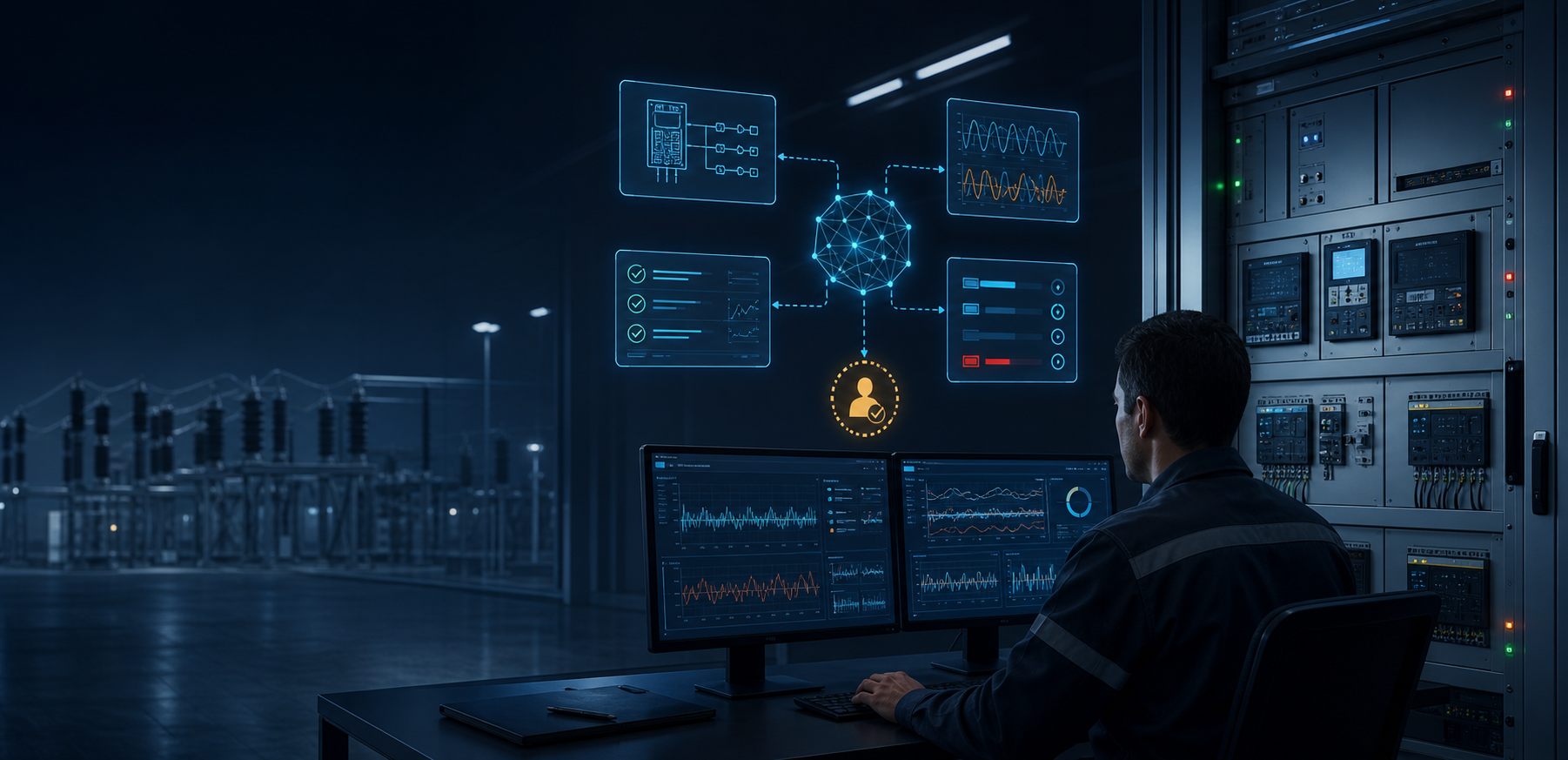
An agentic assistant can act as a coordinator around the simulator:
- Read the approved settings, procedure, and asset context.
- Generate a candidate case matrix from the protection functions in scope.
- Check for missing nominal values, units, firmware assumptions, or network context.
- Run deterministic simulation tools that are allow-listed for the project.
- Compare the output to deterministic expected behavior and record exceptions.
- Draft a pre-outage review pack with citations and open questions.
The important phrase is candidate case matrix. The assistant should not silently decide that a particular case is unnecessary. An engineer may deliberately exclude a scenario because it is out of scope, already covered by another test, or unsafe to reproduce; that decision belongs in the record.
The physical handoff
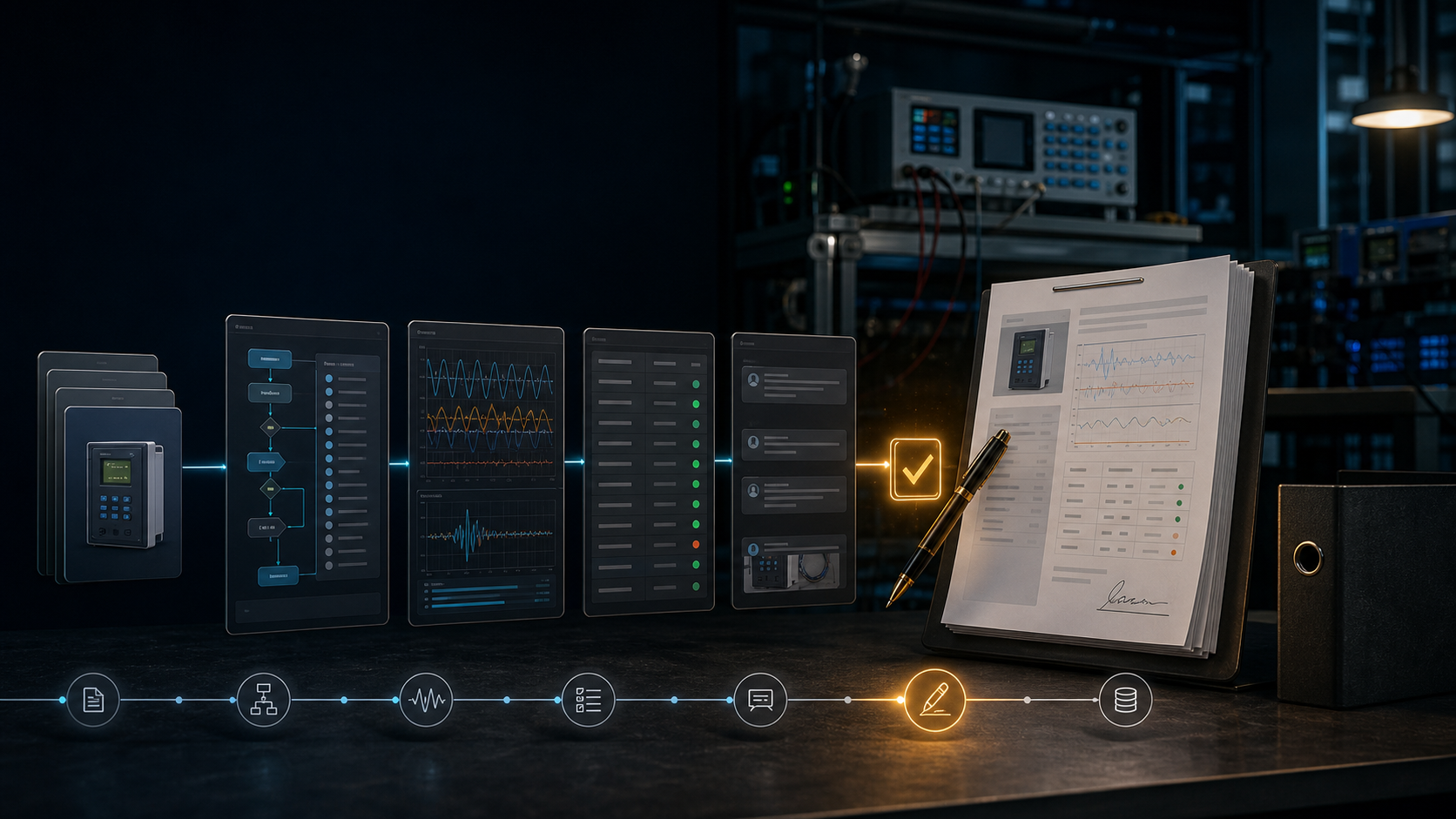
At the end of the rehearsal, produce a handoff that a field team can actually use:
- asset identity and settings checksum;
- exact test cases and state transitions;
- expected signals and tolerances;
- binary input/output map;
- test-set and accessory requirements;
- GOOSE/SV and timing prerequisites;
- isolation and safety conditions;
- required physical checks that simulation did not cover;
- evidence filename and version conventions;
- stop conditions and escalation contacts.
The field engineer should be able to see which items came from simulation, which are to be verified physically, and which require a named approval. Do not merge the simulation result and the field result into one undifferentiated “pass.”
Common simulation mistakes
The most dangerous simulation mistakes are quiet:
- using an ideal source where the field fault level is different;
- ignoring CT saturation because the steady-state phasor looks correct;
- using an unverified breaker or teleprotection delay;
- treating a nominal SCL file as the installed configuration;
- assuming every relay model implements the standard curve identically;
- testing a single waveform and generalizing to a class of faults;
- allowing an AI-generated parameter to enter the model without review.
The CT saturation article and distance reach guide illustrate why a single idealized case is not enough. A simulator improves coverage only when the team deliberately models the conditions that matter.
Where ProtectionAI fits
ProtectionAI’s public workflow is simulator-first. That is a useful product boundary rather than a weakness to hide: it allows plan authoring, manual retrieval, deterministic calculation, training, and report drafting without claiming that the software has already qualified every physical test-set path. When a customer needs physical injection, the correct next step is a scoped integration and qualification effort under the customer’s procedure.
Measure the pilot by the issues found before the outage, the time saved in review, the number of missing assumptions closed, and the quality of the handoff. Do not measure only the speed of producing a screenshot.
References
- IEEE Power System Relaying and Control Committee, Working Group I-25. (2017). Commissioning testing of protection systems. IEEE Power & Energy Society. https://www.pes-psrc.org/kb/report/052.pdf
- Megger. (n.d.). FREJA and SMRT Digital Twin: High-fidelity simulator [Product page]. Retrieved August 1, 2026, from https://www.megger.com/en/products/freja-and-smrt-digital-twin-high-fidelity-simulator
- OMICRON. (n.d.). RelaySimTest [Product page]. Retrieved August 1, 2026, from https://www.omicronenergy.com/en/products/relaysimtest/
- Pashaei, M., Rastegar, H., Zandrazavi, S. F., Kauhaniemi, K., & Laaksonen, H. (2024). Real-time hardware-in-the-loop approach for adaptive centralized protection schemes using clustering algorithms. Expert Systems with Applications, 255, Article 124707. https://doi.org/10.1016/j.eswa.2024.124707
- Kezunovic, M. (2021). Life cycle testing of synchrophasor based systems used for protection, monitoring and control (CIGRE Technical Brochure No. 843). https://www.e-cigre.org/publications/detail/843-life-cycle-testing-of-synchrophasor-based-systems-used-for-protection-monitoring-and-control.html
References
Questions engineers ask
What does a simulator-first relay test prove?
It can prove that a model, settings interpretation, sequence, expected result, and evidence workflow behave as intended in the simulated conditions. It does not prove physical wiring, hardware accuracy, trip-circuit behavior, or site performance.
Can simulator results be used as commissioning acceptance?
Only if the applicable procedure explicitly defines that evidence for the relevant purpose; simulator output is not a substitute for required physical FAT, SAT, or field testing.
Why add AI to a simulator workflow?
A bounded assistant can help select cases, retrieve manuals, explain contradictions, and draft the review package while deterministic simulation and engineer approval remain in control.