Why Substations Should Combine ProtectionAI and AgenticGrid Pro
A precise commissioning and maintenance handoff between ProtectionAI for relay evidence and AgenticGrid Pro for transformer diagnostic evidence, condition assessment, and engineer-approved work packages.
On this page
Substation commissioning and maintenance produce two different evidence streams that are often reviewed in the same outage window. One stream asks whether the protection system behaved as designed. The other asks what the transformer evidence says about condition, risk, and the work that should be planned next. Combining those workflows can improve continuity, but only if “combine” means a controlled evidence handoff rather than an invented software suite.
Two products, two engineering jobs
ProtectionAI is the relay and protection workspace. Its bounded role is to help build protection test plans, manage settings evidence, review event records, calculate deterministic expected values, compare measured results with tolerances, and export a test record. The product documentation describes a simulator-qualified path and separate qualification limits for physical integrations. It does not authorize a trip, change a relay setting, or replace calibrated field equipment.
AgenticGrid Pro is the transformer asset-performance-management workbench. It organizes diagnostic evidence such as DGA, PRPD, SFRA, thermal and loading records, inspections, and maintenance history; applies quality gates; drafts a condition assessment; and, only after a named engineer approves or edits the assessment, assembles a maintenance work package and evidence-pack report. It is not a protection-settings tool and has no operational authority.
That division follows the evidence, not a marketing category. Relay test evidence proves a protection function, channel, logic path, or setting version. Transformer evidence supports a condition assessment and a maintenance decision. They may concern the same bay or event, but they are not interchangeable.
The precise handoff
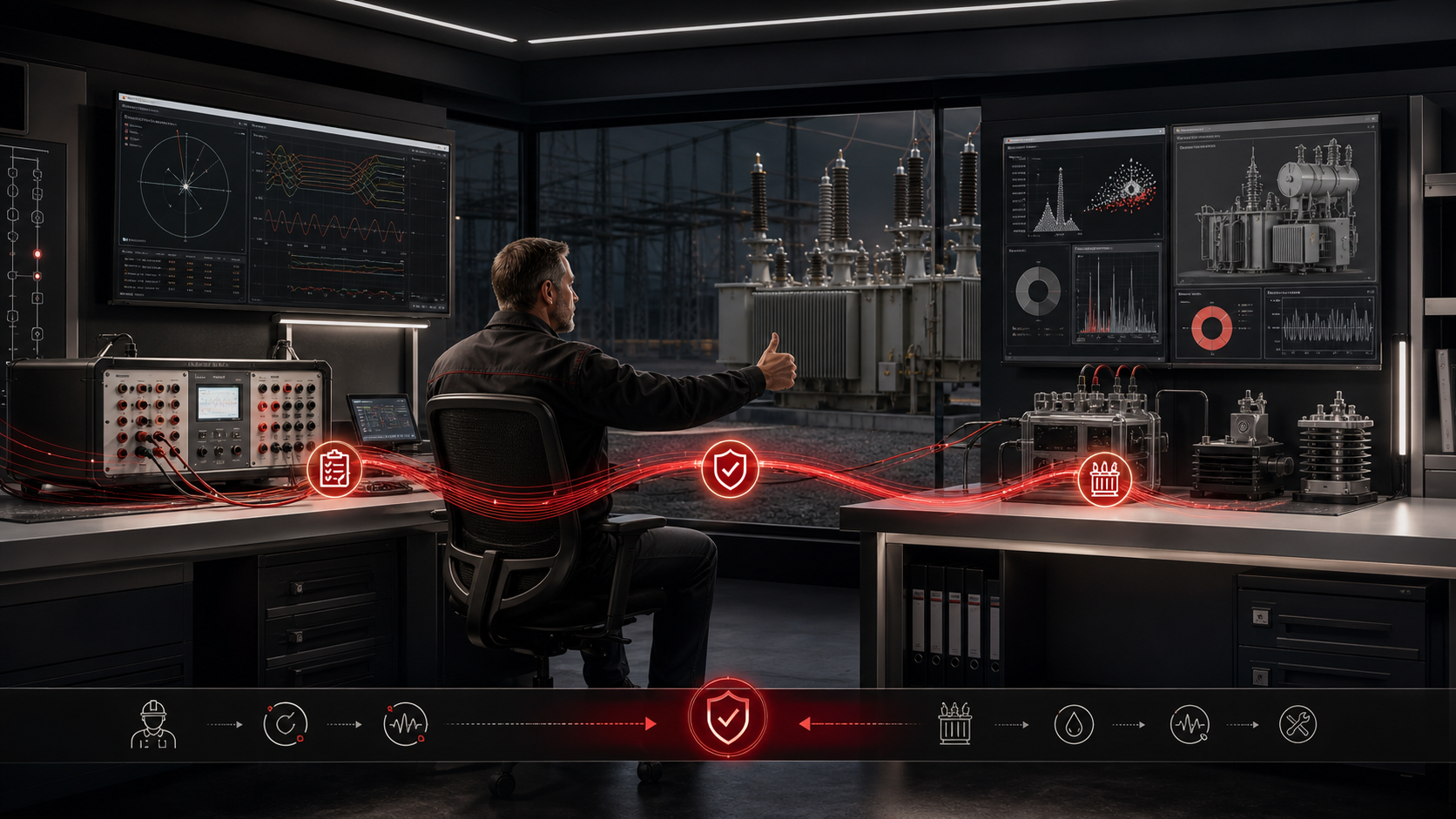
The handoff should be specified as a record contract in the utility’s commissioning or maintenance procedure:
| Stage | ProtectionAI responsibility | AgenticGrid Pro responsibility |
|---|---|---|
| Evidence intake | Relay identity, settings version, test plan, COMTRADE/SER event files, measured values, expected values, and test report | Transformer identity, DGA, PRPD, SFRA, thermal, loading, inspection, and maintenance records |
| Engineering review | Validate the protection interpretation, test verdicts, as-found/as-left state, and any settings or coordination issue | Validate data quality, diagnostic context, contradictions, confidence, and the condition-assessment draft |
| Approved handoff | Preserve an event or test reference, asset/bay identifier, timestamps, source versions, and reviewer decision | Accept the approved reference or exported evidence as contextual input; do not reinterpret it as a relay command |
| Output | Filed relay/protection evidence and any engineer-approved corrective-action recommendation | Engineer-approved condition assessment, maintenance work package, and evidence-pack report |
The shared boundary is audit and provenance: both workflows should retain the asset identifier, source file or record, time basis, version, units, assumptions, reviewer, decision, and timestamp. A utility can link the records with a case ID or approved evidence reference. That does not claim a product-to-product connector. The products remain separately licensed, and there is no shared autonomous control path.
Commissioning workflow: prove the protection, baseline the transformer
During FAT and SAT, begin with the protection case. Freeze the one-line, CT/VT data, relay firmware, settings group, logic, SCL configuration, network assumptions, and expected operating sequence. Use IEEE C37.233 as the testing frame: verify component behaviour, then the assembled function and its communications. CIGRE TB 637 and TB 760 add the practical FAT, SAT, commissioning, IEC 61850, GOOSE, sampled-value, and maintenance-test perspective for modern PAC systems.
ProtectionAI can package the test plan and measured evidence. The commissioning team still validates wiring, signal mapping, timing, isolation, trip circuits, breaker operation, and the actual installed equipment. A simulator rehearsal can expose a wrong vector group or a stale setting before the outage; it cannot prove a physical circuit that was never energized under the approved test procedure. The IEC 61850 commissioning article gives the digital-chain detail.
In parallel, the transformer baseline belongs in AgenticGrid Pro. Load the nameplate, latest oil and DGA records, PRPD or SFRA evidence, thermal and loading context, inspection findings, and existing work history. The workbench can flag missing dates, units, or contradictory sources and draft the assessment. A qualified engineer decides whether the baseline is acceptable, requires more testing, or creates a maintenance action. The result is a condition record, not a relay setting.
Maintenance workflow: correlate, then separate decisions
After an event, ProtectionAI handles the protection evidence first: retrieve the active settings version, correlate the event record and sequence of operations, compare the observed response with the expected scheme behaviour, and preserve the test or investigation record. If the event indicates a through-fault, transformer differential concern, abnormal thermal stress, or a repeated protection issue, the engineer can reference the approved event package in the transformer review.
AgenticGrid Pro then performs its own quality-gated assessment against transformer evidence. It may produce a ranked investigation or maintenance work package, but only after engineer sign-off. The output could be an oil sample, targeted electrical test, inspection, load review, or outage task; it is not an automatic work order and it does not write to a CMMS without an explicit utility-controlled export process. This is consistent with transformer differential commissioning review and with a maintenance evidence workflow that treats the record as the deliverable.
The boundary to put in procurement documents
State the following in the pilot scope: the products have separate licences; each product has its own asset and evidence model; any cross-reference is human-mediated and export-based; no product issues switching or protection commands; no AI output is an approval; physical tests and site safety controls remain in scope; and standards references describe context, not certification. NIST SP 800-82’s OT posture supports keeping the review workflow separate from operational control, while CIGRE TB 843 reinforces lifecycle testing and re-testing when systems change or misoperate.
The reason to use both products is therefore practical. ProtectionAI keeps relay and protection evidence coherent. AgenticGrid Pro keeps transformer condition evidence coherent. A shared provenance contract lets an engineer connect the stories around one event without pretending they are the same story—or giving either product authority it does not have.
References
- GridAPM. (2026). ProtectionAI product overview. https://www.gridapm.com/products/protectionai/
- GridAPM. (2026). AgenticGrid Pro product overview. https://www.gridapm.com/products/agenticgrid-pro/
- IEEE. (2023). IEEE guide for power system protection testing (IEEE C37.233-2023). https://standards.ieee.org/ieee/C37.233/6676/
- CIGRE. (2015). Acceptance, commissioning and field testing techniques for protection and automation systems (Technical Brochure 637). https://www.e-cigre.org/publications/detail/637-acceptance-commissioning-and-field-testing-techniques-for-protection-and-automation-systems.html
- CIGRE. (2019). Test strategy for Protection, Automation and Control (PAC) functions in a fully digital substation based on IEC 61850 applications (Technical Brochure 760). https://www.e-cigre.org/publications/detail/760-test-strategy-for-protection-automation-and-control-pac-functions-in-a-fully-digital-substation-based-on-iec-61850-applications.html
- CIGRE. (2021). Life cycle testing of synchrophasor based systems used for protection, monitoring and control (Technical Brochure 843). https://www.e-cigre.org/publications/detail/843-life-cycle-testing-of-synchrophasor-based-systems-used-for-protection-monitoring-and-control.html
- Stouffer, K., Pease, M., Tang, C., Zimmerman, T., Pillitteri, V., Lightman, S., Hahn, A., Saravia, S., Sherule, A., & Thompson, M. (2023). Guide to operational technology (OT) security (NIST SP 800-82 Rev. 3). National Institute of Standards and Technology. https://csrc.nist.gov/pubs/sp/800/82/r3/final
- U.S. Bureau of Reclamation. (2022). Management of protective relay settings (FIST Volume 6-4). https://www.usbr.gov/power/data/fist/FIST_6-4_%281-2022%29.pdf
References
- GridAPM — ProtectionAI product overview
- GridAPM — AgenticGrid Pro product overview
- IEEE C37.233 IEEE C37.233-2023 — IEEE Guide for Power System Protection Testing
- CIGRE Technical Brochure 637 — Acceptance, Commissioning and Field Testing Techniques for Protection and Automation Systems
- CIGRE Technical Brochure 760 — Test Strategy for PAC Functions in a Fully Digital Substation
- CIGRE Technical Brochure 843 — Life Cycle Testing of Synchrophasor Based Systems
- NIST SP 800-82 Rev. 3 — Guide to Operational Technology Security
- U.S. Bureau of Reclamation FIST Volume 6-4 — Management of Protective Relay Settings
Questions engineers ask
Are ProtectionAI and AgenticGrid Pro one integrated product?
No. They are separate licensed products for different engineering work. A utility may use an approved export or evidence reference across its own workflow, but there is no implied shared database, live connector, or autonomous command path between them.
What does each product handle?
ProtectionAI handles relay and protection test planning, event evidence, settings evidence, deterministic test results, and test reporting. AgenticGrid Pro handles transformer diagnostic evidence, condition assessment, engineer sign-off, and maintenance work packages.
Can either product operate substation equipment automatically?
No. Both products are decision-support workspaces. Commissioning still requires qualified personnel, approved procedures, isolation controls, and physical test equipment where applicable; final decisions and OT actions remain engineer-approved.