ProtectionAI for Utility Event Review: A Bounded Workflow for Disturbance Records
How a utility can use ProtectionAI and a human-reviewed AI workflow to triage disturbance records, reconstruct protection sequences, identify evidence gaps, and plan follow-up tests without treating a model as the final authority.
On this page
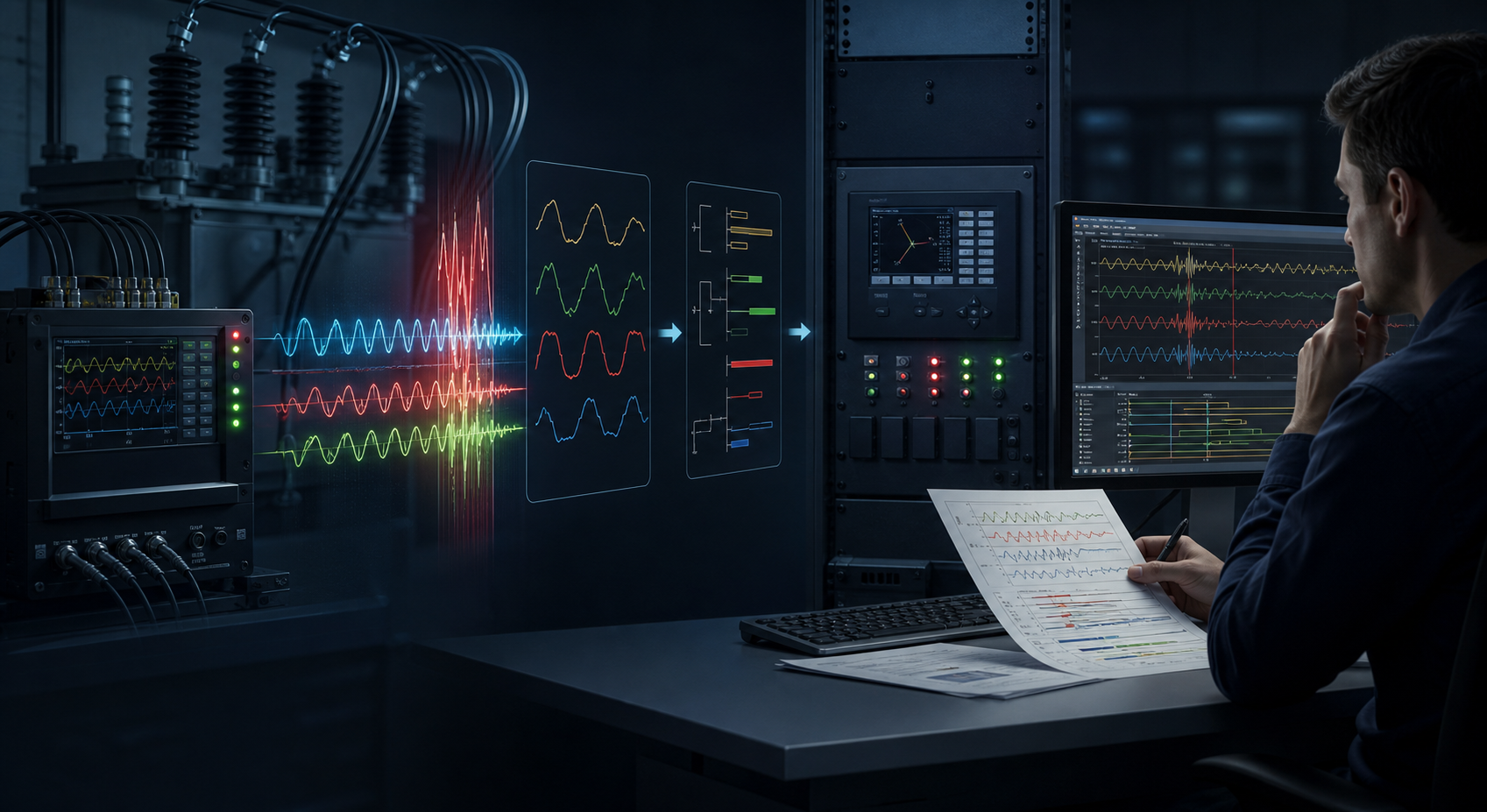
Utility event review is where protection evidence becomes an engineering decision. The raw material is familiar—COMTRADE files, sequence-of-events records, relay targets, settings, breaker states, PMU or SCADA context—but the workload grows quickly when records arrive from many vendors and time bases. ProtectionAI can make the packet easier to assemble and compare. The boundary is that an AI draft remains a draft until a qualified engineer validates the evidence and records the disposition.
A six-stage review workflow
1. Preserve and identify the case
Assign a case ID and preserve the original disturbance records without editing them. Record the source system, collection time, device name, firmware, file names, export options, and collector. Keep the COMTRADE configuration and data together, and retain any header or information file that explains the event. IEC 60255-24 standardizes the exchange format; it does not validate the source recorder, channel map, or timestamp.
Include the study-case version, topology, settings group, and event window. A useful record says “relay A, setting group 2, firmware 7.4, event at 14:32:10 UTC” rather than “line relay tripped.” Identity is the foundation for every later comparison.
2. Run a quality gate before interpretation
Check the sample rate, nominal frequency, channel scaling, polarity, phase labels, CT and VT ratios, filtering, pre-fault duration, clipping, missing samples, and time source. Compare the event clock with breaker and station sequence-of-events clocks. If clocks disagree, preserve the disagreement and quantify the uncertainty. Do not shift a file silently to make the traces line up.
The quality gate should classify each field as verified, plausible, missing, conflicting, or not applicable. A missing time reference is not a minor note if the review depends on operate time or inter-device sequence. A COMTRADE waveform with an unknown scale factor cannot be used as if it were a calibrated measurement.
3. Reconstruct the observed sequence
Build an event timeline from observations first: disturbance onset, element pickup, logic assertion, communications signal, trip output, breaker movement, current interruption, reclose, lockout, and restoration. Add inverter or plant-controller state changes where the asset is an IBR. Separate observed facts from calculated quantities and engineering hypotheses.
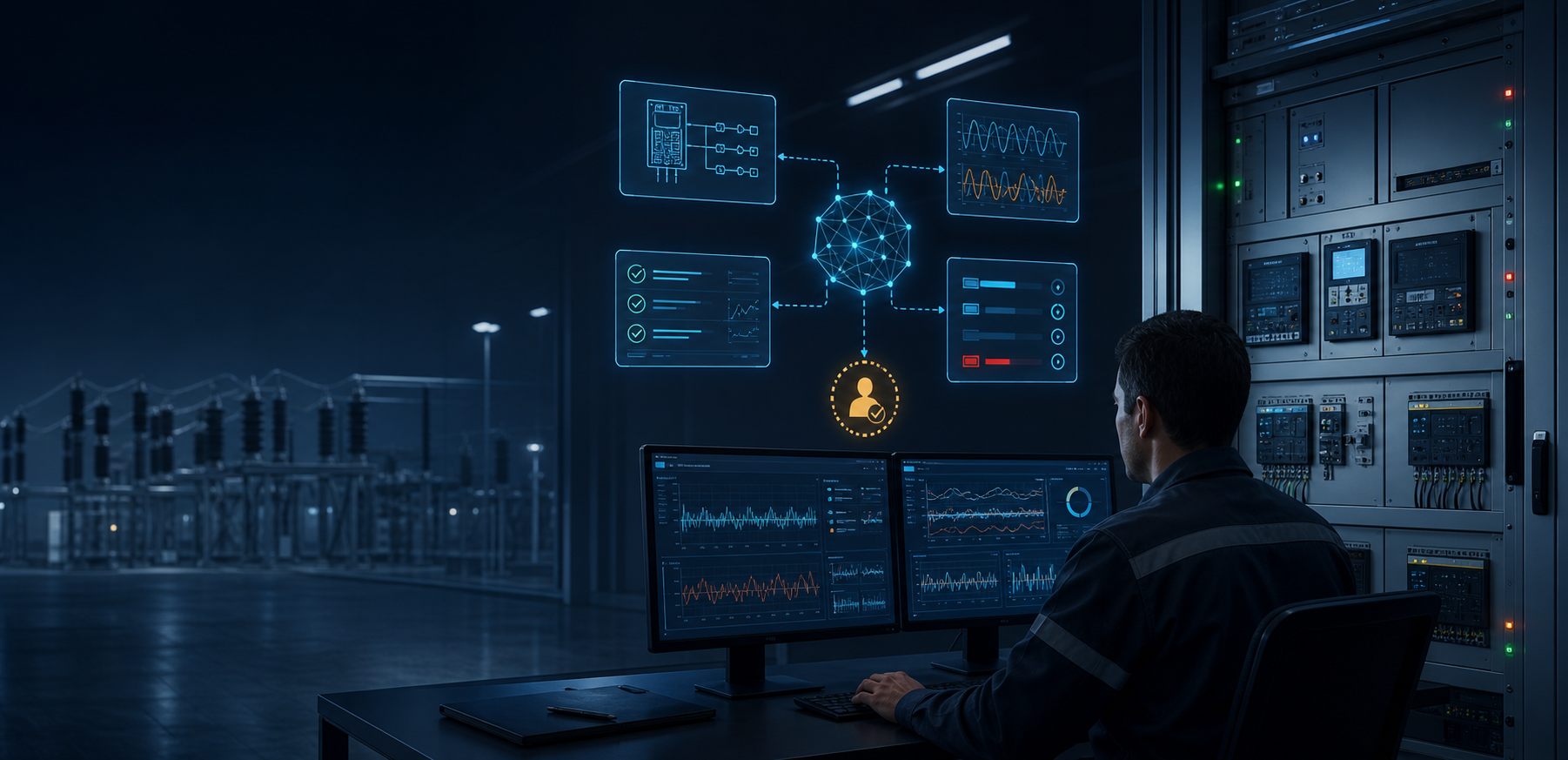
This is where a bounded AI assistant is useful. It can extract device names, map repeated labels, find a settings version in the evidence bundle, summarize the sequence, and identify missing records. It can also place the same event in a queue with other events for human triage. CIGRE TB 946’s operational perspective is relevant here: AI/ML can support decision-making, but the operational context, data requirements, risks, and human role remain part of the deployment.
4. Compare the event with the approved expectation
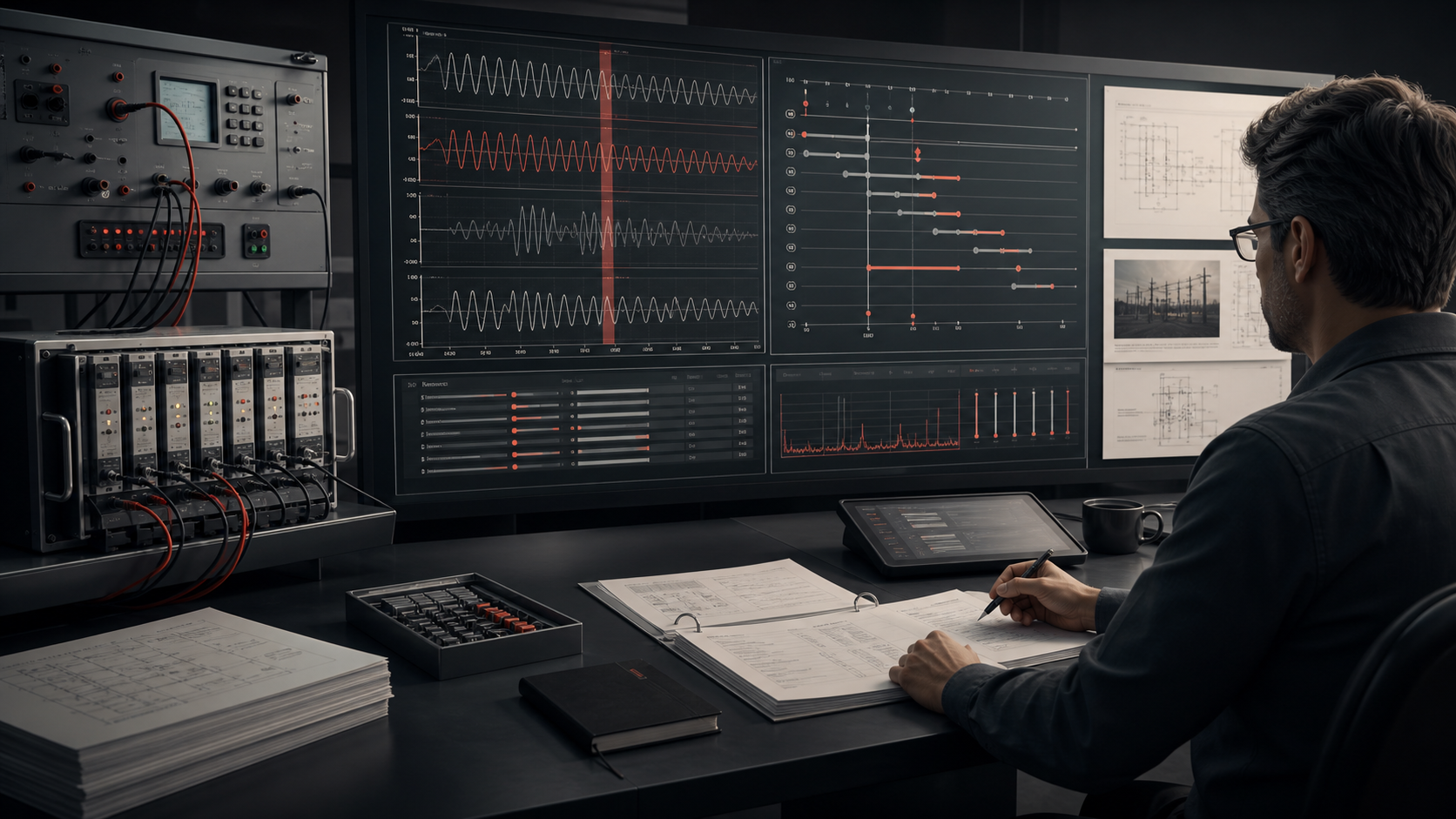
The engineer supplies the reference behaviour: the protection study, coordination intent, active settings, logic diagram, communication scheme, and expected clearing sequence. Compare the observed and expected records element by element. For example, a distance element may assert in the expected zone but trip too slowly; a differential element may remain restrained; a breaker may open after a correct trip output; or a communications channel may fail to provide permission.
Use deterministic calculations for the comparison. ProtectionAI is bounded as a relay/protection evidence workspace: it can help handle settings and event records, build a reproduction or follow-up test plan, calculate expected results, and draft the report. It is not an authority that converts a language model’s confidence into a pass/fail verdict. COMTRADE event analysis is strongest when the raw record and the derived chart remain side by side.
5. Classify the disposition, including “not yet determined”
The review should end with a controlled classification such as correct operation, incorrect operation, delayed operation, failure to operate, unwanted operation, external cause, device or circuit issue, communications issue, model mismatch, or insufficient evidence. The category is not the root cause; it tells the next reviewer what work remains.
NERC PRC-004-6 supplies the misoperation-identification and correction context, while PRC-027-1 supplies the protection-coordination context. A responsible record includes the evidence supporting the classification, the missing evidence, corrective-action owner, due date, and approval. If the cause is not proven, say so.
6. Convert the decision into a test or maintenance action
The next action may be a simulator reproduction, a settings comparison, a CT/VT inspection, a communication test, an end-to-end test, a field retest, model validation, or a transformer condition review. The action should reference the case ID and the exact evidence that caused it.
If the event points to transformer stress or a diagnostic question, an engineer can transfer an approved event reference into AgenticGrid Pro as context for DGA, PRPD, SFRA, thermal, loading, and inspection evidence. AgenticGrid Pro’s output is a condition assessment and, after engineer approval, a maintenance work package. It does not change relay settings or issue a control command.
How to govern the pilot
Set a small review scope first: one event class, a known set of record formats, and a reviewer who can inspect the raw files. Keep original records outside the model prompt where possible and expose only the minimum evidence needed for the draft. Record the model/provider version, prompt or workflow version, sources retrieved, draft output, reviewer edits, final decision, and unresolved gaps. NIST AI RMF provides a useful Govern–Map–Measure–Manage structure; NIST SP 800-82 provides the OT security context for keeping the review path distinct from control systems.
Measure whether the workflow produces more complete packets and more reproducible decisions, not whether it sounds confident. A useful pilot can reduce clerical rework while still finding that the event is undetermined. That is a sign the gate is working, not a product failure.
References
- IEEE Power & Energy Society, Power System Relaying and Control Committee. (2023). Practical applications of artificial intelligence / machine learning in power system protection and control (PSRC Working Group C43 report). https://www.pes-psrc.org/kb/report/117.pdf
- IEEE. (2023). IEEE guide for power system protection testing (IEEE C37.233-2023). https://standards.ieee.org/ieee/C37.233/6676/
- International Electrotechnical Commission. (2013). IEC 60255-24: Measuring relays and protection equipment—Part 24: Common format for transient data exchange (COMTRADE) for power systems. https://webstore.iec.ch/en/publication/1170
- CIGRE. (2024). The impact of the growing use of machine learning/artificial intelligence in the operation and control of power networks from an operational perspective (Technical Brochure 946). https://www.e-cigre.org/publications/detail/946-the-impact-of-the-growing-use-of-machine-learningartificial-intelligence-in-the-operation-and-control-of-power-networks-from-an-operational-perspective.html
- North American Electric Reliability Corporation. (2020). PRC-004-6: Protection system misoperation identification and correction. https://www.nerc.com/standards/reliability-standards/prc/prc-004-6
- North American Electric Reliability Corporation. (n.d.). PRC-027-1: Coordination of protection systems for performance during faults. https://www.nerc.com/standards/reliability-standards/prc/prc-027-1
- Oelhaf, J., Kordowich, G., Pashaei, M., Bergler, C., Maier, A., Jäger, J., & Bayer, S. (2025). A scoping review of machine learning applications in power system protection and disturbance management. International Journal of Electrical Power & Energy Systems, 172, 111257. https://doi.org/10.1016/j.ijepes.2025.111257
- Tabassi, E. (2023). Artificial intelligence risk management framework (AI RMF 1.0) (NIST AI 100-1). National Institute of Standards and Technology. https://doi.org/10.6028/NIST.AI.100-1
- Stouffer, K., Pease, M., Tang, C., Zimmerman, T., Pillitteri, V., Lightman, S., Hahn, A., Saravia, S., Sherule, A., & Thompson, M. (2023). Guide to operational technology (OT) security (NIST SP 800-82 Rev. 3). National Institute of Standards and Technology. https://csrc.nist.gov/pubs/sp/800/82/r3/final
References
- IEEE PES PSRC C43 — Practical Applications of Artificial Intelligence / Machine Learning in Power System Protection and Control
- IEEE C37.233 IEEE C37.233-2023 — IEEE Guide for Power System Protection Testing
- IEC 60255-24 IEC 60255-24:2013 — Common Format for Transient Data Exchange (COMTRADE)
- CIGRE Technical Brochure 946 — The Impact of Machine Learning/Artificial Intelligence in the Operation and Control of Power Networks
- NERC PRC-004 NERC PRC-004-6 — Protection System Misoperation Identification and Correction
- NERC PRC-027 NERC PRC-027-1 — Coordination of Protection Systems for Performance During Faults
- NIST AI RMF NIST AI Risk Management Framework 1.0
- A scoping review of machine learning applications in power system protection and disturbance management
Questions engineers ask
What can ProtectionAI do in a utility event review?
ProtectionAI can support settings and event-evidence retrieval, disturbance-record handling, deterministic comparisons, reproduction or follow-up test planning, and report drafting. The exact physical and network integration boundary must be checked against the current product capability page and the utility's qualification process.
What should an AI event-review workflow never do?
It should not overwrite original records, invent missing channels, declare a misoperation from incomplete evidence, change relay settings, authorize energization, issue a trip or switching command, or replace the engineer's final disposition.
How should a utility measure an AI event-review pilot?
Measure evidence completeness, time to a review-ready packet, unresolved evidence gaps, agreement between AI drafts and engineer dispositions, repeat-analysis rate, and corrective-action traceability. Do not treat a pilot as proof of savings or improved reliability without utility-specific evidence.