Common OMICRON Test Universe Workflow Bottlenecks—and How to Remove Rework
Where protection teams lose time around Test Universe workflows—and how evidence pre-flight, case coverage, and review discipline reduce rework.

On this page
OMICRON Test Universe is a mature modular environment, so the most useful article should not attack it or imply that an AI layer makes it obsolete. The useful question is where a protection team loses time before, between, and after the modules run.
The recurring bottlenecks
Teams commonly discover that the plan has the wrong relay model, an outdated firmware assumption, incomplete binary mapping, or a missing settings export. A copied template may carry the previous asset identity or a tolerance convention that no longer matches the procedure. During reporting, a result may be technically correct but difficult to retrieve with the settings checksum, calibration record, raw trace, and reviewer decision attached.
The remedy is a pre-flight checklist:
- asset, serial, firmware, and setting group;
- approved procedure and acceptance criteria;
- test-set model, calibration, and accessories;
- settings import and mapping review;
- binary and communication map;
- test-case coverage and excluded cases;
- raw-file and report naming;
- as-found/as-left and deviation handling.
Where an agent helps
An agentic assistant can read the approved work order and settings package, retrieve the relevant manual passage, compare the test plan with the asset, and return an exception list. It can draft the report narrative from actual module results and preserve the question that remains open.
The assistant should not bypass the CMC safety workflow or silently edit the test plan. The test-set manufacturer’s qualified module remains authoritative for the physical operation. If the assistant proposes a change, the engineer should see the before/after value and approve it under the local procedure.
ProtectionAI’s role
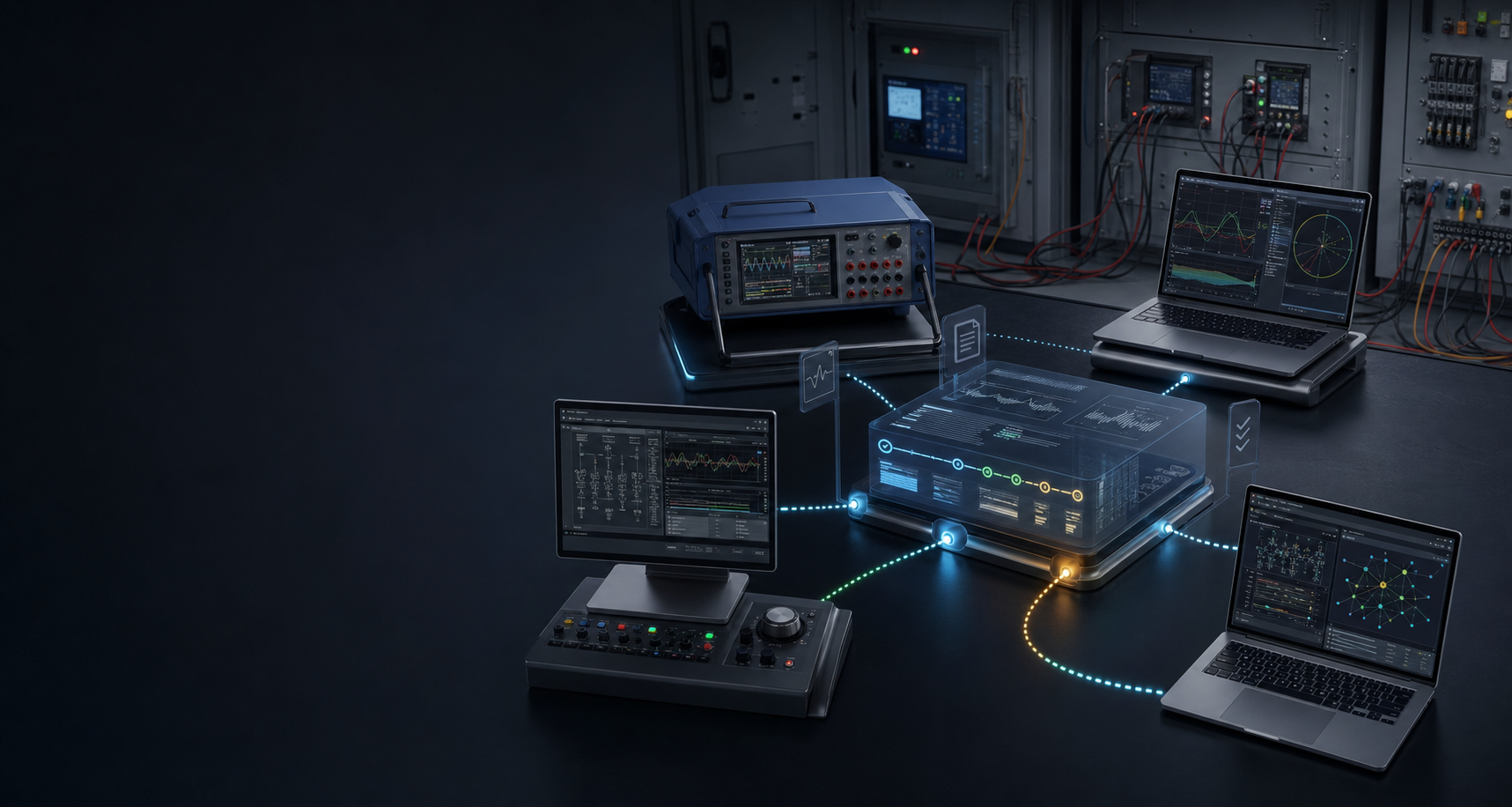
ProtectionAI can complement a hardware-linked suite by preparing and reviewing the context before the technician opens the test window. Published product limitations must remain visible: simulator-first workflows and any physical OMICRON I/O path are different validation scopes.
Separate the four moments of the job
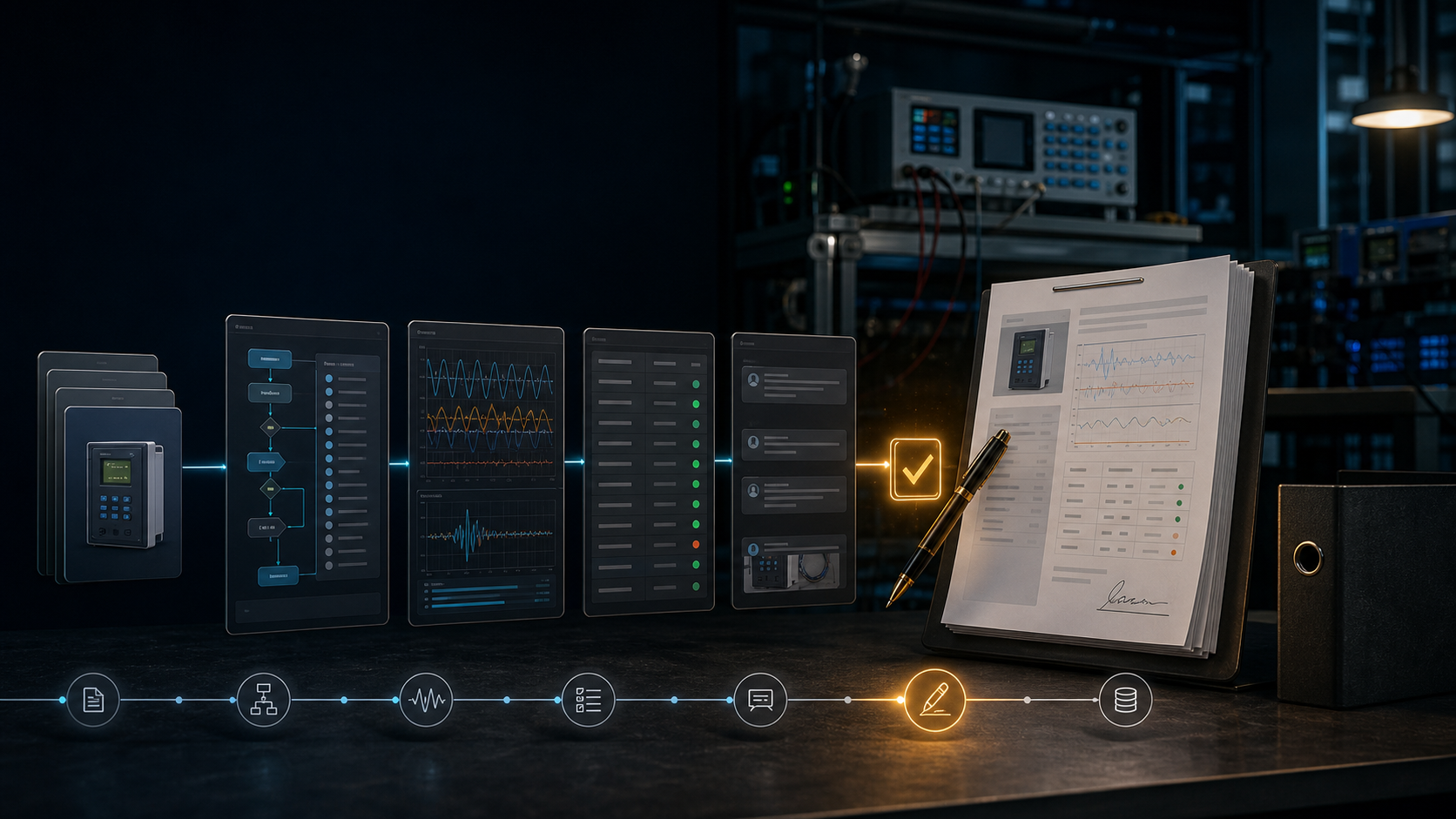
Most rework happens before the test set is connected, between two modules, or during report review. A useful checklist therefore has four moments: pre-flight, execution, exception handling, and closeout. Pre-flight verifies asset identity, relay model, firmware, settings group, procedure, calibration, and expected cases. Execution records what the module actually injected and which contacts or protocol responses were observed. Exception handling preserves the failed case and the engineer’s reasoning instead of overwriting it. Closeout links the raw result, report, deviations, as-left settings, and sign-off.
For a modular environment, the handoff between modules deserves explicit testing. Check that a copied template does not retain the previous asset’s identifiers, that imported XRIO/RIO data maps to the correct relay, and that a change to a tolerance is visible in the final report. If an assistant proposes a change, show a before-and-after diff and require approval. “Automation” should remove retyping, not remove review.
A safe agentic pattern
Let the assistant read an approved work order and a bounded evidence package. Ask it for an exception list: missing input, conflicting setting, uncovered function, stale manual, or unexplained result. Require each item to cite its source file and row or section. Do not give it credentials that can change the test-set configuration or publish substation traffic. If later integrations are qualified, add one allow-listed capability at a time and test the audit trail and rollback.
The case for ProtectionAI is strongest when it complements Test Universe rather than competing with it: simulator-first rehearsal, context assembly, and evidence review can be evaluated before any physical I/O claim is made.
References
- OMICRON. (n.d.). Test Universe [Product page]. https://www.omicronenergy.com/en/products/test-universe/
- OMICRON. (n.d.). CMC 356 [Product page]. https://www.omicronenergy.com/products/cmc-356/
- IEEE Power System Relaying and Control Committee, Working Group I-25. (2017). Commissioning testing of protection systems. https://www.pes-psrc.org/kb/report/052.pdf
- CIGRE Working Group B5.45. (2015). Acceptance, commissioning and field testing techniques for protection and automation systems (Technical Brochure No. 637). https://www.e-cigre.org/publications/detail/637-acceptance-commissioning-and-field-testing-techniques-for-protection-and-automation-systems.html
References
Questions engineers ask
What are common relay-test workflow bottlenecks?
Wrong relay model or firmware, stale copied templates, incomplete binary mapping, missing settings exports, unclear tolerance conventions, and reports detached from raw evidence are common sources of rework.
Does an AI layer make Test Universe obsolete?
No. The useful boundary is complementary: the vendor software remains hardware-bound and execution-authoritative while an evidence layer helps prepare, compare, and review context.
What should a pre-flight catch?
It should catch asset identity, settings revision, firmware, calibration, channel mapping, case coverage, expected values, procedure version, and missing raw-file or reviewer requirements.