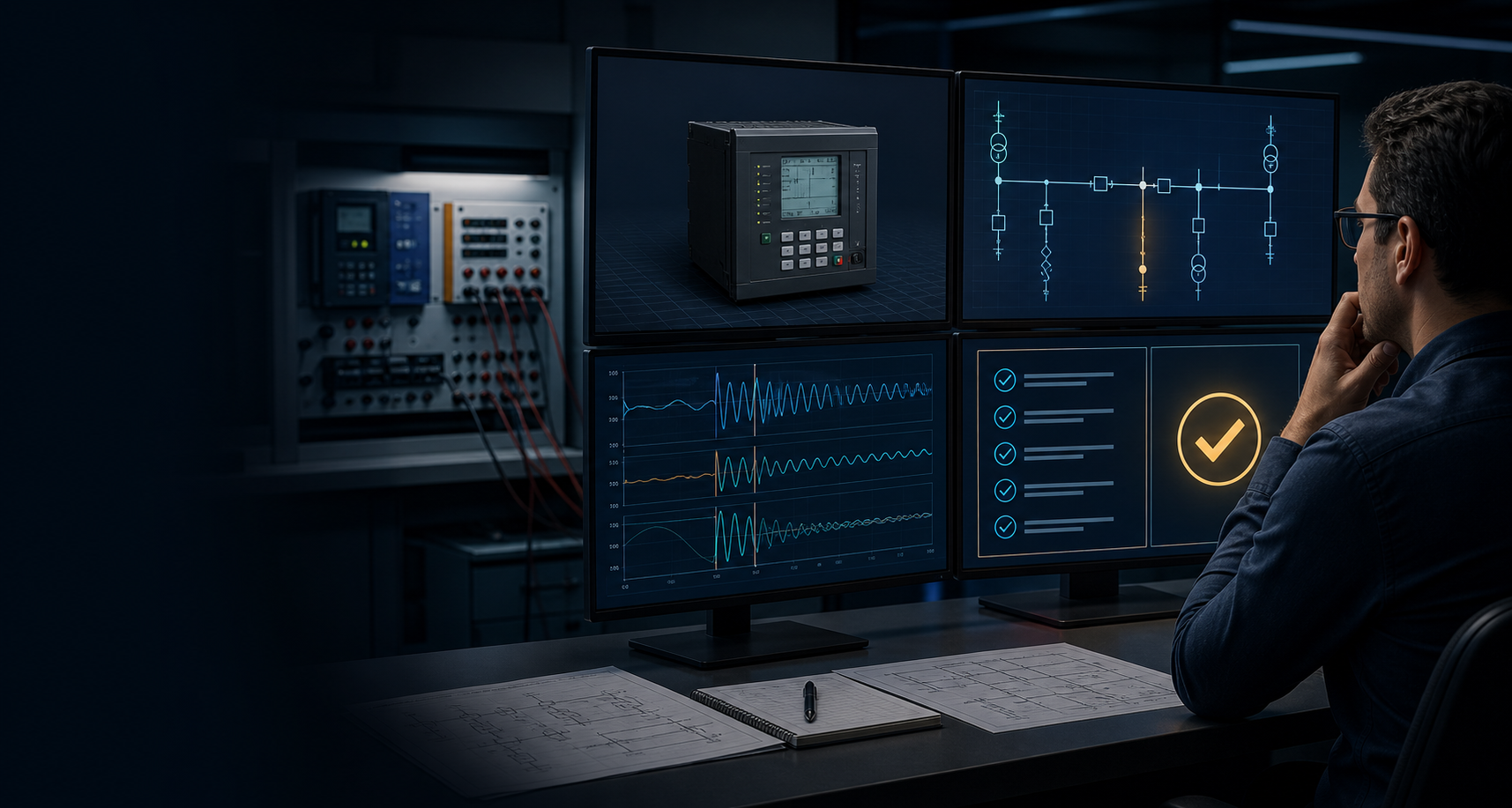
How to Choose a Relay Test Set for Commissioning and Maintenance
A vendor-neutral engineering framework for selecting relay test equipment based on channels, output capability, binary I/O, timing, communications, portability, safety, and evidence.
On this page
Choosing relay test equipment by brand or channel count alone is a procurement shortcut. The engineering question is whether the complete test system can reproduce the cases your protection programme needs, connect to the defined boundary safely, measure the required response, and leave an evidence trail.
Start with the test catalogue
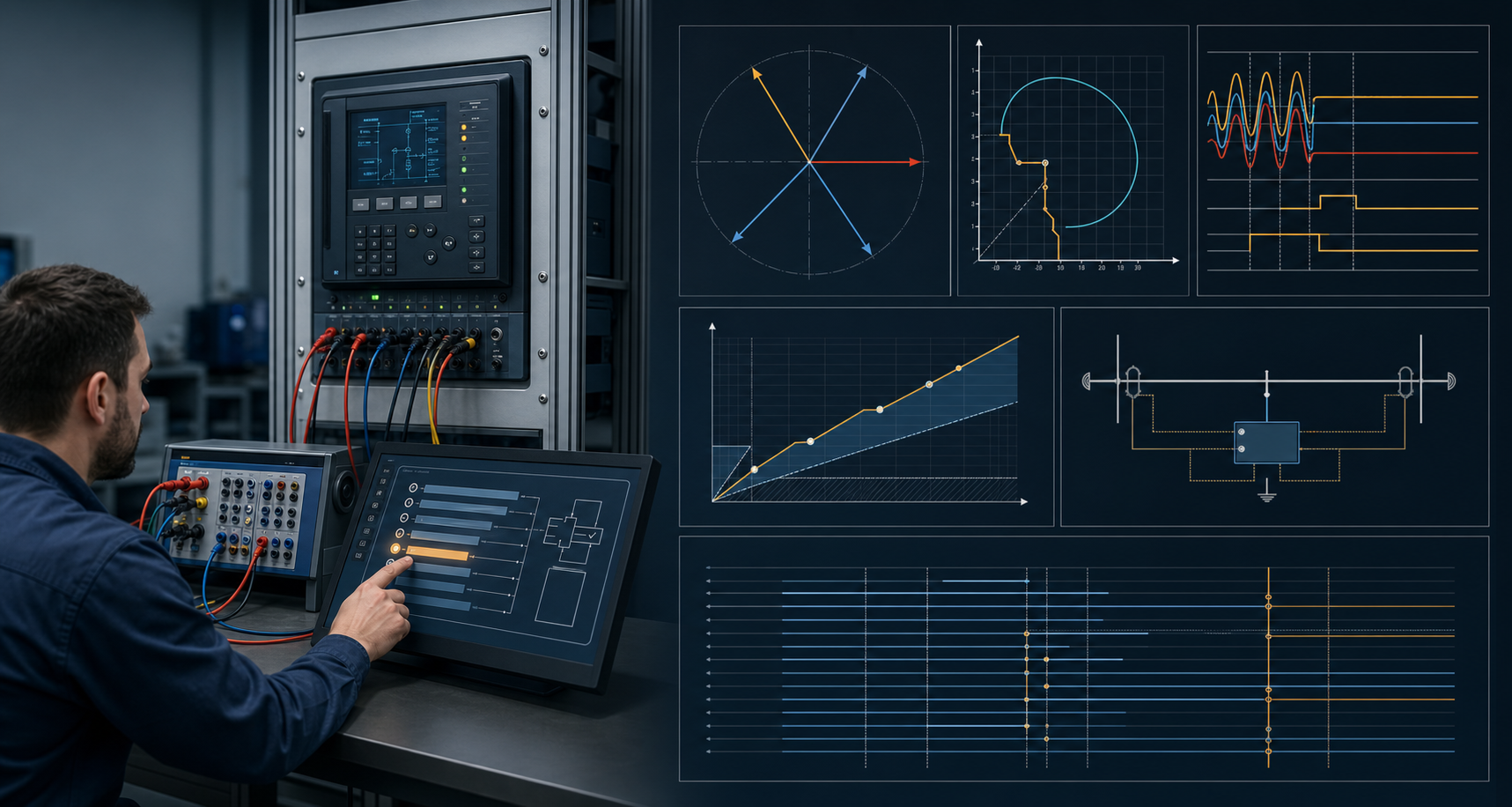
Inventory the protection functions and schemes: overcurrent, distance, differential, breaker failure, autoreclose, synchronism check, busbar, line communications, GOOSE, sampled values, and event playback where relevant. For each, record current and voltage channels, phase relationships, frequency or transient behavior, binary inputs and outputs, time reference, and expected evidence.
The catalogue prevents buying a test set for a nominal relay element and discovering later that the commissioning scope requires system-level or communications-assisted cases.
Electrical capability
Review the actual output ranges, compliance and burden capability, resolution, accuracy, phase control, frequency range, transient behavior, and simultaneous output requirements against the cases. For primary injection, the source and safety boundary are different from relay-terminal secondary injection. Do not infer one from the other.
Ask for documented limits under the load and waveform conditions used by the procedure. A headline output value without the associated compliance or accuracy context is not an engineering comparison.
Binary, timing, and synchronization
Protection tests often depend on binary states and sequence timing as much as on analog values. Check input and output count, isolation, debounce or threshold behavior, timestamp resolution, triggering, pre-trigger capture, external synchronization, and the ability to correlate multiple devices.
For end-to-end or digital-substation cases, define the time source and the evidence required to prove the sequence. If the test set cannot show its timing assumptions, the report needs an explicit limitation.
Digital and data interfaces
If the programme includes GOOSE, sampled values, or SCL, verify the exact service and profile required. IEC 61850 support is not a single feature: the workflow may need configuration import, message generation or subscription, quality handling, timing, network connection, packet evidence, and application-level response.
Also check COMTRADE import and export, RIO or equivalent settings exchange where relevant, API or file portability, and whether raw data can be retained outside the vendor database.
Field usability and safety
Consider weight, power, isolation, connection accessories, test-switch support, environmental limits, transport, local service, calibration, training, and the procedure for connecting to a panel. A test set that is powerful but awkward or unsafe for the field context can increase rather than reduce risk.
Ask how a technician prevents the wrong asset, setting group, or output channel from being selected. The user interface and evidence workflow are part of the control system.
Evidence and lifecycle
The report should retain the asset identity, settings, procedure, expected values, measured values, tolerances, raw traces, binary evidence, deviations, as-found/as-left state, and reviewer. Exportability matters when equipment is replaced or a utility needs to retrieve records years later.
ProtectionAI can sit above test equipment as an evidence and planning layer. It should not imply that it drives hardware it does not control. The equipment and the assistant must each state their actual boundary.
References
- Institute of Electrical and Electronics Engineers. (2023). IEEE guide for power system protection testing (IEEE Std C37.233-2023). https://standards.ieee.org/ieee/C37.233/6676/
- IEEE Power & Energy Society. (n.d.). Relaying performance testing. https://resourcecenter.ieee-pes.org/publications/technical-reports/pestr4
- International Electrotechnical Commission. (2025). Measuring relays and protection equipment—Part 216-1: Digital interfaces for protection functions (IEC TS 60255-216-1:2025). https://webstore.iec.ch/en/publication/77735
- International Electrotechnical Commission. (2022). Communication networks and systems for power utility automation—Part 10-3: Functional testing of IEC 61850 systems (IEC TR 61850-10-3:2022). https://webstore.iec.ch/en/publication/61395
- CIGRE Working Group B5.45. (2015). Acceptance, commissioning and field testing techniques for protection and automation systems (Technical Brochure No. 637). https://www.e-cigre.org/publications/detail/637-acceptance-commissioning-and-field-testing-techniques-for-protection-and-automation-systems.html
References
- IEEE C37.233 IEEE C37.233-2023 — Guide for Power System Protection Testing
- IEEE PES Relaying Performance Testing
- IEC TS 60255-216-1:2025 — Digital interfaces for protection functions
- IEC 61850 IEC TR 61850-10-3:2022 — Functional testing of IEC 61850 systems
- CIGRE Technical Brochure 637 — Acceptance, commissioning, and field testing
Questions engineers ask
What is the most important relay test-set specification?
The most important specification is the capability required by the protection cases in scope: output channels, electrical range and compliance, binary I/O, timing, synchronization, communications, and safe connection—not a single headline rating.
Do all test sets support the same relay functions?
No. Test capability depends on the hardware, software, templates, communications profile, and the procedure. Confirm the complete workflow against representative cases.
Should reporting influence the equipment decision?
Yes. A technically capable test set that cannot retain raw evidence, settings context, expected values, deviations, and review history may create avoidable lifecycle work.