AI-Assisted Protection Engineering Workflows: From Study Case to Engineer-Approved Test Evidence
A bounded workflow for using AI to assemble protection studies, plan relay tests, correlate event evidence, and produce engineer-approved records without handing operational authority to a model.
On this page
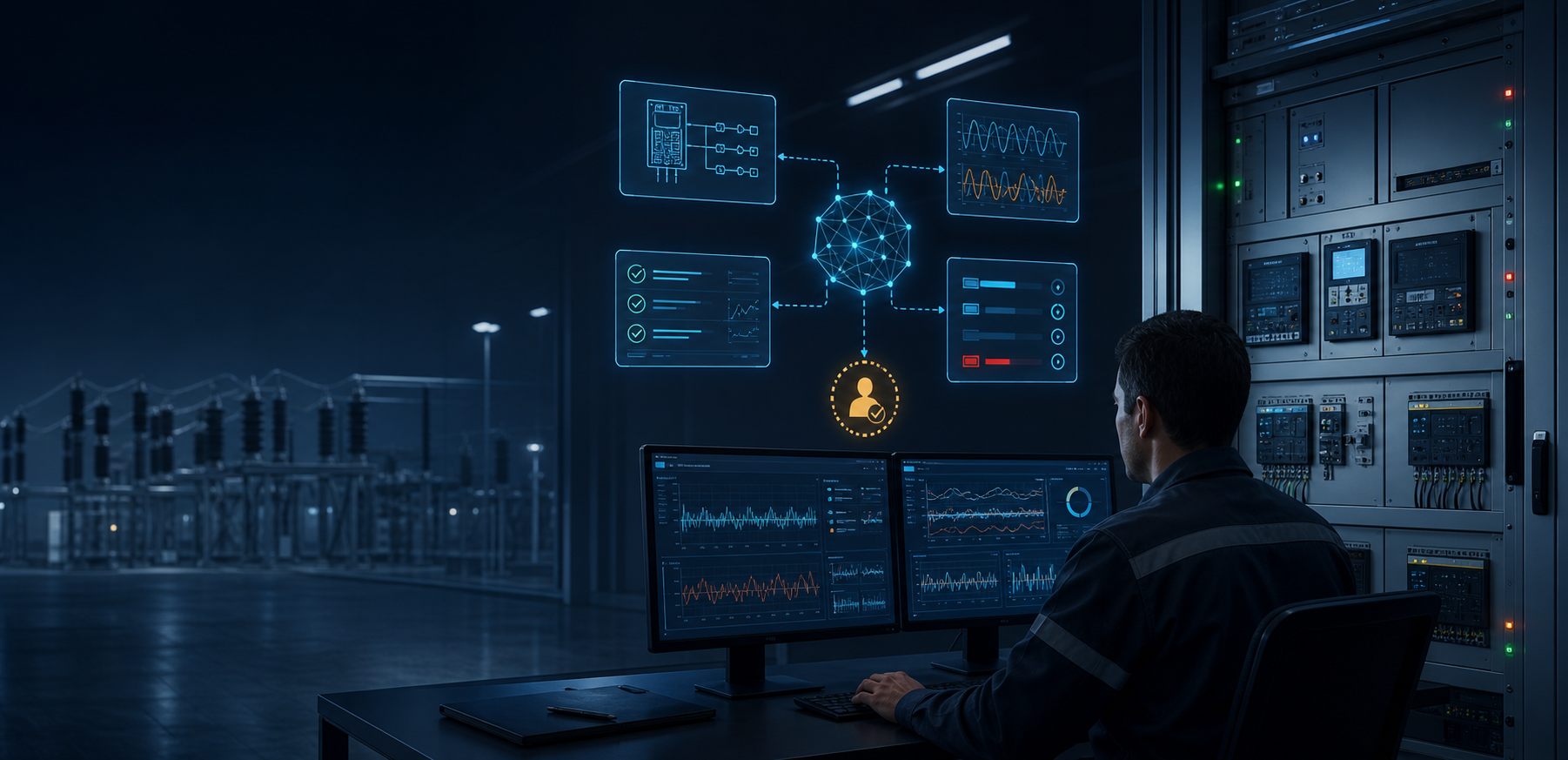
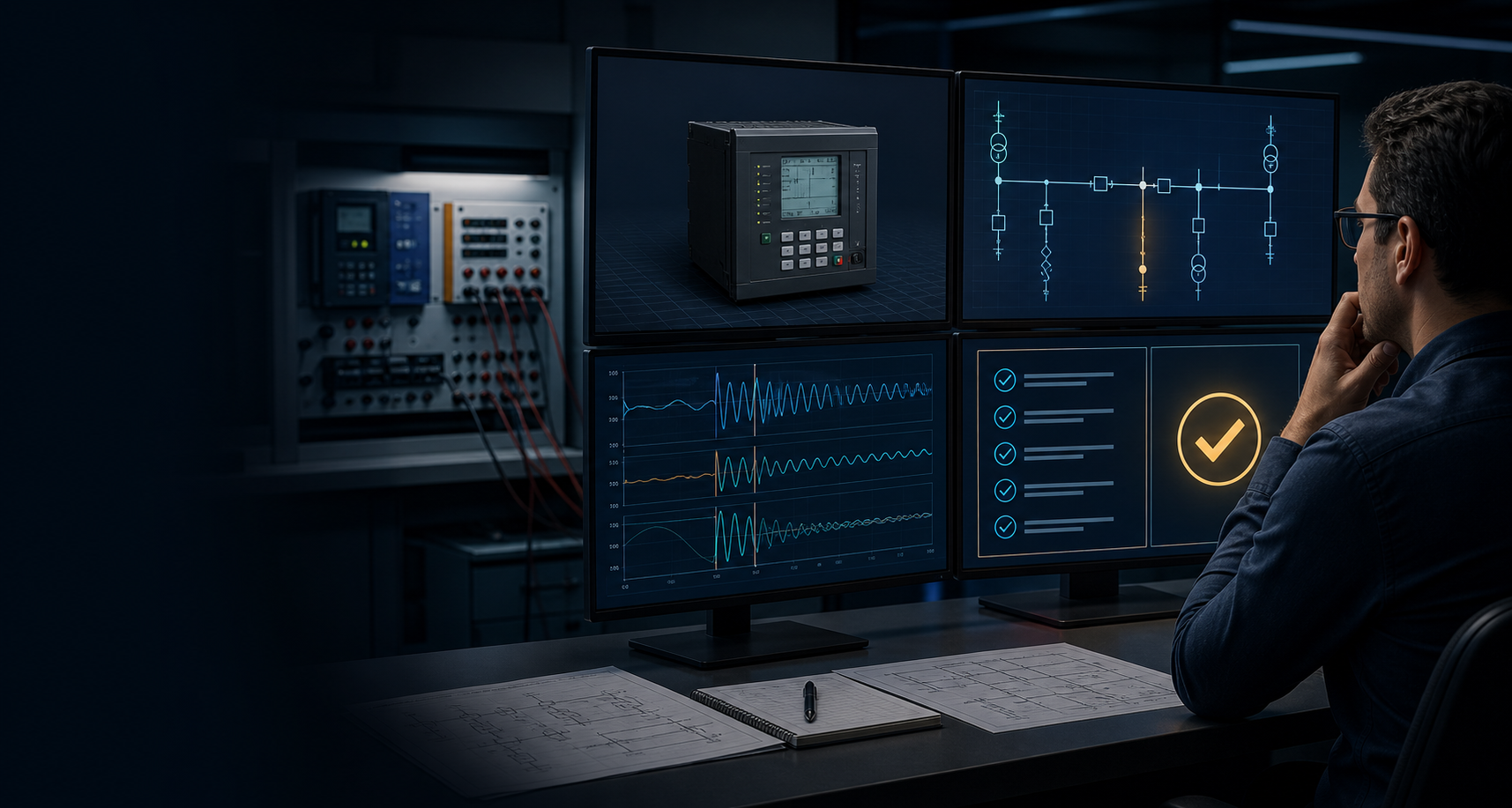
Protection engineering has a strong candidate for bounded AI assistance: the work around the calculation. A model can collect study inputs, identify a missing CT ratio, draft a sequence of relay tests, and assemble a record for review. It should not become the protection authority. The engineer-approved workflow is the product: the reasoning is traceable, the arithmetic is deterministic, the test is performed under the site’s controls, and the final record names who accepted it.
The workflow contract
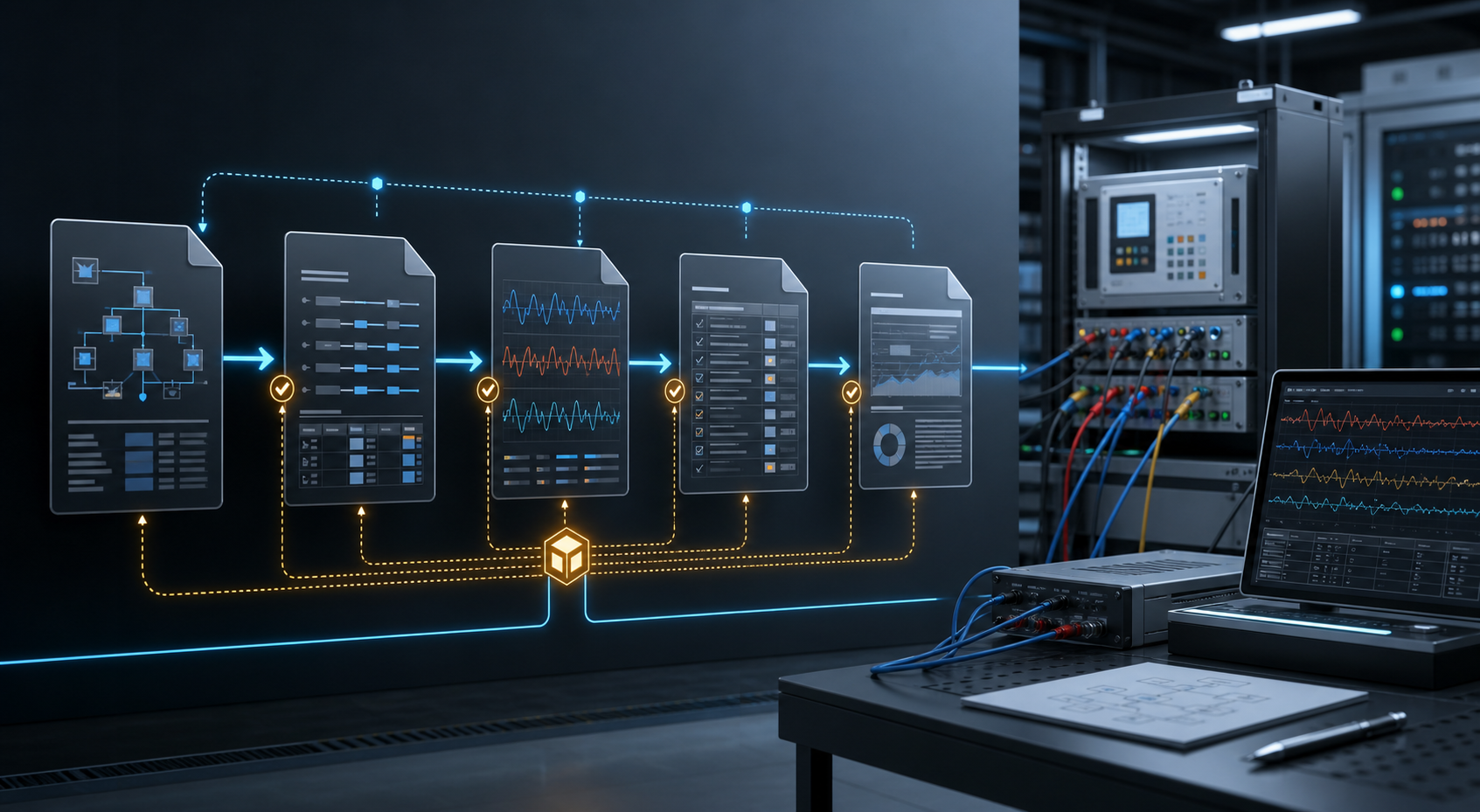
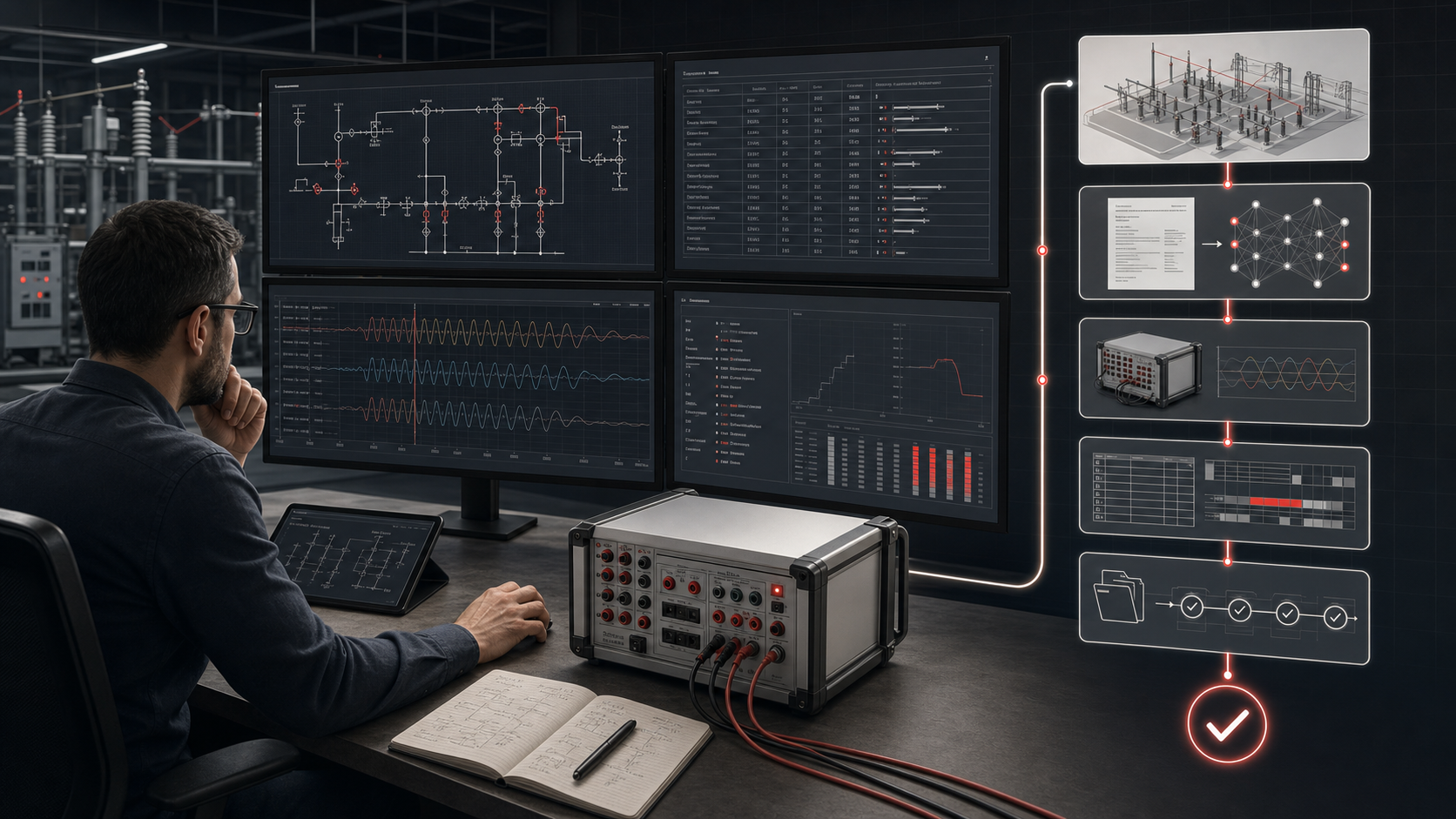
Use a six-stage contract: study case, test plan, expected values, execution, evidence review, and approval. The IEEE C37.233 Guide for Power System Protection Testing describes a bottom-up path from component behaviour to interconnected, function-oriented protection testing. The AI layer can help move information between those stages, but it must not collapse them into one opaque answer.
The IEEE PES PSRC C43 report is useful for setting expectations. It discusses data types, post-event analysis, validation, field implementation, and acceptance criteria for AI/ML in protection and control. That is a better deployment model than asking a general-purpose model to declare a relay “healthy” from a screenshot.
1. Freeze the study case before asking for a plan
Start with a case identifier and a frozen input bundle: one-line topology, short-circuit model, CT and VT data, transformer vector group where applicable, relay model and firmware, active setting group, logic diagrams, communication map, breaker data, station configuration files, and the approved protection settings. Add the operating scenario, fault locations, prefault load, grounding assumptions, and the acceptance tolerances that the engineer’s procedure requires.
The AI can compare the inventory with a checklist and call out gaps such as “relay settings supplied without firmware,” “SCL file does not match the named bay,” or “event record has no stated time reference.” It cannot infer a missing engineering value safely. A missing input becomes an explicit hold point, not a guessed default. This is also where protection-data interoperability matters: the source format, conversion step, and version should travel with the case.
2. Draft tests, then calculate expected results locally
Once the case is complete enough to proceed, let the assistant draft test objectives: pickup and timing, characteristic reach, directional polarization, differential restraint, breaker-failure logic, communications-assisted schemes, GOOSE or sampled-value paths, and the negative cases that must not operate. The engineer selects the cases and fixes the pass criteria.
Expected values should come from deterministic engineering code or an approved study tool. Curve equations, phasor transformations, sequence quantities, operate times, tolerances, and pass/fail logic should be reproducible without a language model. ProtectionAI is bounded for this role: it is a relay-testing workspace for test planning, settings records, event evidence, deterministic results, and report export; its built-in simulator is the qualified path described by the product documentation. A simulation rehearsal is valuable, but it does not turn the workstation into qualified physical test equipment. The simulator-first relay testing workflow shows how to use the rehearsal to find bad assumptions before the outage.
3. Treat digital-substation communications as a system test
For an IEC 61850 installation, the test case must include the full functional chain: SCL identity and data mapping, merging-unit inputs, sampled-value quality and time, GOOSE publisher and subscriber logic, VLAN or network assumptions, trip outputs, interlocking, and the expected response to loss or degradation of communications. IEEE PES TR84 and CIGRE TB 760 frame application testing as more than checking whether an individual IED accepts a file. The digital-substation commissioning guide is a practical companion for keeping those boundaries visible.
AI can generate a matrix of signals and missing confirmations, but a qualified test team still has to validate the installation, the timing, the network, and the physical wiring. CIGRE TB 637’s FAT, SAT, commissioning, and maintenance perspective is a useful reminder that repeatability is a process property, not a feature of a chat interface.
4. Make evidence review a real gate
The evidence pack should let a second engineer reconstruct the test: approved settings version, as-found and as-left records, test-set identity and calibration status, injected quantities, measured values, expected values, tolerance basis, binary transitions, event timestamps, failures and retests, operator identity, and the final disposition. A report that says “passed” without the underlying values is a summary, not evidence. The relay-test evidence trail explains why the record should be created during the session rather than rebuilt from memory.
The AI may draft a narrative or rank questions for the reviewer. Deterministic code owns the verdict. The engineer checks the source files, the scenario, the calculated expectation, the physical result, and the safety status before approving. Any output path that could energize a circuit requires the site’s isolation confirmation and explicit human action; it is not an implicit consequence of an AI recommendation.
5. Feed lessons back into maintenance without changing settings automatically
After commissioning, event review and maintenance should update the evidence set, not silently rewrite the baseline. A trip can trigger a new study case, a settings comparison, a targeted retest, a communication check, or a review of the protection coordination. In the context of NERC PRC-004-6 and PRC-027-1, the record should preserve the misoperation analysis, the coordination basis, the corrective action, and the approval trail. The AI copilot boundary is the right mental model: AI drafts and retrieves; the protection engineer decides.
The durable pattern is simple: freeze the case, expose uncertainty, calculate locally, test the real system under procedure, preserve measured evidence, and require named approval. That is how AI becomes useful to protection engineering without becoming an unreviewable control path.
References
- IEEE Power & Energy Society, Power System Relaying and Control Committee. (2023). Practical applications of artificial intelligence / machine learning in power system protection and control (PSRC Working Group C43 report). https://www.pes-psrc.org/kb/report/117.pdf
- IEEE. (2023). IEEE guide for power system protection testing (IEEE C37.233-2023). https://standards.ieee.org/ieee/C37.233/6676/
- IEEE PES PSRC H6. (2020). Application testing of IEC 61850 based systems (PES-TR84). https://resourcecenter.ieee-pes.org/publications/technical-reports/pes_tp_tr84_psrc_120720
- CIGRE. (2015). Acceptance, commissioning and field testing techniques for protection and automation systems (Technical Brochure 637). https://www.e-cigre.org/publications/detail/637-acceptance-commissioning-and-field-testing-techniques-for-protection-and-automation-systems.html
- CIGRE. (2019). Test strategy for Protection, Automation and Control (PAC) functions in a fully digital substation based on IEC 61850 applications (Technical Brochure 760). https://www.e-cigre.org/publications/detail/760-test-strategy-for-protection-automation-and-control-pac-functions-in-a-fully-digital-substation-based-on-iec-61850-applications.html
- Tabassi, E. (2023). Artificial intelligence risk management framework (AI RMF 1.0) (NIST AI 100-1). National Institute of Standards and Technology. https://doi.org/10.6028/NIST.AI.100-1
- Stouffer, K., Pease, M., Tang, C., Zimmerman, T., Pillitteri, V., Lightman, S., Hahn, A., Saravia, S., Sherule, A., & Thompson, M. (2023). Guide to operational technology (OT) security (NIST SP 800-82 Rev. 3). National Institute of Standards and Technology. https://csrc.nist.gov/pubs/sp/800/82/r3/final
- U.S. Bureau of Reclamation. (2022). Management of protective relay settings (FIST Volume 6-4). https://www.usbr.gov/power/data/fist/FIST_6-4_%281-2022%29.pdf
- North American Electric Reliability Corporation. (2020). PRC-004-6: Protection system misoperation identification and correction. https://www.nerc.com/standards/reliability-standards/prc/prc-004-6
- North American Electric Reliability Corporation. (n.d.). PRC-027-1: Coordination of protection systems for performance during faults. https://www.nerc.com/standards/reliability-standards/prc/prc-027-1
References
- IEEE PES PSRC C43 — Practical Applications of Artificial Intelligence / Machine Learning in Power System Protection and Control
- IEEE C37.233 IEEE C37.233-2023 — IEEE Guide for Power System Protection Testing
- IEC 61850 IEEE PES TR84 — Application Testing of IEC 61850 Based Systems
- CIGRE Technical Brochure 637 — Acceptance, Commissioning and Field Testing Techniques for Protection and Automation Systems
- CIGRE Technical Brochure 760 — Test Strategy for PAC Functions in a Fully Digital Substation
- NIST AI RMF NIST AI Risk Management Framework 1.0
- NIST SP 800-82 Rev. 3 — Guide to Operational Technology Security
- U.S. Bureau of Reclamation FIST Volume 6-4 — Management of Protective Relay Settings
- NERC PRC-004 NERC PRC-004-6 — Protection System Misoperation Identification and Correction
- NERC PRC-027 NERC PRC-027-1 — Coordination of Protection Systems for Performance During Faults
Questions engineers ask
What part of protection engineering can AI safely assist?
AI can help assemble study inputs, draft test scenarios, find missing or conflicting evidence, summarize event records, and prepare a reviewable report. Deterministic protection calculations, test-set measurements, safety controls, and the qualified engineer's decision remain authoritative.
Can an AI assistant approve a relay test or change settings?
No. An AI assistant should not approve a test, authorize energization, write settings to a relay, or issue an operational command. The workflow should stop at an engineer review gate with the evidence, assumptions, and proposed action visible.
Does AI replace physical relay testing?
No. Simulation and evidence preparation can reduce rework before an outage, but commissioning and maintenance still require the physical tests, calibrated equipment, isolation controls, and procedures applicable to the installation.