Transmission-Line Protection Testing: From Network Model to Field Record
How to connect transmission-line models, settings, fault cases, relay injection, breaker logic, communications assumptions, and field evidence.
On this page
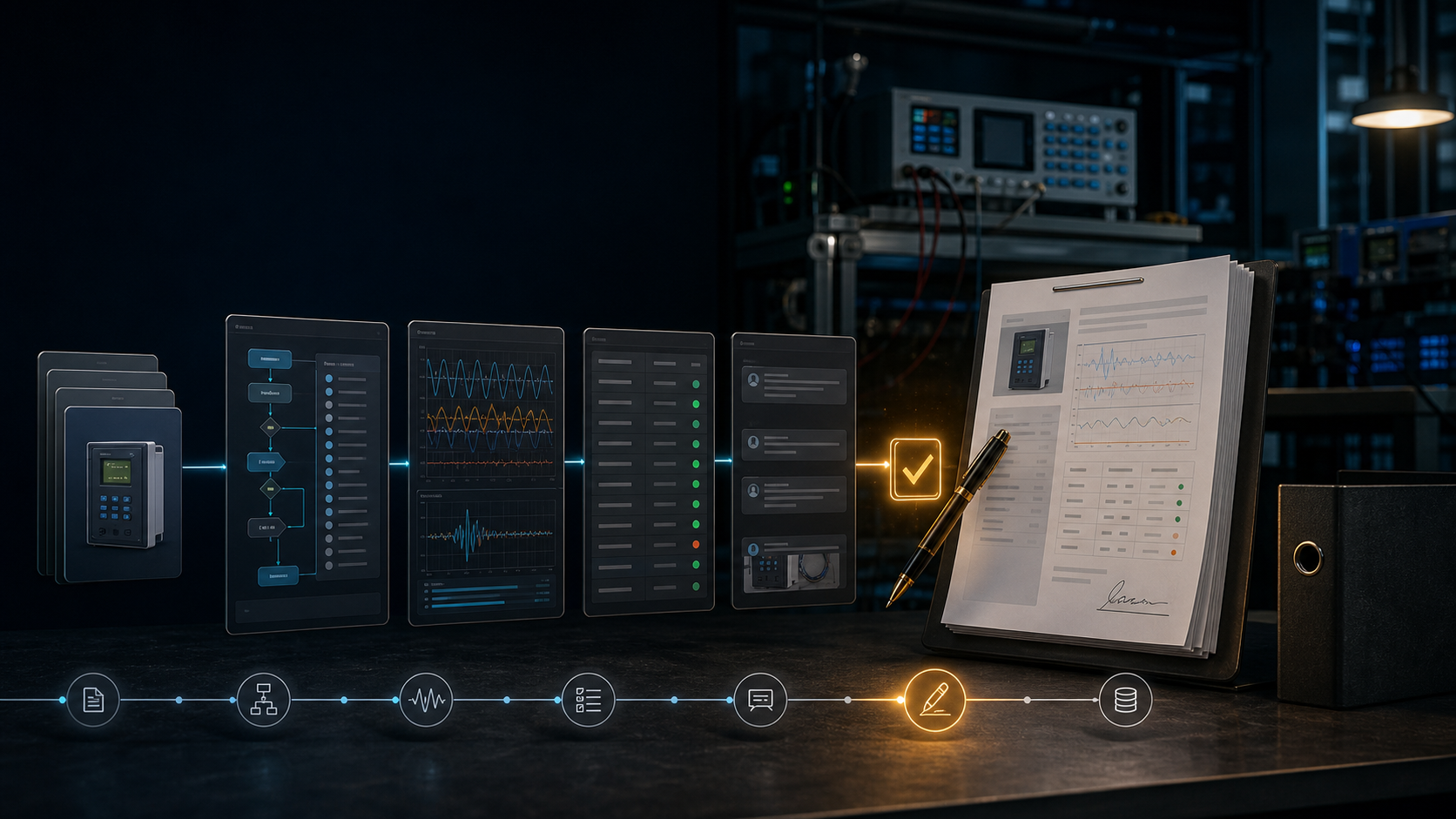
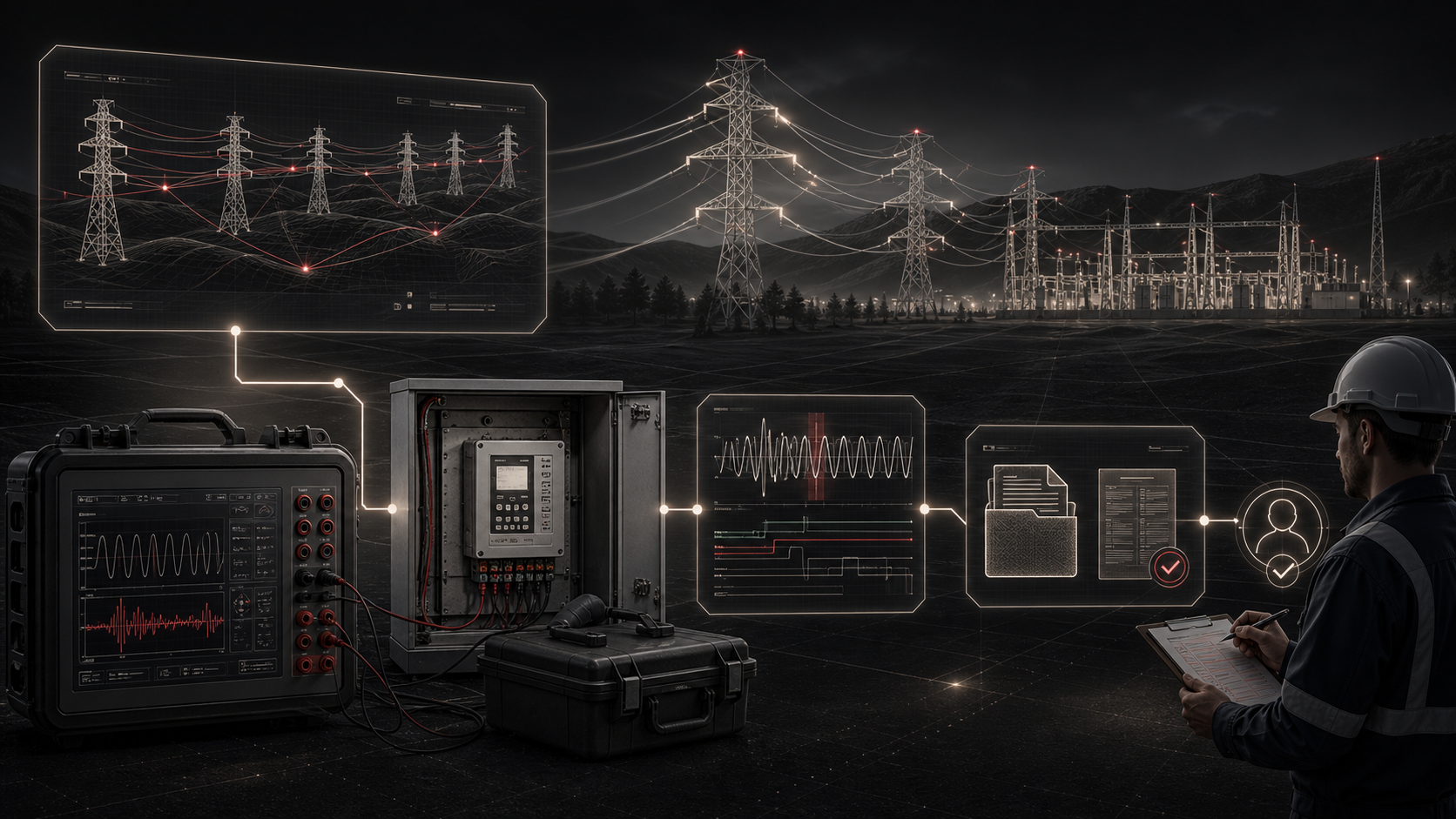
Transmission-line protection testing is strongest when the model, settings, injection, relay response, breaker logic, and report remain connected. A distance characteristic sweep alone does not prove teleprotection, breaker failure, reclosing, or end-to-end behavior.
The model-to-record chain
Start with line impedance, source equivalents, CT/VT ratios, relay settings, communications assumptions, and the fault cases in scope. Generate expected phasors or transients deterministically. Record what is injected, what the relay measures, what binary outputs occur, and how the result is assessed. Preserve the model version and the reason for each case.
An agentic assistant can enumerate cases, find missing assumptions, and draft the handoff. It should not change the model to make a failing case pass. Model uncertainty belongs in the report.
Common gaps
Teams often test one location, one fault type, and one direction. They may not cover resistive reach, load encroachment, power swings, memory polarization, communications delay, or the breaker sequence. A pre-outage review can identify those gaps before the test set is connected.
ProtectionAI positioning
ProtectionAI can help build a simulator-first case matrix and connect the resulting evidence to the report. Physical system-based testing remains tied to qualified test equipment, a valid network model, and the commissioning procedure.
Coverage is a system question
Distance protection is commonly reduced to a reach plot, but commissioning evidence should match the scheme. The matrix may need forward and reverse faults, phase and earth faults, different fault resistances, source strengths, power swings, load encroachment, memory polarisation, weak infeed, communications delay, permissive or blocking logic, breaker failure, and reclosing. The exact list depends on the design and procedure; the important point is that an omitted case is visible rather than hidden inside a template.
Keep the network model and relay settings under version control. Record line impedance, source equivalents, CT/VT ratios, channel scaling, fault inception angle, time reference, communications assumptions, and expected trip or permissive signals. If the case is generated from an event file, preserve the source COMTRADE files and scaling. If it is synthetic, retain the model revision and parameter provenance.
From exception list to field handoff
An agentic assistant can read the approved work order and case manifest, enumerate missing coverage, compare a setting revision with the model, and draft a field handoff. It can highlight that only one fault location was tested or that a teleprotection case has no delay assumption. The engineer then decides whether the gap is intentional, adds a case, or documents the exclusion.
ProtectionAI should be measured on source-linked findings and reviewer time, not on whether it writes a confident distance-relay explanation. The physical test equipment, communications channel, and qualified commissioning procedure remain the proof of the field result.
References
- OMICRON. (n.d.). RelaySimTest [Product page]. https://www.omicronenergy.com/en/products/relaysimtest/
- IEEE. (2023). IEEE guide for power system protection testing (IEEE Std C37.233-2023). https://standards.ieee.org/ieee/C37.233/6676/
- CIGRE Working Group B5.45. (2015). Acceptance, commissioning and field testing techniques for protection and automation systems (Technical Brochure No. 637). https://www.e-cigre.org/publications/detail/637-acceptance-commissioning-and-field-testing-techniques-for-protection-and-automation-systems.html
- Porawagamage, G., et al. (2024). A review of machine learning applications in power system protection. Frontiers in Smart Grids, 3, Article 1371153. https://doi.org/10.3389/frsgr.2024.1371153
References
Questions engineers ask
What should a transmission-line protection test record connect?
Connect the network model, source equivalents, line and CT/VT data, settings revision, fault case, injected signals, relay response, binary outputs, communications assumptions, breaker sequence, and reviewer disposition.
Does a distance reach sweep prove teleprotection?
No. Teleprotection, weak infeed, power swings, communications delay, breaker failure, reclosing, and end-to-end behavior need their own defined cases when they are in scope.
How can ProtectionAI assist?
It can enumerate coverage, compare model and settings context, surface missing assumptions, preserve case provenance, and draft a field handoff without changing a model to make a failing case pass.