Transformer Health Index Uncertainty: Why the Number Needs Its Evidence
A practical guide to making transformer health-index uncertainty visible through source quality, missing data, model assumptions, sensitivity, and engineer-approved action.
On this page
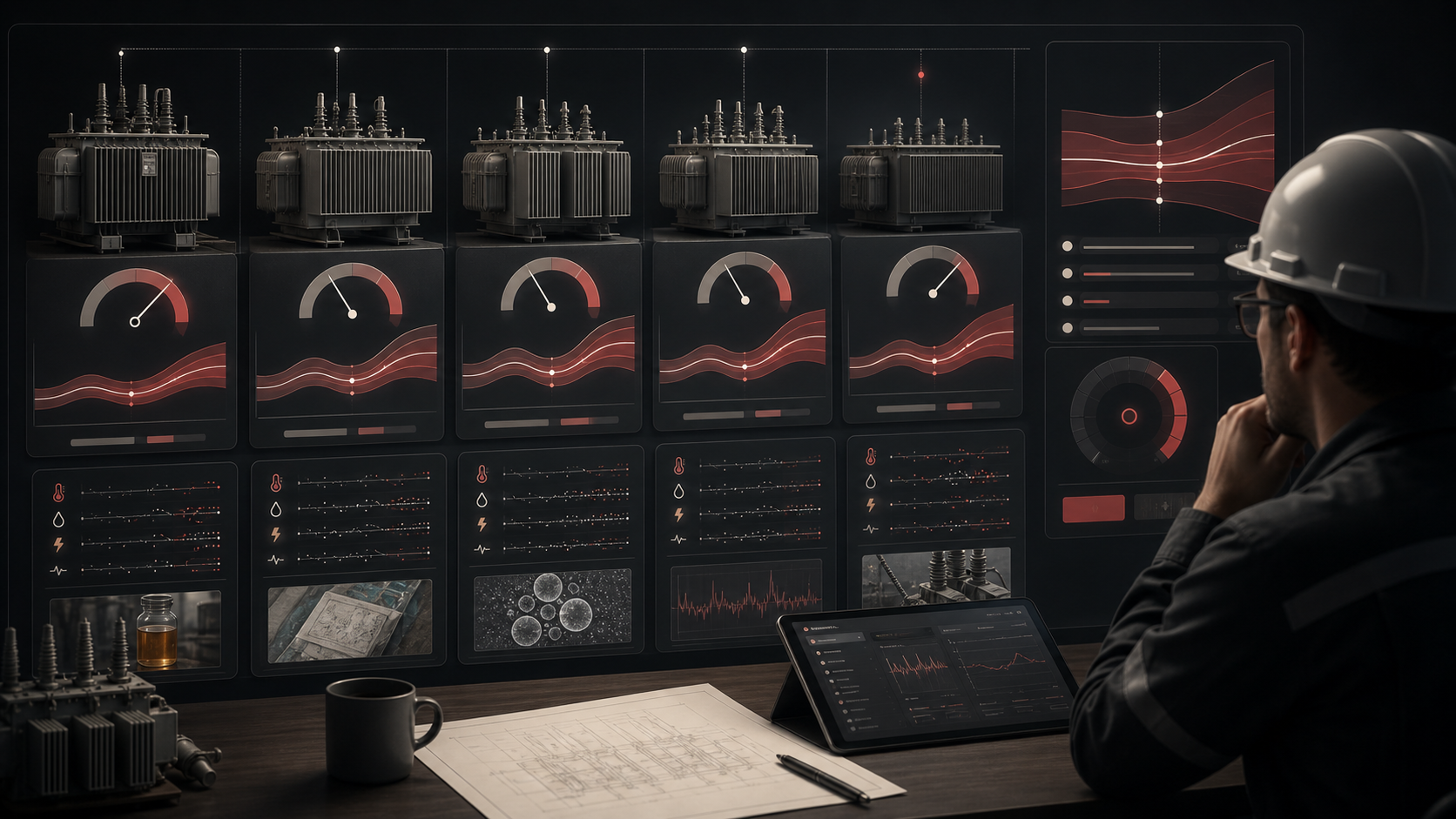
A transformer health index is useful because a fleet team cannot read every diagnostic record at the same time. It is risky when the number is treated as if it were a direct measurement of health. A score compresses evidence. It does not remove stale tests, missing metadata, conflicting indicators, weighting choices, or uncertainty about how a particular transformer is operated.
Treat the index as a screening signal
CIGRE Technical Brochure 761 describes assessment indices as a way to rank transformers and connect a score to an appropriate action and time horizon. That is a valuable asset-management use. It is different from diagnosing one unit. A fleet screen can identify which records deserve attention; a diagnostic review must still inspect the source measurements, test setup, trend, operating context, and failure mode being considered.
Write the intended use at the top of the model: fleet triage, maintenance planning, replacement study, outage preparation, or engineering diagnosis. The same score should not silently move between those purposes. A model suitable for ranking may be too coarse for a decision to energize, derate, repair, or replace.
Name the uncertainty sources
At minimum, expose five classes of uncertainty:
- Evidence uncertainty: the sample date, sensor source, calibration, units, or asset identity is missing or disputed.
- Condition uncertainty: DGA, oil, PRPD, SFRA, thermal, inspection, and maintenance records point in different directions or observe different failure modes.
- Model uncertainty: the chosen thresholds, weights, aggregation rule, or aging relationship may not fit the asset class.
- Context uncertainty: loading, ambient temperature, cooling availability, duty cycle, and fault exposure have changed since the evidence was collected.
- Decision uncertainty: the consequence of failure, redundancy, outage window, spare availability, and approved risk tolerance are not represented by the score.
The peer-reviewed work on data uncertainty in transformer insulation health indices is a useful reminder that uncertainty is not merely a presentation problem. It affects how evidence should be combined and how much confidence a decision-maker should place in the result.
Build an evidence-carrying index
For every component of the score, retain the underlying observation, source, date, quality status, transformation, threshold or weight, and reviewer note. If DGA contributes to the model, link the laboratory report and the interpretation basis in IEEE C57.104 or IEC 60599. If loading and thermal stress contribute, record the load history, ambient assumptions, cooling state, and model version; IEEE C57.91-2025 provides the loading context.
Do not turn missing evidence into a neutral value without saying so. “No recent SFRA” is not the same as “SFRA normal.” “No DGA trend available” is not the same as “no gassing.” The index can carry a missing-evidence flag, a confidence band, or an explicit “not fit for decision” status. The exact representation depends on the organization’s method, but the limitation must remain visible.
Use sensitivity before escalation
Run a reviewer-friendly sensitivity check. Which inputs move the unit from one priority band to another? Does the ranking change if an old test is excluded, a disputed weight is reduced, or a missing monitor record remains unknown? Are a few high-consequence failure modes hidden by a favorable average? A sensitivity note can be more useful than an extra decimal place.
The output should include the current index, the evidence completeness, the main drivers, the main counter-evidence, the uncertainty that could change the result, and the next data or inspection needed. That format lets an engineer decide whether to maintain, retest, inspect, repair, plan an outage, commission a deeper diagnostic, or leave the unit on routine monitoring.
Recent CIGRE session material on evidence theory and online monitoring makes the same practical point: richer inputs and more elaborate fusion can improve prioritization only when the uncertainty model and source evidence remain visible to the reviewer.
Connect the score to maintenance governance
Commissioning provides the first baseline: asset identity, design data, test records, sensor configuration, oil and insulation evidence, and as-left condition. Maintenance updates the record when loading changes, a fault occurs, an oil sample moves, a cooling system fails, or a diagnostic test is repeated. CIGRE maintenance guidance emphasizes planning, execution, recording, and optimization; the record is part of the maintenance process, not an afterthought.
The transformer CBM evidence-readiness checklist and condition-based maintenance guide can help turn the index into a review cadence. Keep the approval state explicit: draft, engineering review, approved for planning, approved for work, or closed with rationale.
Where the GridAPM products fit
AgenticGrid Pro can organize the source records behind a health index, show missing and conflicting evidence, preserve model and reviewer metadata, and draft a human-reviewed assessment or evidence pack. It can help make the number inspectable; it does not make the number true, certify a condition, or choose a maintenance action without engineering approval.
ProtectionAI is a separate relay-testing workbench. Its bounded simulator and report workflow may help with protection evidence around an event or commissioning task, but it is not a transformer health-index engine and cannot replace diagnostic measurement, physical test equipment, or a qualified engineer.
References
International Electrotechnical Commission. (2022). Mineral oil-filled electrical equipment in service—Guidance on the interpretation of dissolved and free gases analysis (IEC 60599:2022). https://webstore.iec.ch/en/publication/66491
Institute of Electrical and Electronics Engineers. (2019). IEEE guide for the interpretation of gases generated in mineral oil-immersed transformers (IEEE C57.104-2019). https://standards.ieee.org/ieee/C57.104/7476/
Institute of Electrical and Electronics Engineers. (2025). IEEE guide for loading mineral-oil-immersed transformers and step-voltage regulators (IEEE C57.91-2025). https://standards.ieee.org/ieee/C57.91/7163/
International Council on Large Electric Systems. (2019). Condition assessment of power transformers (Technical Brochure 761). https://www.e-cigre.org/publications/detail/761-condition-assessment-of-power-transformers.html
International Council on Large Electric Systems. (2026). Transformer health index calculation using evidence theory and considering online monitoring data and machine learning. https://www.e-cigre.org/publications/detail/a2-12378-2026-transformer-health-index-calculation-using-evidence-theory-and-machine-learning.html
National Institute of Standards and Technology. (2023). Artificial intelligence risk management framework (AI RMF 1.0). https://www.nist.gov/itl/ai-risk-management-framework
Prasojo, R. A., Suwarno, & Abu-Siada, A. (2021). Dealing with data uncertainty for transformer insulation system health index. IEEE Access, 9, 74703–74712. https://doi.org/10.1109/ACCESS.2021.3081699
U.S. Bureau of Reclamation. (2005). Transformers: Basics, maintenance, and diagnostics. https://www.usbr.gov/tsc/techreferences/mands/mands-pdfs/Trnsfrmr.pdf
References
- CIGRE Technical Brochure 761, Condition Assessment of Power Transformers
- IEEE C57.104 IEEE C57.104-2019, Guide for the Interpretation of Gases
- IEC 60599 IEC 60599:2022, Dissolved and Free Gases Analysis
- IEEE C57.91 IEEE C57.91-2025, Guide for Loading Mineral-Oil-Immersed Transformers
- Prasojo et al., Dealing With Data Uncertainty for Transformer Insulation System Health Index
- CIGRE, Transformer Health Index Calculation Using Evidence Theory
- NIST AI RMF NIST AI Risk Management Framework
- U.S. Bureau of Reclamation, Transformers: Basics, Maintenance, and Diagnostics
Questions engineers ask
What does a transformer health index actually tell an engineer?
It provides a structured screening or prioritization signal based on selected evidence and assumptions. It does not by itself identify a fault, prove remaining life, or prescribe maintenance.
What creates uncertainty in a transformer health index?
Common sources include missing or stale tests, uncertain data provenance, measurement quality, conflicting indicators, chosen weights and thresholds, model limitations, changing operating context, and the difference between fleet screening and unit diagnosis.
Can AgenticGrid Pro make the health-index decision automatically?
No. AgenticGrid Pro can organize source evidence, show gaps and conflicts, and draft a human-reviewed assessment. The responsible engineer decides whether the index is fit for the intended maintenance or investment decision.


