Transformer Diagnostic Evidence Chains: From Raw Record to Engineer-Approved Action
A practical transformer diagnostic evidence chain that connects raw DGA, SFRA, monitoring, inspection, and maintenance records to a reviewable, engineer-approved action.
On this page
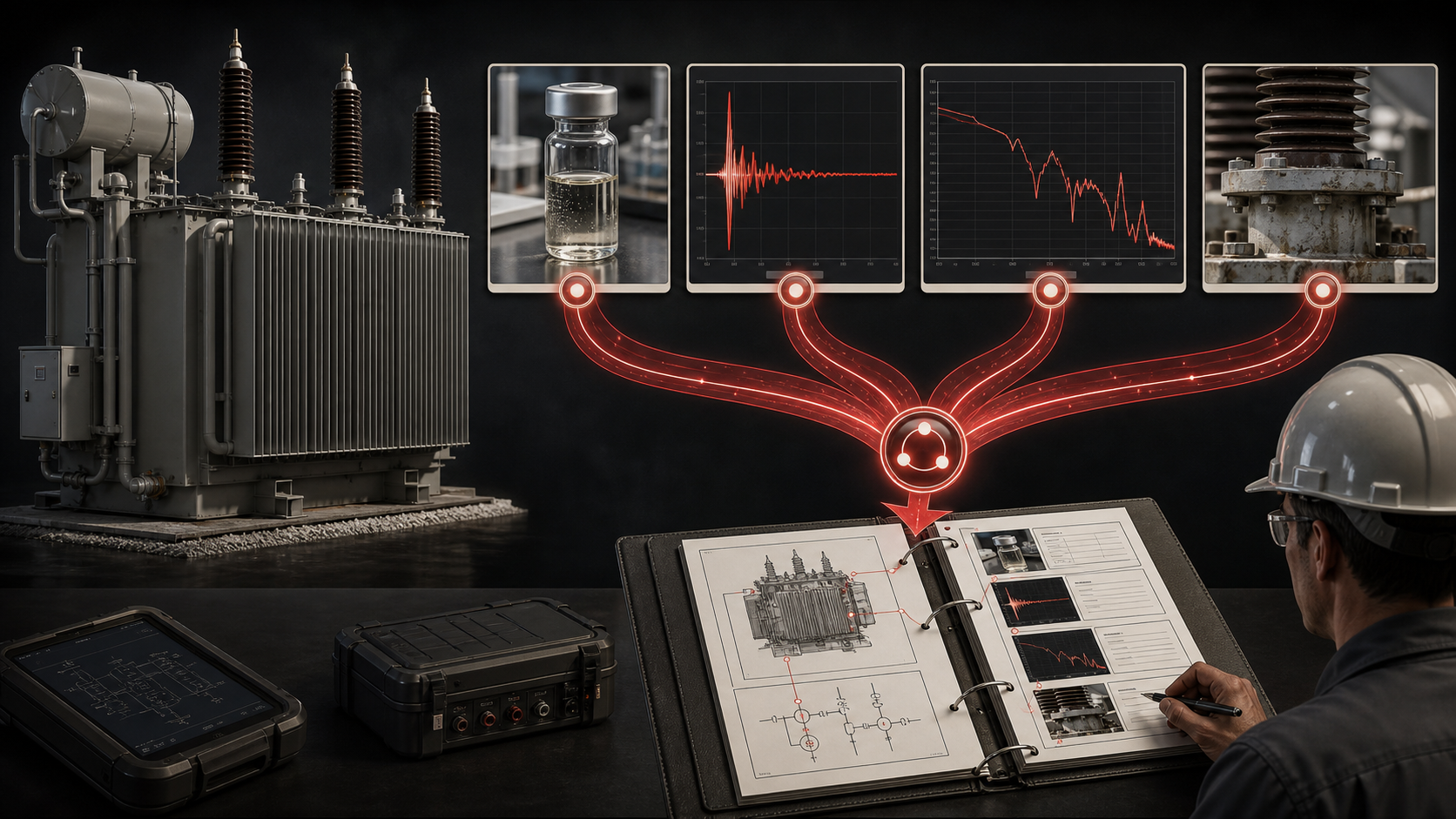
A transformer diagnostic result is only as defensible as the path that connects it to a decision. A gas concentration without an asset identifier, sample date, unit, method, or reviewer is a loose fact. A source-linked record with those fields, operating context, and an approval outcome becomes evidence that can travel from commissioning to maintenance planning and later audit.
That is the purpose of a transformer diagnostic evidence chain. It is not a new diagnostic method. It is the discipline that keeps DGA, SFRA, monitoring, inspection, and maintenance records connected without turning a single value into an automatic verdict.
The six links in a diagnostic chain
- Asset identity. Attach every observation to the correct fleet, site, transformer, tank, winding, bushing, tap changer, cooling system, or sensor. The power transformer diagnostic data model is useful because it treats component identity as part of the evidence, not as a filename convention.
- Raw source record. Keep the original laboratory report, monitor export, SFRA trace, inspection note, photograph, or CMMS record. Record the source system, file name or record ID, acquisition method, and checksum when the workflow supports it.
- Measurement context. Preserve timestamp, sample date, units, detection limits, calibration or verification notes, sensor status, test setup, tap position, load, and ambient conditions. For SFRA, IEEE C57.149 specifically makes instrumentation, procedure, comparison, and long-term storage part of useful practice.
- Derived evidence. A rate of change, gas ratio, baseline deviation, or fleet comparison is a calculation. Store the inputs, formula version, unit conversion, time interval, and whether the result is illustrative or measured. Do not present a calculated indicator as if it were a raw observation.
- Engineering interpretation. IEEE C57.104 and IEC 60599 provide interpretation context for DGA. IEC 60599 states that resulting action requires proper engineering judgment; the evidence chain should preserve that boundary.
- Decision and outcome. Record whether the reviewer approved monitoring, requested a repeat sample, commissioned another test, planned an outage, deferred action with rationale, rejected the hypothesis, or escalated it. Close the loop with the post-action result.
A practical commissioning-to-maintenance workflow
During commissioning, start with the asset register and the test plan. Confirm the transformer nameplate identity, component hierarchy, serial number, oil type, monitor mapping, and the expected file formats. If a DGA monitor is being introduced, verify its gas coverage, clock behavior, communications status, and calibration or laboratory-correlation plan before relying on its alarms.
At ingestion, reject or quarantine records with missing units, ambiguous timestamps, duplicate samples, an unknown asset, or an unexplained change of laboratory or monitor. Keep the raw record unchanged and create a normalized view beside it. A normalized view can make parts-per-million, date formats, or component names consistent; it must not erase the original value or method.
During review, compare the new observation with the asset history and operating context. The DGA generation-rate workflow explains why a rate needs a trustworthy interval. Check loading, cooling, oil processing, recent faults, inspection findings, and maintenance history. Then show the standards reference, the uncertainty, the missing evidence, and the candidate next steps to a qualified reviewer.
For maintenance handoff, attach the approved evidence pack to the CMMS or EAM work package. The handoff should include a source manifest, the diagnostic interpretation, the requested scope, safety and outage assumptions, approval identity, and a field for as-found and as-left results. A recommendation that cannot be reconstructed after the work is complete is not a finished evidence chain.
Illustrative example, not a customer measurement
Consider a fictional transformer record: an online monitor reports a rising hydrogen trend over three intervals, while a laboratory sample arrives with a different timestamp and no load context. The correct workflow is not “trip” or “create a maintenance order.” The reviewer first checks monitor health, sample handling, clock alignment, and laboratory reconciliation. The engineer may request a repeat sample, inspect operating history, or compare another diagnostic channel. Only after review can the utility decide whether to monitor, investigate, or plan work. The values and asset in this example are illustrative, not customer data.
Where AgenticGrid Pro and ProtectionAI fit
AgenticGrid Pro is described here as a bounded transformer APM workbench: it can organize permitted evidence, expose provenance and gaps, calculate configured indicators, and draft a source-linked review packet. ProtectionAI is GridAPM’s separate Windows relay-testing application; its test records can be an input to a transformer protection work package, but the two products do not grant OT authority. Neither product should issue a trip, change a relay setting, dispatch maintenance, or replace qualified engineers or physical test equipment. Final decisions and OT actions remain engineer-approved.
The human-in-the-loop AI workflow and sample evidence pack show the review pattern buyers should inspect: source records first, interpretation second, approval last. A controlled GridAPM pilot can measure whether that chain is complete and usable on a defined asset cohort.
References
- IEEE. (2019). IEEE guide for the interpretation of gases generated in mineral oil-immersed transformers (IEEE Std C57.104-2019). https://standards.ieee.org/ieee/C57.104/7476/
- International Electrotechnical Commission. (2022). Mineral oil-filled electrical equipment in service—Guidance on the interpretation of dissolved and free gases analysis (IEC 60599:2022). https://webstore.iec.ch/en/publication/66491
- IEEE. (2024). IEEE guide for the application and interpretation of frequency response analysis for oil-immersed transformers (IEEE Std C57.149-2024). https://standards.ieee.org/ieee/C57.149/7354/
- CIGRE. (2019). Condition assessment of power transformers (Technical Brochure 761). https://www.e-cigre.org/publications/detail/761-condition-assessment-of-power-transformers.html
- Tabassi, E. (2023). Artificial intelligence risk management framework (AI RMF 1.0) (NIST AI 100-1). National Institute of Standards and Technology. https://doi.org/10.6028/NIST.AI.100-1
- Thang, K. F., Aggarwal, R. K., McGrail, A. J., & Esp, D. G. (2003). Analysis of power transformer dissolved gas data using the self-organizing map. IEEE Transactions on Power Delivery, 18(4), 1241–1248. https://doi.org/10.1109/TPWRD.2003.817733
References
- IEEE C57.104 IEEE C57.104-2019: Guide for the Interpretation of Gases Generated in Mineral Oil-Immersed Transformers
- IEC 60599 IEC 60599:2022: Mineral oil-filled electrical equipment in service
- IEEE C57.149 IEEE C57.149-2024: Application and Interpretation of Frequency Response Analysis
- CIGRE TB 761 CIGRE TB 761: Condition assessment of power transformers
- NIST AI RMF NIST AI RMF 1.0
- Thang et al., Analysis of power transformer dissolved gas data using the self-organizing map
Questions engineers ask
What is a transformer diagnostic evidence chain?
It is the traceable path from an identified source record through measurement verification, normalization, operating context, diagnostic interpretation, reviewer decision, and recorded follow-up.
Does a DGA threshold automatically create a transformer maintenance order?
No. A DGA threshold or trend is a review input. Qualified engineers must evaluate measurement quality, trend, context, criticality, and available tests before approving monitoring, maintenance, outage, or escalation.
How can AgenticGrid Pro help with diagnostic evidence?
Within a bounded pilot, AgenticGrid Pro can organize permitted records, preserve source links and metadata, calculate configured indicators, surface missing context, and draft a review package. It does not replace engineers, physical test equipment, or approval controls.


