PRPD and SFRA Together: A Multimodal Transformer Review Workflow
A practical review workflow for combining phase-resolved partial-discharge evidence with SFRA results, DGA, operating context, and engineer-approved transformer maintenance decisions.
On this page
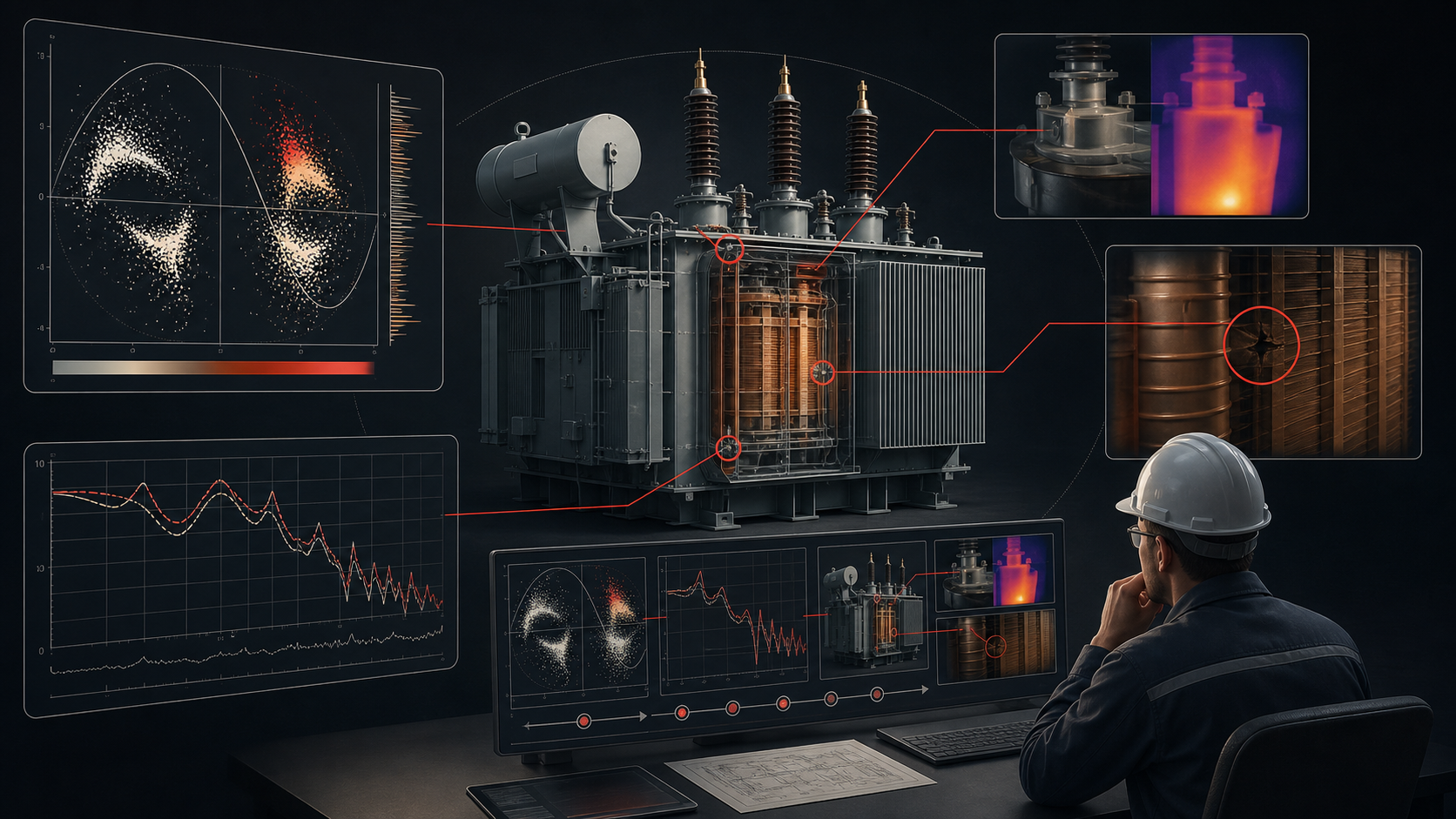
PRPD and SFRA are complementary, not interchangeable. Phase-resolved partial-discharge evidence describes discharge activity under a defined measurement arrangement. Sweep frequency response analysis describes the transformer’s electrical response across frequency and is commonly used to compare mechanical or electrical condition with a reference. Reviewing both can improve the quality of a transformer investigation, but only if the test context and uncertainty travel with the result.
Preserve the measurement context first
Before comparing a trace, create a test-configuration record. For PRPD, capture the test voltage, frequency, apparent-charge basis, calibration method, sensor and coupling arrangement, bandwidth, noise checks, phase reference, environmental conditions, and whether the test was factory, site, offline, or online. IEC 60270:2025 gives the general charge-based measurement framework; CIGRE guidance discusses conventional and unconventional methods and the practical challenge of separating discharge from interference.
For SFRA, record the transformer identity, tap position, winding and terminal connections, grounding point, test leads, instrument, sweep range, temperature, oil state, and reference trace. IEC 60076-18 and IEEE C57.149-2024 emphasize measurement technique, equipment, procedures, interpretation, and long-term storage. A trace without its connection method is an incomplete diagnostic record.
Establish a commissioning baseline
The strongest multimodal review often starts at commissioning. Preserve the as-tested PRPD result, SFRA traces, DGA and oil records, ratio and winding-resistance results, bushing information, tap position, and as-left configuration. If a test is repeated after transport, a fault, or major work, repeat the relevant setup as closely as practical and document every deliberate difference.
Commissioning teams should agree in advance which findings require a hold point. Examples include unexplained discharge above the agreed noise and sensitivity boundary, a non-reproducible PRPD pattern, an SFRA change that is not explained by test configuration, or a conflict between the diagnostic result and the physical inspection. The hold point should stop the record from being treated as accepted evidence until a qualified reviewer resolves it.
Use a four-pass review
Pass one: evidence quality. Confirm identity, date, tap, test setup, calibration, file integrity, units, and reference provenance. Mark missing or uncertain metadata before interpretation.
Pass two: PRPD review. Examine phase location, polarity symmetry, amplitude or apparent-charge context, repetition, pattern stability, background activity, and the relationship between electrical and non-electrical channels. Treat pattern recognition as a way to organize hypotheses, not as a certificate of defect type. Peer-reviewed classifier research can be useful for method development, but a laboratory result does not automatically transfer to every field sensor, noise environment, or transformer design.
Pass three: SFRA review. Compare the measured response with the correct factory, commissioning, sister-phase, or prior reference. Note deviations by frequency region, phase consistency, repeatability, connection differences, and whether the change is supported by an event such as through-fault, transport, short circuit, or internal work. Avoid a single numeric index without the trace and test context.
Pass four: correlation and action. Add DGA, oil quality, thermal history, load events, protection operations, transport records, inspection notes, and maintenance history. A PRPD concern with a stable SFRA may call for one follow-up path; an SFRA change with no credible PRPD evidence may call for another. These are review hypotheses, not automatic diagnoses.
Do not average unlike evidence
A multimodal workflow should not convert PRPD, SFRA, DGA, and thermal data into one opaque score simply because the inputs are available. Keep each source’s observation, confidence, limitations, and reviewer notes visible. A missing calibration record should reduce confidence in the evidence pack; it should not be silently replaced with a default value.
The PRPD signatures guide provides internal context for pattern review, while the transformer CBM evidence checklist helps make the maintenance handoff explicit. The final output should state what is known, what is suspected, what is contradicted, what is missing, and which engineer-approved next step follows.
Where the GridAPM products fit
AgenticGrid Pro is the GridAPM transformer APM workbench. It can store and organize approved PRPD, SFRA, DGA, thermal, loading, inspection, and maintenance evidence, preserve source links and metadata, surface contradictions, and draft a reviewable work package. It does not replace the diagnostic engineer, the measurement system, calibration, or physical inspection.
ProtectionAI is a separate Windows protective-relay testing application with a bounded copilot and simulator. It can help prepare protection test evidence around commissioning, but it is not a PRPD/SFRA diagnostic instrument and its output cannot qualify a transformer condition or authorize an OT action.
References
International Electrotechnical Commission. (2012). Power transformers—Part 18: Measurement of frequency response (IEC 60076-18:2012). https://webstore.iec.ch/en/publication/597
International Electrotechnical Commission. (2025). High-voltage test techniques—Charge-based measurement of partial discharges (IEC 60270:2025). https://webstore.iec.ch/en/publication/65087
Institute of Electrical and Electronics Engineers. (2024). IEEE guide for the application and interpretation of frequency response analysis for oil-immersed transformers (IEEE C57.149-2024). https://standards.ieee.org/ieee/C57.149/7354/
International Council on Large Electric Systems. (2016). Guidelines for partial discharge detection using conventional (IEC 60270) and unconventional methods (Technical Brochure 662). https://www.e-cigre.org/publications/detail/662-guidelines-for-partial-discharge-detection-using-conventional-iec-60270-and-unconventional-methods.html
International Council on Large Electric Systems. (2017). Partial discharges in transformers (Electra 291). https://www.e-cigre.org/publications/detail/elt-291-1-partial-discharges-in-transformers.html
International Council on Large Electric Systems. (2025). Guide for transformer maintenance (Technical Brochure 962). https://www.e-cigre.org/publications/detail/962-guide-for-transformer-maintenance.html
National Institute of Standards and Technology. (2023). Artificial intelligence risk management framework (AI RMF 1.0). https://www.nist.gov/itl/ai-risk-management-framework
Sun, S., Sun, Y., Xu, G., Zhang, L., Hu, Y., & Liu, P. (2021). Partial discharge pattern recognition of transformers based on the gray-level co-occurrence matrix of optimal parameters. IEEE Access, 9, 102422–102432. https://doi.org/10.1109/ACCESS.2021.3096287
References
- IEC 60270 IEC 60270:2025, Charge-Based Measurement of Partial Discharges
- IEC 60076-18 IEC 60076-18:2012, Measurement of Frequency Response
- IEEE C57.149 IEEE C57.149-2024, Guide for Frequency Response Analysis
- CIGRE Technical Brochure 662, Partial Discharge Detection
- CIGRE Electra 291, Partial Discharges in Transformers
- CIGRE Technical Brochure 962, Guide for Transformer Maintenance
- Sun et al., Partial Discharge Pattern Recognition of Transformers
- NIST AI RMF NIST AI Risk Management Framework
Questions engineers ask
Why review PRPD and SFRA together?
They observe different evidence domains: PRPD describes phase-related discharge activity under a stated measurement setup, while SFRA compares a transformer’s frequency response to a suitable baseline or reference. Together they can narrow review questions, but neither automatically identifies a root cause.
Can an unusual SFRA trace prove winding damage?
No. Test leads, grounding, tap position, temperature, connection state, instrument setup, and reference quality can affect the comparison. A qualified engineer must assess whether a deviation is credible and what confirmatory work is needed.
Can AI interpret PRPD and SFRA without a diagnostic engineer?
No. A bounded workflow can organize traces, metadata, source documents, and comparison notes. It can draft questions and a report, but the diagnostic interpretation and maintenance decision remain engineer-approved.


