Online DGA Alarm Review: A Human-Approved Workflow for Transformer Gas Trends
How to review online DGA alarms with monitor quality, laboratory reconciliation, gas trends, operating context, and engineer-approved next steps.
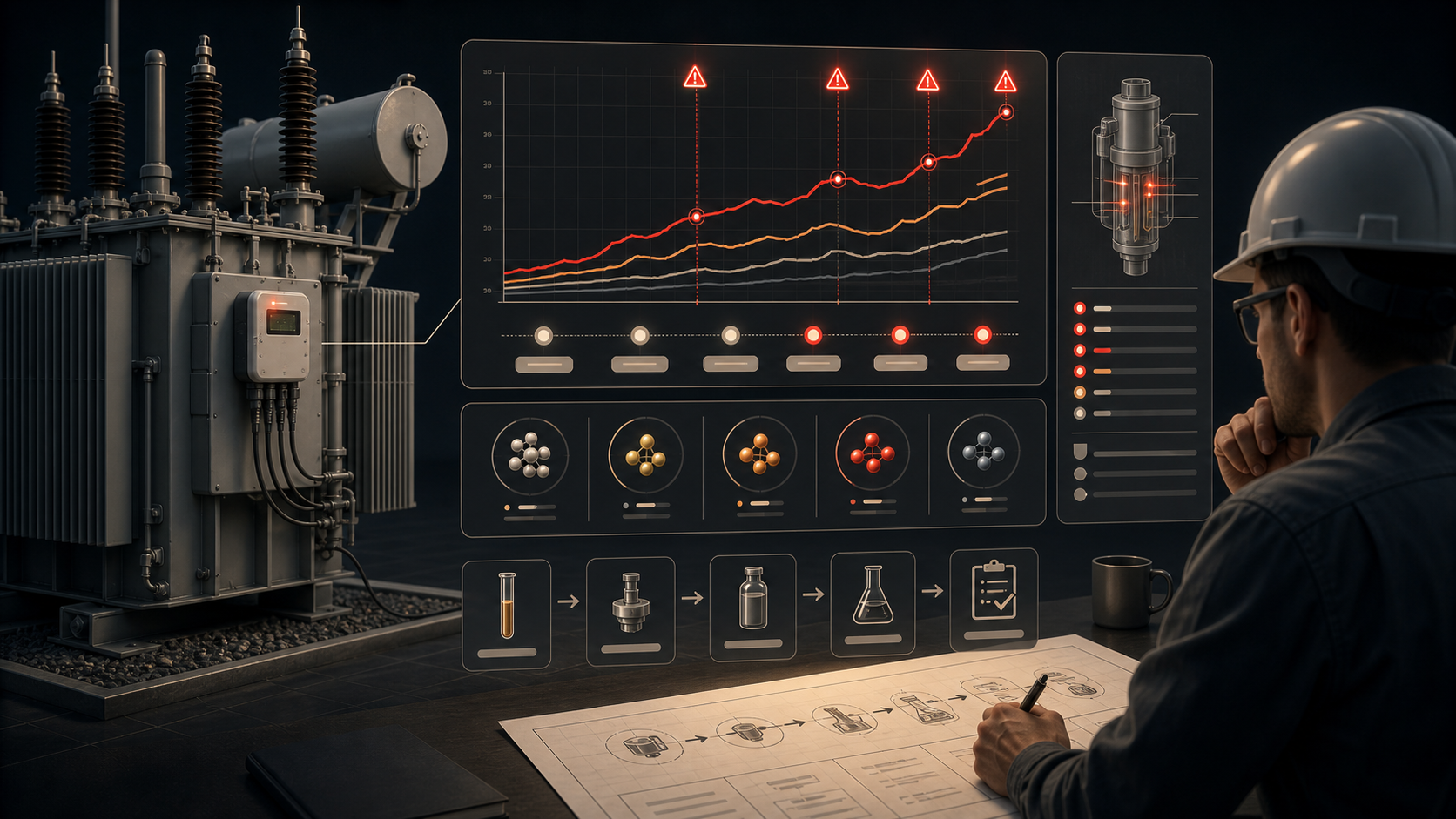
On this page
An online dissolved gas analysis alarm is a request for attention, not a verdict. The alarm may reflect genuine gas generation, monitor drift, a communications fault, a unit mismatch, a clock problem, or a short-lived operating condition. The safe value of an online DGA system comes from shortening the path to a well-qualified review, not from letting a threshold control the transformer.
The online DGA monitoring solution is therefore best understood as a workflow: verify the signal, compare it with trusted history, add context, ask what is missing, and route the case to an engineer-approved outcome.
Phase 1: verify that the alarm is real
Start with the monitor, not the diagnosis. Record the monitor ID, transformer and component mapping, gas channels, firmware or configuration revision, time zone, clock synchronization, communications status, last calibration or verification, and the period covered by the alarm. IEEE C57.143 covers application of monitoring equipment and explicitly separates monitoring application from interpretation of monitoring results.
The reviewer should check for flatlined values, repeated identical timestamps, impossible negative values, sudden unit changes, missing samples, or a change in gas coverage. CIGRE TB 783 is useful context because it addresses online gas-monitor technologies and procedures for checking agreement between laboratory and monitor results.
If the monitor is unhealthy, label the alarm as a data-quality event and follow the site’s instrument-maintenance process. Do not let a bad input become a high-confidence transformer condition.
Phase 2: reconcile online and laboratory evidence
Create a side-by-side record for the online observation and the nearest laboratory sample. Keep the original values and methods visible. IEC 60567 describes sampling and analysis guidance; it is a reminder that a laboratory result is not just a number but the output of sampling, extraction, analysis, and quality control.
Compare gas coverage, units, sample time, laboratory receipt time, monitor measurement time, oil temperature, load, and any oil processing or maintenance between the observations. If the records disagree, show the disagreement. Do not average them silently or choose the value that supports the most urgent story.
Phase 3: review trend, rate, and persistence
The next question is whether the signal is persistent and moving. The DGA generation-rate analysis guide explains why a rate needs a known time interval and a trustworthy source. Review the direction and velocity of each gas, the number of observations, the sampling cadence, and whether the trend changes after an oil intervention or loading event.
IEEE C57.104 and IEC 60599 provide interpretation context, but a threshold is not an automatic trip or maintenance order. IEC 60599 describes indications as guidance and states that action requires proper engineering judgment. A review record should therefore say “review triggered by configured alarm” rather than “maintenance required by threshold.”
Phase 4: add operating and asset context
Pull the evidence that can change the meaning of the gas movement:
- Load, top-oil temperature, ambient temperature, cooling state, and recent overloads.
- Oil processing, filtration, sampling, top-up, leaks, or preservation-system work.
- Recent trips, through-faults, switching, tap-changer activity, or protection events.
- Inspection observations, bushing or PRPD evidence, thermal findings, and prior DGA interpretation.
- Transformer criticality, spare availability, outage constraints, and safety requirements.
Use the DGA interpretation guide to keep key-gas, ratio, and Duval classifications in their proper role: they help classify a pattern after abnormal gassing is established; they do not determine the operational action by themselves.
Phase 5: record an engineer-approved outcome
The review can end in several valid ways: continue observation, verify the monitor, request a laboratory sample, commission another diagnostic test, schedule an inspection, prepare an outage study, or escalate under an existing operating procedure. The record should capture the evidence reviewed, missing evidence, uncertainty, reviewer identity, decision, rationale, due date, and follow-up owner.
Illustrative example, not a customer measurement
Imagine a fictional alarm showing a step change in hydrogen followed by two lower readings. The monitor is healthy, but the nearest lab sample predates the alarm and the transformer was recently loaded heavily. The responsible outcome is a qualified review of the time series, load context, and a new sample or verification plan—not an automatic trip or work order. This example contains no customer measurement and does not prescribe a universal threshold.
Product boundary
AgenticGrid Pro can be used as a bounded evidence-workflow layer for permitted data: it can assemble records, calculate configured trend indicators, link source files, surface missing context, and draft reviewer questions. ProtectionAI is the separate GridAPM relay-testing application; a relay test report may support the case, but neither application grants authority to change settings, issue trips, dispatch work, or replace qualified engineers or physical test equipment. Final decisions and OT actions remain engineer-approved.
Teams can compare the output structure with the sample evidence pack and use a defined pilot to measure review latency, source completeness, and follow-up quality. The objective is a reliable human decision loop, not a promise that every alarm predicts failure.
References
- IEEE. (2019). IEEE guide for the interpretation of gases generated in mineral oil-immersed transformers (IEEE Std C57.104-2019). https://standards.ieee.org/ieee/C57.104/7476/
- International Electrotechnical Commission. (2022). Mineral oil-filled electrical equipment in service—Guidance on the interpretation of dissolved and free gases analysis (IEC 60599:2022). https://webstore.iec.ch/en/publication/66491
- International Electrotechnical Commission. (2023). Oil-filled electrical equipment—Sampling of free gases and analysis of free and dissolved gases in mineral oils and other insulating liquids—Guidance (IEC 60567:2023). https://webstore.iec.ch/en/publication/70013
- IEEE. (2024). IEEE guide for application of monitoring equipment to liquid-immersed transformers and components (IEEE Std C57.143-2024). https://standards.ieee.org/ieee/C57.143/6961/
- CIGRE. (2019). DGA monitoring systems (Technical Brochure 783). https://www.e-cigre.org/publications/detail/783-dga-monitoring-systems.html
- CIGRE. (2019). Advances in DGA interpretation (Technical Brochure 771). https://www.e-cigre.org/publications/detail/771-advances-in-dga-interpretation.html
- Duval, M. (2002). A review of faults detectable by gas-in-oil analysis in transformers. IEEE Electrical Insulation Magazine, 18(3), 8–17. https://doi.org/10.1109/MEI.2002.1014963
References
- IEEE C57.104 IEEE C57.104-2019: Guide for the Interpretation of Gases Generated in Mineral Oil-Immersed Transformers
- IEC 60599 IEC 60599:2022: Interpretation of dissolved and free gases analysis
- IEC 60567 IEC 60567:2023: Sampling of free gases and analysis of dissolved gases
- IEEE C57.143 IEEE C57.143-2024: Application of Monitoring Equipment to Liquid-Immersed Transformers
- CIGRE TB 783 CIGRE TB 783: DGA monitoring systems
- CIGRE TB 771 CIGRE TB 771: Advances in DGA interpretation
- Duval, A review of faults detectable by gas-in-oil analysis in transformers
Questions engineers ask
Does an online DGA alarm mean the transformer should trip?
No. An alarm starts a review. Monitor health, data quality, trend persistence, laboratory evidence, operating context, and asset consequence must be assessed before any operational or maintenance decision.
How should online DGA and laboratory DGA be reconciled?
Compare timestamps, gas coverage, units, sampling or extraction method, monitor status, calibration or verification evidence, and the time interval between records. Differences should be documented and reviewed, not silently averaged.
Can AgenticGrid Pro create a maintenance order from a DGA alarm?
It can help draft a source-linked review package and candidate next steps in a bounded workflow. It should not create an approved maintenance order, issue a trip, or take OT action without the utility's engineer-approved process.

