Maintenance-Window Prioritization for Transformer Fleets: Evidence Before Urgency
A practical, evidence-first method for prioritizing transformer maintenance windows across condition, criticality, outage readiness, safety, spares, and engineering approval.
On this page
Transformer maintenance windows are scarce, but urgency is not the same as evidence. A high alarm, an aging asset, a deferred work order, and a looming outage constraint may all be important while still pointing to different actions. Fleet teams need a prioritization method that makes those differences visible before a window is assigned.
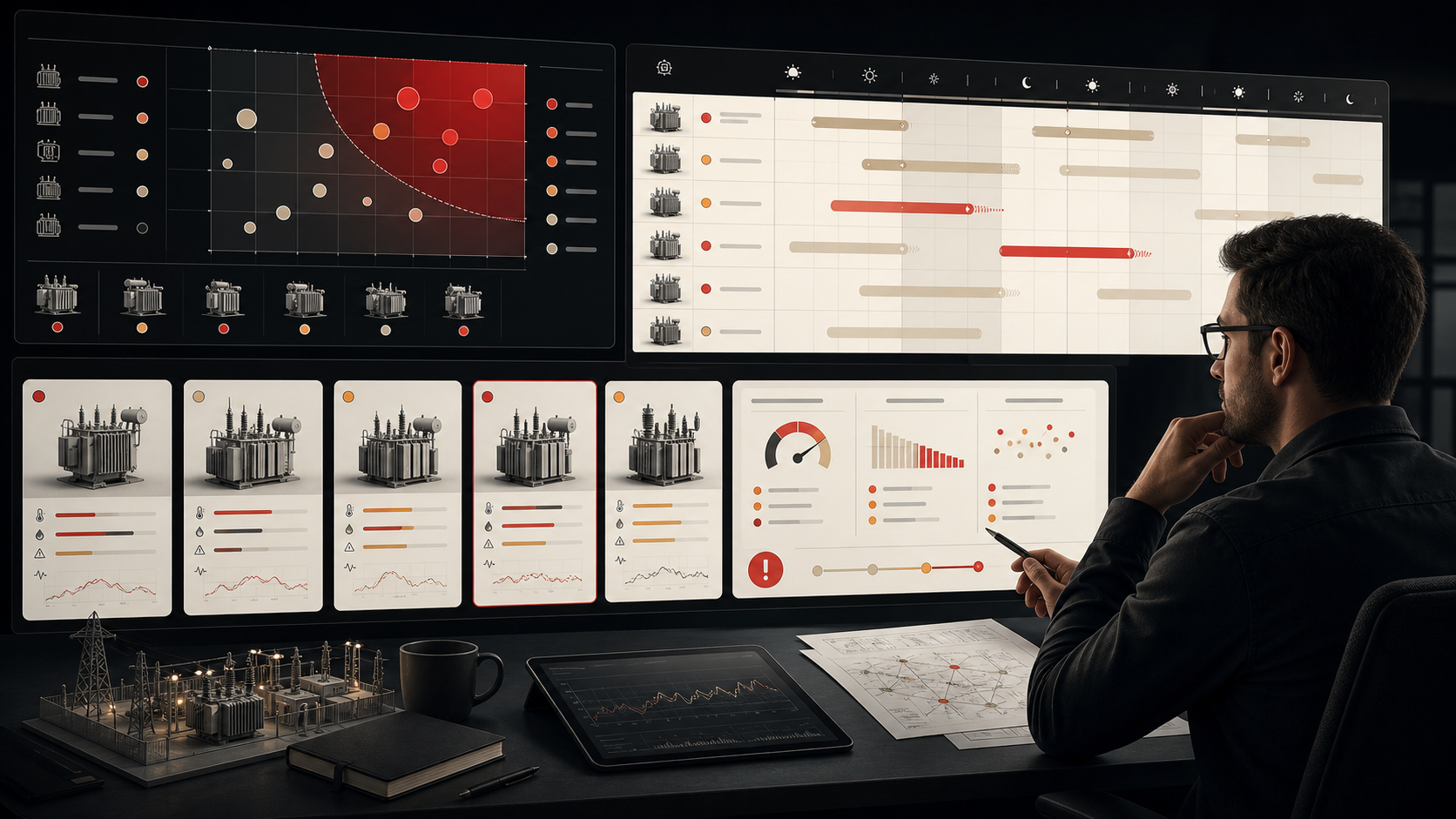
The practical objective is a reviewable queue: which work packages have credible condition evidence, material consequence, a feasible outage path, and an explicit owner for the final decision? A queue that ranks only by alarm severity can create avoidable rework. A queue that ranks only by criticality can postpone a deteriorating asset whose evidence is already actionable.
Prioritize the package, not the alert
Start with the asset and the proposed work package, not with an alert label. The package should connect condition evidence to the maintenance opportunity and show what would be learned or changed during the window.
| Review dimension | Evidence to assemble | Question for the window board |
|---|---|---|
| Condition | DGA and oil history, thermal/loading context, inspection notes, monitor quality, PRPD or SFRA where relevant | What changed, how reliable is the measurement, and what remains uncertain? |
| Consequence | System role, redundancy, customer or generation impact, protection context, environmental or safety exposure | What is the consequence if the suspected issue progresses or the work is deferred? |
| Execution | Outage dates, switching plan, crew capability, access, permits, test equipment, parts, and contingency | Can the proposed scope be executed safely inside this window? |
| Learning value | Measurement, inspection, test, or repair that will confirm or reject the working hypothesis | What evidence will return to the fleet record after the work? |
| Approval | Named asset, maintenance, operations, protection, and safety reviewers | Who can approve, reject, defer, or narrow the work? |
This is consistent with the Bureau of Reclamation’s public asset-management practice: condition assessment and maintenance planning are connected to mission, reliability, safety, and investment decisions, not reduced to one condition number. NERC’s event-analysis material makes a similar operational point: trend information is useful when it informs a remedy and a responsible review path.
A maintenance-window workflow
-
Freeze the planning snapshot. Record the window, asset identity, current operating state, available spares, and the source-data cutoff. A later reviewer should know which evidence was available when the queue was built.
-
Normalize the evidence. Bring timestamps, units, sample provenance, loading state, cooling mode, event context, and data-quality notes into one review. IEEE C57.104 and IEC 60076-7 can provide standards-aware context for DGA and loading discussions, but they do not remove the need to assess the actual asset and measurement conditions.
-
Separate evidence from inference. Write the observed fact, the engineering interpretation, the proposed action, and the missing evidence as separate fields. “Gas increased after an oil-processing event” is different from “internal fault confirmed.” The second statement needs evidence and qualified review.
-
Test window feasibility. A technically sensible task may be infeasible if the switching plan, safety controls, crew, parts, test equipment, or return-to-service checks are not ready. Mark the package as blocked by execution readiness rather than inflating its risk label.
-
Approve a bounded scope. The approval should name the work, the acceptance evidence, the hold points, and the rollback or stop conditions. The window board should be able to narrow the scope, request a diagnostic step first, or defer the work with a recorded rationale.
-
Close the loop. After the window, attach as-found and as-left observations, test files, photographs, samples, defects, and follow-up tasks. Compare the result with the working hypothesis. A confirmed issue, a benign finding, and an inconclusive inspection should remain distinguishable in the fleet history.
Where AI helps—and where it stops
The useful AI contribution is preparation: find records, identify missing timestamps, correlate events with loading and maintenance history, draft reviewer questions, and assemble a source-linked package. The unsafe shortcut is to treat a generated priority as an outage approval, a transformer diagnosis, a protection change, or an instruction to field personnel.
CIGRE Technical Brochure 946 is useful context because it examines AI and machine learning in power-network operation alongside implementation journeys, limitations, and risk. It should be read as operational context, not as permission for autonomous maintenance decisions. NIST AI RMF and NIST CSF 2.0 help translate that boundary into governance, cybersecurity, accountability, and review controls.
The maintenance-window evidence prioritizer and AI-assisted maintenance planning guide show how to make the queue concrete. Teams can also use the GridAPM tools hub, pilot workflow, sample evidence pack, and trust model to define a controlled evaluation.
ProtectionAI and AgenticGrid Pro in the workflow
AgenticGrid Pro is the power-transformer APM workbench for organizing condition, maintenance, criticality, and reviewer evidence. It can support a human-reviewed queue and work package; it does not approve outages, issue OT commands, or replace a transformer engineer’s final decision.
ProtectionAI is Windows desktop protective-relay testing software with an agentic AI copilot. It can support the preparation and review of relay settings, test plans, event records, and reports within documented scope. It does not control physical test sets or on-network protection traffic, and it does not replace qualified protection engineers or physical test equipment.
The fleet rule is therefore straightforward: prioritize the evidence-ready package, document the uncertainty, and keep final scope, switching, protection, and maintenance decisions engineer-approved.
References
- Institute of Electrical and Electronics Engineers. (n.d.). IEEE guide for the interpretation of gases generated in mineral oil-immersed transformers (IEEE Std C57.104). https://standards.ieee.org/ieee/C57.104/7476/
- International Electrotechnical Commission. (2018). Power transformers—Part 7: Loading guide for oil-immersed power transformers (IEC 60076-7). https://webstore.iec.ch/en/publication/34351
- International Council on Large Electric Systems. (2024). The impact of the growing use of machine learning/artificial intelligence in the operation and control of power networks from an operational perspective (Technical Brochure 946). https://www.e-cigre.org/publications/detail/946-the-impact-of-the-growing-use-of-machine-learningartificial-intelligence-in-the-operation-and-control-of-power-networks-from-an-operational-perspective.html
- National Institute of Standards and Technology. (2023). Artificial intelligence risk management framework (AI RMF 1.0). https://www.nist.gov/itl/ai-risk-management-framework
- National Institute of Standards and Technology. (2024). The NIST Cybersecurity Framework (CSF) 2.0 (NIST CSWP 29). https://www.nist.gov/publications/nist-cybersecurity-framework-csf-20
- North American Electric Reliability Corporation. (n.d.). Event analysis, reliability assessment, and performance analysis. https://nerc.com/pa/RAPA/Pages/default.aspx
- U.S. Department of the Interior, Bureau of Reclamation. (2020). Strategic asset management plan. https://www.usbr.gov/infrastructure/docs/Reclamation_Strategic_Asset_Management_Plan.pdf
References
- NIST AI RMF NIST AI Risk Management Framework
- NIST Cybersecurity Framework 2.0
- CIGRE Technical Brochure 946 — AI/ML in power network operation and control
- U.S. Bureau of Reclamation — Strategic Asset Management Plan
- NERC — Event Analysis, Reliability Assessment, and Performance Analysis
- IEC 60076-7 IEC 60076-7 — Loading guide for oil-immersed power transformers
- IEEE C57.104 IEEE C57.104 — Guide for the Interpretation of Gases Generated in Mineral Oil-Immersed Transformers
Questions engineers ask
What should determine transformer maintenance-window priority?
Use the combination of credible condition evidence, asset and system consequence, uncertainty, outage feasibility, safety constraints, spares or repair options, and the quality of the proposed acceptance evidence. A single alarm should not decide the window by itself.
Can AI rank transformer work automatically?
AI can organize evidence, expose missing context, and draft a review queue. It should not approve an outage, set a maintenance scope, change protection settings, or dispatch a crew without the utility's qualified approval process.
How should teams handle a high-urgency item with weak evidence?
Separate urgency from confidence. Escalate the item for targeted inspection, sampling, event review, or engineering clarification, and record the reason the evidence is insufficient instead of hiding uncertainty inside a high priority label.


