Large-Load Transformer Planning Assumptions: Make the Evidence Pack Auditable
A planning workflow for large-load transformer studies that records electrical assumptions, model versions, controls, event evidence, commissioning results, and approval history.
On this page
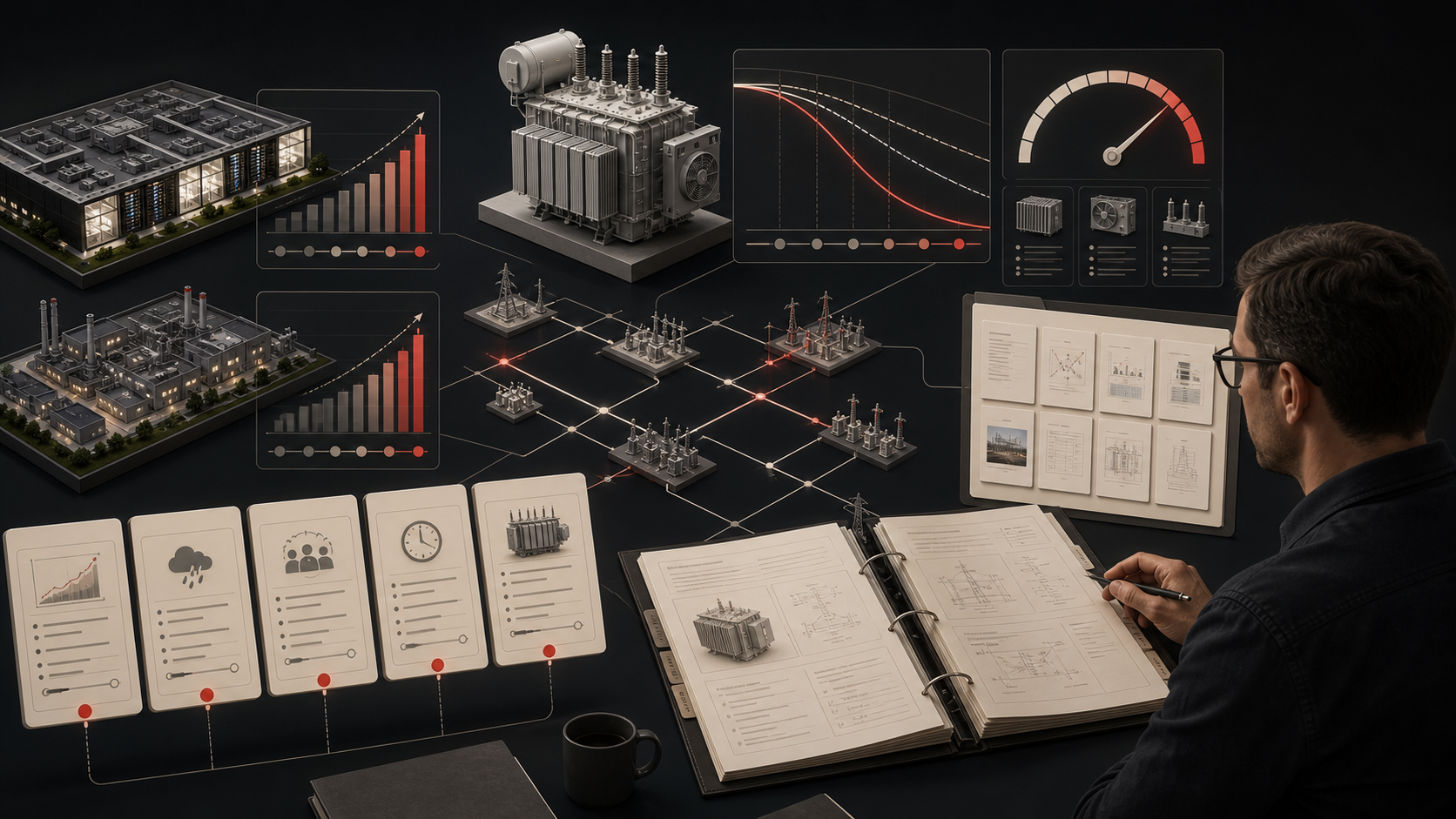
Large-load planning fails quietly when assumptions are remembered rather than recorded. A transformer study may contain a load profile, a network model, protection settings, control behavior, and an expected commissioning sequence, yet the package becomes difficult to audit when the files are separated from the assumptions that shaped them.
The answer is an evidence pack with a visible chain from request to model to field result. It should let a planner or engineer identify what was assumed, why it was selected, who approved it, what changed, and which commissioning or operating evidence should update the study.
Why large loads change the transformer evidence problem
NERC’s Large Loads Task Force describes emerging loads through more than peak demand. Computational, industrial, and other power-electronic loads can have control behavior, ramping, power-quality, stability, ride-through, cyber, and observability implications. Those characteristics affect transformer planning even when the transformer itself has not changed.
For the evidence pack, “large load” is therefore not just a nameplate field. It is a set of assumptions about normal demand, abnormal behavior, backup systems, reactive support, control modes, protection interfaces, load restoration, and the data available to planners and operators. A transformer APM record that omits those assumptions can misread a later temperature trend or event record.
The auditable evidence-pack structure
Use stable identifiers and explicit ownership for each layer.
| Evidence layer | Record it as | Approval question |
|---|---|---|
| Scope and identity | Point of interconnection, transformer and bay IDs, study case, facilities included, and excluded interfaces | Is the study boundary complete and unambiguous? |
| Electrical assumptions | Load shape, power factor, voltage range, fault contribution, harmonic or power-quality assumptions, and contingency cases | Are the assumptions sourced, dated, and appropriate to the decision? |
| Control behavior | Normal, fault, ride-through, restart, backup, and demand-response modes with owners for each model or document | Does the model represent the behavior that matters to the grid? |
| Transformer context | Rating, impedance, tap range, cooling, thermal limits, protection functions, monitoring, and maintenance constraints | Can the transformer team interpret the study in asset context? |
| Evidence quality | Source file, version, timestamp, units, time zone, data gaps, and validation notes | Can another reviewer reproduce the input set? |
| Decision and change log | Reviewer, disposition, approved version, open issue, expiry or re-review trigger | What may be used, by whom, and until when? |
NERC’s emerging-large-load material is especially useful here because it identifies observability and data risk alongside planning, operations, stability, and security risk. The evidence pack should make those categories visible instead of hiding them in a narrative appendix.
From planning to commissioning and maintenance
-
Intake the request. Capture the proposed load purpose, operating modes, schedule assumptions, interconnection boundary, transformer scope, and responsible planning authority. Mark commercial or customer-supplied data as such; do not turn an estimate into a verified measurement.
-
Version the study inputs. Store the network model, load model, control descriptions, protection files, equipment data, and source correspondence as a coherent snapshot. Record units, base quantities, time references, and the relationship between the model and the physical design.
-
Review the transformer consequences. Connect the study to thermal/loading, tap changer, cooling, insulation, protection, power-quality, and outage assumptions. The large-load transformer planning guide and computational-load evidence pack provide adjacent review patterns.
-
Define commissioning evidence before energization. Specify which measurements, protection tests, control-mode checks, event captures, communications checks, and as-built documents will confirm the study assumptions. IEC or IEEE references may define the method, but the project still needs an approved acceptance record and a named reviewer.
-
Reconcile field results. If measured behavior differs from the model, preserve both the result and the disposition. Update the model only after engineering review. Do not silently replace the planning assumption or overwrite the original source file.
-
Feed operations and maintenance. Link the approved load behavior to transformer monitoring, event review, outage planning, and maintenance triggers. A later event should be traceable to the applicable model version and commissioning state.
IEEE PES-TR112 is a useful boundary-setting reference for protection and control: it discusses practical AI and machine-learning applications while retaining the role of protection engineers and engineering evaluation. CIGRE Technical Brochure 946 similarly frames AI/ML in power-network operation as a deployment journey with limitations and risks. Neither source authorizes AI to make interconnection or operating decisions.
Where the products fit
AgenticGrid Pro is the power-transformer APM workbench for bringing planning context, condition evidence, event records, maintenance history, and reviewer decisions into a source-linked workbench. It can help prepare an evidence pack and reveal missing context; it does not approve an interconnection, calculate an operating limit as final authority, or issue control commands.
ProtectionAI is Windows desktop protective-relay testing software with an agentic AI copilot. It can help organize settings, test procedures, COMTRADE records, configuration evidence, and reports within documented scope. It does not control physical test sets or on-network GOOSE or Sampled Values, and it does not replace protection engineering or physical testing.
Use the GridAPM platform, pilot evaluation, and grid modernization evidence planner to define a bounded evaluation. The final interconnection, model acceptance, commissioning, protection, and OT decisions remain with the responsible engineers and operating authorities.
References
- IEEE Power System Relaying and Control Committee. (2023). Practical applications of artificial intelligence and machine learning in power system protection and control (PES-TR112). https://www.pes-psrc.org/kb/report/117.pdf
- Institute of Electrical and Electronics Engineers. (2022). IEEE standard for interconnection and interoperability of inverter-based resources associated with transmission electric power systems (IEEE Std 2800-2022). https://standards.ieee.org/ieee/2800/10453/
- International Council on Large Electric Systems. (2024). The impact of the growing use of machine learning/artificial intelligence in the operation and control of power networks from an operational perspective (Technical Brochure 946). https://www.e-cigre.org/publications/detail/946-the-impact-of-the-growing-use-of-machine-learningartificial-intelligence-in-the-operation-and-control-of-power-networks-from-an-operational-perspective.html
- Liao, Q. V., & Vaughan, J. W. (2024). AI transparency in the age of LLMs: A human-centered research roadmap. Harvard Data Science Review, Special Issue 5. https://hdsr.mitpress.mit.edu/pub/aelql9qy/release/2
- National Institute of Standards and Technology. (2024). The NIST Cybersecurity Framework (CSF) 2.0 (NIST CSWP 29). https://www.nist.gov/publications/nist-cybersecurity-framework-csf-20
- North American Electric Reliability Corporation. (2025). Characteristics and risks of emerging large loads: Large Loads Task Force white paper. https://www.nerc.com/globalassets/who-we-are/standing-committees/rstc/whitepaper-characteristics-and-risks-of-emerging-large-loads.pdf
- North American Electric Reliability Corporation. (n.d.). Large Loads Action Plan. https://prod.nerc.com/initiatives/large-loads-action-plan
References
- NERC — Characteristics and Risks of Emerging Large Loads
- NERC — Large Loads Action Plan
- IEEE PES-TR112 — Practical Applications of Artificial Intelligence and Machine Learning in Power System Protection and Control
- CIGRE Technical Brochure 946 — AI/ML in power network operation and control
- IEEE 2800 IEEE 2800-2022 — Standard for Interconnection and Interoperability of Inverter-Based Resources
- NIST Cybersecurity Framework 2.0
- Harvard Data Science Review — AI Transparency in the Age of LLMs
Questions engineers ask
What makes a large-load transformer planning assumption auditable?
Each assumption should have a source, owner, version, timestamp, units, validity boundary, reviewer, and disposition. The evidence pack should also show how the assumption affects the study, commissioning plan, or maintenance handoff.
Does a planning evidence pack approve a large-load interconnection?
No. It organizes study and commissioning evidence for the responsible planning, protection, operations, and interconnection authorities. It does not grant hosting capacity, approve a connection, or set operating limits.
Why connect large-load planning to transformer APM?
Large-load behavior changes loading, thermal context, event exposure, protection interactions, and maintenance assumptions around transformers. APM teams need the approved planning context to interpret later condition and event evidence.

