IEC 61850 Edition Migration: A Protection and Automation Test Matrix
A practical test matrix for migrating IEC 61850 projects between editions or engineering toolchains without losing protection, communications, or evidence coverage.
On this page
IEC 61850 edition migrations are sometimes treated as file-format exercises. That is too narrow for protection. A changed engineering tool, edition, firmware context, or SCL export can alter how services, data objects, datasets, control blocks, or subscriptions are represented. The migration should therefore be managed as a configuration and functional regression project.
Freeze the baseline
Collect the approved and installed SCL files, engineering-tool versions, IED firmware, settings exports, network and time design, GOOSE and sampled-value manifests, MMS or supervisory requirements, and the existing test pack. Record hashes or version identifiers according to the project record policy.
The baseline is the comparison point. Without it, a migration test can prove that the new system works in isolation but not that it retained the previous protection behavior.
Compare structure before behavior
First compare the engineered objects:
- substations, voltage levels, bays, and IED identity;
- logical nodes, data objects, functional constraints, and quality;
- data sets and control blocks;
- publisher and subscriber relationships;
- network addresses, VLAN assumptions, and redundancy;
- time synchronization and timestamp meaning;
- settings groups, logic equations, inputs, and outputs.
Any unexplained difference becomes a review item. Do not treat a tool-generated “successful import” as an engineering approval.
Regression-test the functions
Re-run the functional cases that depend on the changed context. Include GOOSE and sampled-value normal operation, supervision, loss and recovery, phase and scaling, protection-element response, blocking and permissive logic, alarms, trip outputs, and event records. For a station with multiple IEDs, test interactions rather than only device-level behavior.
Use the same expected-result basis where the function has not changed. If the expected result changes, record why and obtain the required approval.
Stage the migration
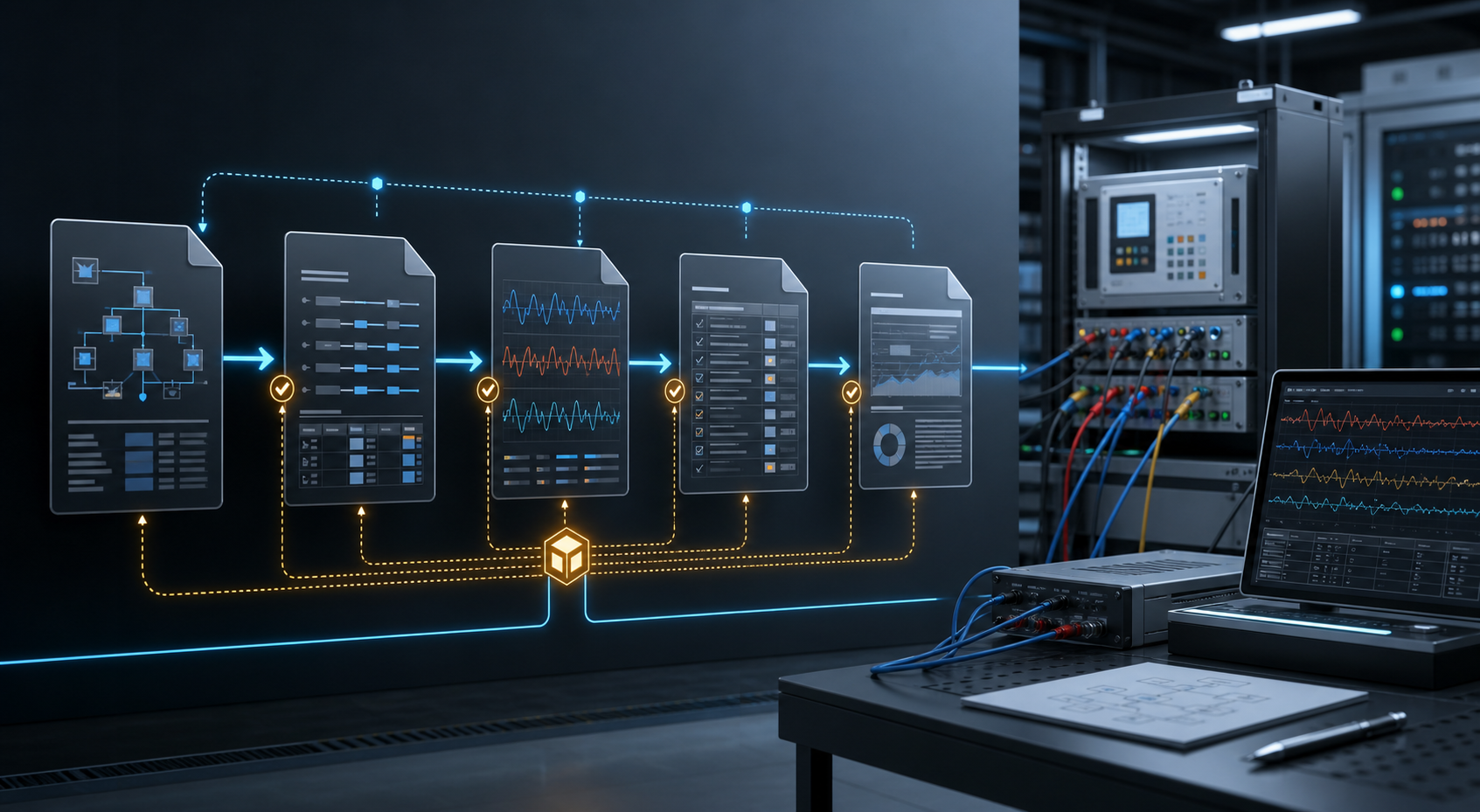
A controlled sequence may include conversion in a non-production engineering environment, offline schema and completeness checks, laboratory functional testing, site communication checks, and final field acceptance. The precise sequence depends on the project and operating constraints.
Keep migrated files separate from the approved live set until the review and test gates are closed. Preserve the rollback or restoration plan.
Use an evidence-first assistant
ProtectionAI can compare structured files, build a difference queue, map changed objects to test cases, and assemble cited evidence. That is useful when a migration has a large configuration surface. The assistant must not hide differences, edit an approved file without controlled change management, or claim that an edition migration is safe because a parser completed.
References
- International Electrotechnical Commission. (2024). Communication networks and systems for power utility automation—Part 6: Configuration description language for communication in electrical substations related to IEDs (IEC 61850-6). https://webstore.iec.ch/en/publication/103863
- International Electrotechnical Commission. (2022). Communication networks and systems for power utility automation—Part 10-3: Functional testing of IEC 61850 systems (IEC TR 61850-10-3:2022). https://webstore.iec.ch/en/publication/61395
- IEEE Power & Energy Society. (n.d.). Application testing of IEC 61850 based systems (Technical Report 84). https://resourcecenter.ieee.org/publications/technical-reports/pes_tp_tr84_psrc_120720
- CIGRE Working Group B5.53. (2019). Test strategy for protection, automation and control (PAC) functions in a fully digital substation based on IEC 61850 applications (Technical Brochure No. 760). https://www.e-cigre.org/publications/detail/760-test-strategy-for-protection-automation-and-control-pac-functions-in-a-fully-digital-substation-based-on-iec-61850-applications.html
References
- IEC 61850-6 IEC 61850-6 — Configuration description language for IEDs
- IEC 61850 IEC TR 61850-10-3:2022 — Functional testing of IEC 61850 systems
- IEC 61850 IEEE PES Technical Report 84 — Application testing of IEC 61850 based systems
- CIGRE Technical Brochure 760 — Test strategy for PAC functions in a fully digital substation
Questions engineers ask
Why does an IEC 61850 edition migration need regression testing?
A migration can change file interpretation, service behavior, data mapping, timing, or engineering-tool output even when the protection intent appears unchanged.
Can SCL validation alone prove a migration?
No. SCL validation is an important gate, but the configured application, network services, protection logic, failure behavior, and installed state still require functional verification.
What should be compared before and after migration?
Compare approved SCL, logical-node and data-object mapping, datasets, control blocks, subscriptions, network and time assumptions, settings, test cases, outputs, and final evidence.