Evidence Provenance for Transformer AI: Source, Timestamp, Unit, Reviewer
A practical provenance contract for transformer AI that records source, timestamp, unit, method, transformation, reviewer, and approval boundary for every diagnostic conclusion.
On this page
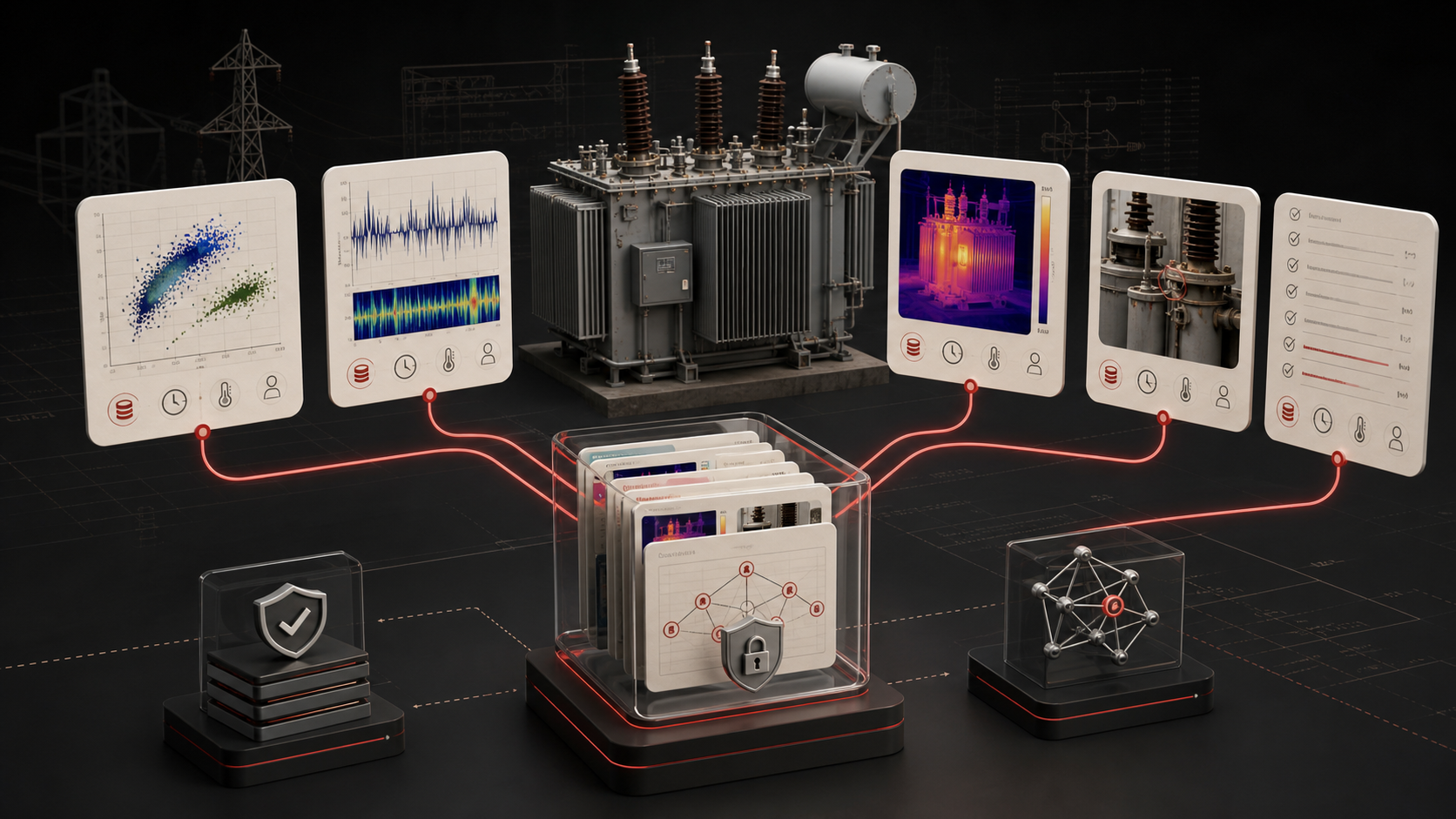
- IntakeApproved evidence streams — DGA, partial discharge, SFRA, thermal, inspection records — are read from your systems.
- Correlate & quality gateSignals are aligned per asset and screened for gaps, unit errors, and stale data before any reasoning starts.
- Agent reasoningAgents draft a condition assessment, citing each piece of evidence and flagging contradictions instead of hiding them.
- EngineerEngineer sign-offA qualified engineer approves, edits, rejects, or escalates the draft. Nothing ships without a named reviewer.
- Work package & reportApproved decisions become maintenance work packages and audit-ready reports for your CMMS and stakeholders.
Transformer AI should be able to answer four basic questions before it asks anyone to trust a conclusion: where did this evidence come from, when was it measured, what does the unit mean, and who reviewed the result? Add the method, transformation history, access boundary, uncertainty, and approval state, and the output becomes a record that an engineer can inspect rather than a sentence that disappears into a chat transcript.
This is evidence provenance. It is especially important for DGA, online monitors, SFRA, thermal history, inspections, and work-order records because each source has different clocks, units, methods, and failure modes.
The minimum provenance contract
For every raw observation, capture:
- Asset identity: fleet, site, transformer, component, serial number, sensor, and configuration.
- Source: laboratory, monitor, historian, test instrument, inspection, CMMS, file, record ID, or API endpoint.
- Time: measurement time, sample time, receipt time, import time, time zone, and clock-quality flag where relevant.
- Quantity: value, unit, detection limit, precision, missing-value code, and any normalization.
- Method: sampling, extraction, instrument, test setup, calibration or verification, tap position, load, or operating state.
- Transformation: formulas, resampling, unit conversion, interpolation, baseline selection, rule version, and model version.
- Actor: importing system, agent identity, delegated user, reviewer, approver, and permission scope.
- Outcome: draft, reviewed, accepted, rejected, escalated, deferred, or superseded.
The power transformer diagnostic data model explains why this contract should sit beneath individual diagnostic channels. Do not collapse a DGA lab result, an online monitor point, and an SFRA trace into one score before preserving their distinct provenance.
A commissioning workflow that tests provenance
Before connecting a source, define its record contract. For DGA, list gas names, units, sample date, laboratory identifier, detection limits, and interpretation status. For online monitoring, list gas coverage, monitor ID, heartbeat, calibration or verification record, communications path, and clock behavior. For SFRA, preserve instrument, lead placement, grounding, tap position, baseline, and comparison event; IEEE C57.149 makes long-term storage and repeatable interpretation part of the measurement context.
Run four tests before production use: a valid record, a missing-unit record, a duplicate timestamp, and a record mapped to the wrong asset. The expected behavior is not silent repair. The workflow should retain the raw record, create a visible exception, and require a person to resolve the mapping or quality issue.
At calculation time, store the input record IDs beside the derived value. If a gas generation rate is calculated, preserve the two source observations, interval, unit, formula, and rounding. If an AI summary says “rising trend,” the record should show which observations support that phrase. IEEE C57.104 and IEC 60599 can provide interpretation context; they do not authorize the system to convert a threshold into a trip or maintenance order.
Provenance and AI risk management
NIST’s AI RMF 1.0 is voluntary and use-case agnostic, but its governance, mapping, measurement, and management functions translate well to transformer APM. Govern the owner, permissions, retention, and review path. Map the intended use, affected assets, operating context, and failure consequences. Measure data quality, model or rule performance, reviewer disagreement, and uncertainty. Manage the risk by limiting tools, escalating ambiguous cases, and recording outcomes.
Agent identity matters when the workflow can query systems or stage a CMMS handoff. Log which agent ran, which user delegated the task, which sources it accessed, whether the access was read-only, and what write boundary existed. If evidence may include BES Cyber System Information, consult the responsible security and compliance teams about NERC CIP-011-3, classification, access, and retention.
Illustrative provenance record, not a customer measurement
An illustrative record might read: “TX-203, main tank, hydrogen 118 ppm, laboratory report LAB-2048, sampled 2026-07-22 09:00 UTC, reported in µL/L, method and quality flag present, imported 2026-07-23, compared with LAB-1999, rate calculation v2, draft summary by agent A-04, reviewed by engineer E-17.” This is invented to show field structure. It is not a customer measurement, a fault diagnosis, or a maintenance instruction.
Review and retention
A reviewer should be able to open the source record, see the transformation, inspect contradictions, and edit or reject the draft. The system should preserve the original AI output, the reviewer changes, the decision rationale, and the final status. A later work package should link back to the same evidence rather than copying an untraceable paragraph.
The audit-trail workflow adds the decision and outcome loop. The human-in-the-loop AI article provides the governance pattern. A sample evidence pack is a useful review artifact before real data is integrated.
Product boundary
AgenticGrid Pro is described here as a bounded transformer APM workbench for assembling permitted records, showing provenance, calculating configured indicators, and drafting source-linked review material. ProtectionAI is GridAPM’s separate Windows relay-testing application; a test report can become a provenance-linked input, but neither product grants autonomous OT authority. They do not replace qualified engineers, laboratory analysis, calibration, physical test equipment, or the utility’s CMMS and security controls. Final decisions and OT actions remain engineer-approved.
References
- Tabassi, E. (2023). Artificial intelligence risk management framework (AI RMF 1.0) (NIST AI 100-1). National Institute of Standards and Technology. https://doi.org/10.6028/NIST.AI.100-1
- North American Electric Reliability Corporation. (n.d.). CIP-011-3: Cyber Security—Information Protection. Retrieved August 1, 2026, from https://prod.nerc.com/standards/reliability-standards/cip/cip-011-3
- IEEE. (2019). IEEE guide for the interpretation of gases generated in mineral oil-immersed transformers (IEEE Std C57.104-2019). https://standards.ieee.org/ieee/C57.104/7476/
- IEEE. (2024). IEEE guide for the application and interpretation of frequency response analysis for oil-immersed transformers (IEEE Std C57.149-2024). https://standards.ieee.org/ieee/C57.149/7354/
- International Electrotechnical Commission. (2022). Mineral oil-filled electrical equipment in service—Guidance on the interpretation of dissolved and free gases analysis (IEC 60599:2022). https://webstore.iec.ch/en/publication/66491
- CIGRE. (2019). DGA monitoring systems (Technical Brochure 783). https://www.e-cigre.org/publications/detail/783-dga-monitoring-systems.html
- Thang, K. F., Aggarwal, R. K., McGrail, A. J., & Esp, D. G. (2003). Analysis of power transformer dissolved gas data using the self-organizing map. IEEE Transactions on Power Delivery, 18(4), 1241–1248. https://doi.org/10.1109/TPWRD.2003.817733
References
- NIST AI RMF NIST AI RMF 1.0
- NERC CIP-011 NERC CIP-011-3: Cyber Security—Information Protection
- IEEE C57.104 IEEE C57.104-2019: Guide for the Interpretation of Gases Generated in Mineral Oil-Immersed Transformers
- IEEE C57.149 IEEE C57.149-2024: Application and Interpretation of Frequency Response Analysis
- IEC 60599 IEC 60599:2022: Interpretation of dissolved and free gases analysis
- CIGRE TB 783 CIGRE TB 783: DGA monitoring systems
- Thang et al., Analysis of power transformer dissolved gas data using the self-organizing map
Questions engineers ask
What provenance fields should transformer AI preserve?
At minimum, preserve asset and component identity, source record, timestamp and time zone, unit, method, calibration or quality status, transformation history, model or rule version, agent identity, reviewer identity, permissions, uncertainty, and decision state.
Why are timestamp and unit as important as the AI output?
A trend, ratio, or comparison is only meaningful when the values are comparable in time and scale. Missing timestamps or units can make a precise-looking calculation misleading.
Does provenance make an AI recommendation an approved engineering decision?
No. Provenance makes a recommendation inspectable. Qualified engineers still interpret the evidence, approve or reject the action, and control all maintenance and OT decisions.


