CMMS/EAM Handoff for Transformer APM: Preserve Evidence When Work Becomes a Task
A practical CMMS and EAM handoff workflow for transformer APM that preserves asset identity, source evidence, approvals, assumptions, and maintenance closeout records.
On this page
A transformer APM finding is not finished when a dashboard shows a priority. It becomes operational only when the evidence survives the handoff into a CMMS or EAM system. That handoff is where asset identity, source files, assumptions, approvals, and field feedback can be reduced to a sentence such as “inspect transformer.” Once that happens, the task may be executable, but it is no longer easy to audit.
The goal is not to copy every diagnostic detail into a work-order screen. The goal is to preserve a traceable relationship between the source evidence, the engineering interpretation, the approved work scope, and the maintenance result.
Why the handoff loses meaning
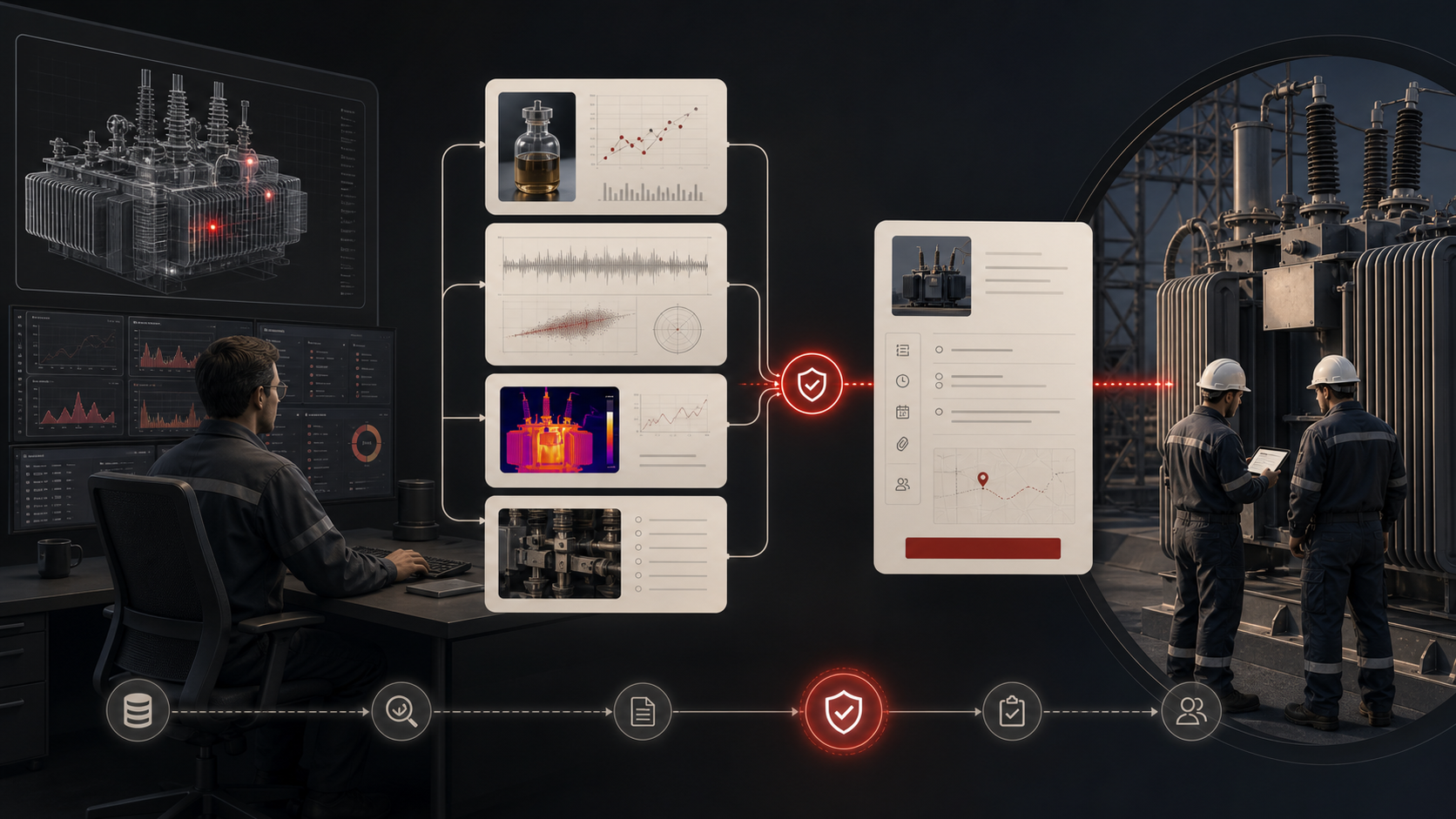
APM teams work with records that rarely share one native structure: DGA laboratory reports, online monitor exports, thermal history, inspection notes, relay events, protection settings, outage constraints, spare information, and prior work orders. A CMMS or EAM record usually needs a concise task, a responsible crew, a due date, safety controls, and closeout fields. Compression is necessary, but silent compression is dangerous.
The power transformer diagnostic data model describes the evidence layer behind a decision. The CMMS/EAM handoff must retain enough of that layer to answer five questions later: Which asset was involved? Which source records were used? What did the reviewer approve? What was intentionally excluded? What did the field team find?
The evidence that should travel with the task
Treat the work item as a controlled pointer to an evidence pack, not as a replacement for it.
| Handoff field | Minimum content | Review purpose |
|---|---|---|
| Asset identity | Utility asset ID, site, bay, transformer designation, and parent-child relationships | Prevents a valid task from being attached to the wrong equipment |
| Trigger | Signal, event, inspection finding, backlog item, or planning constraint | States why the task exists without overstating the diagnosis |
| Source evidence | File or record IDs, timestamps, source system, units, and attachment checksums where available | Makes the interpretation reproducible |
| Engineering context | Loading, cooling state, recent switching, DGA/oil context, protection or event context, and known data gaps | Prevents isolated data from becoming a false conclusion |
| Decision record | Proposed scope, alternatives considered, reviewer, approval state, and conditions | Separates AI drafting from engineering authority |
| Closeout contract | Required measurements, photos, test results, settings confirmation, defects, and follow-up owner | Brings field evidence back into the APM record |
This structure also supports security review. NIST SP 800-82 Rev. 3 treats OT as a safety- and reliability-constrained environment, so an EAM integration should not quietly become a new path into control systems. The integration should exchange approved records through a controlled interface, with least-privilege identities, logging, and a clear boundary between evidence management and OT action.
A controlled workflow from signal to task
-
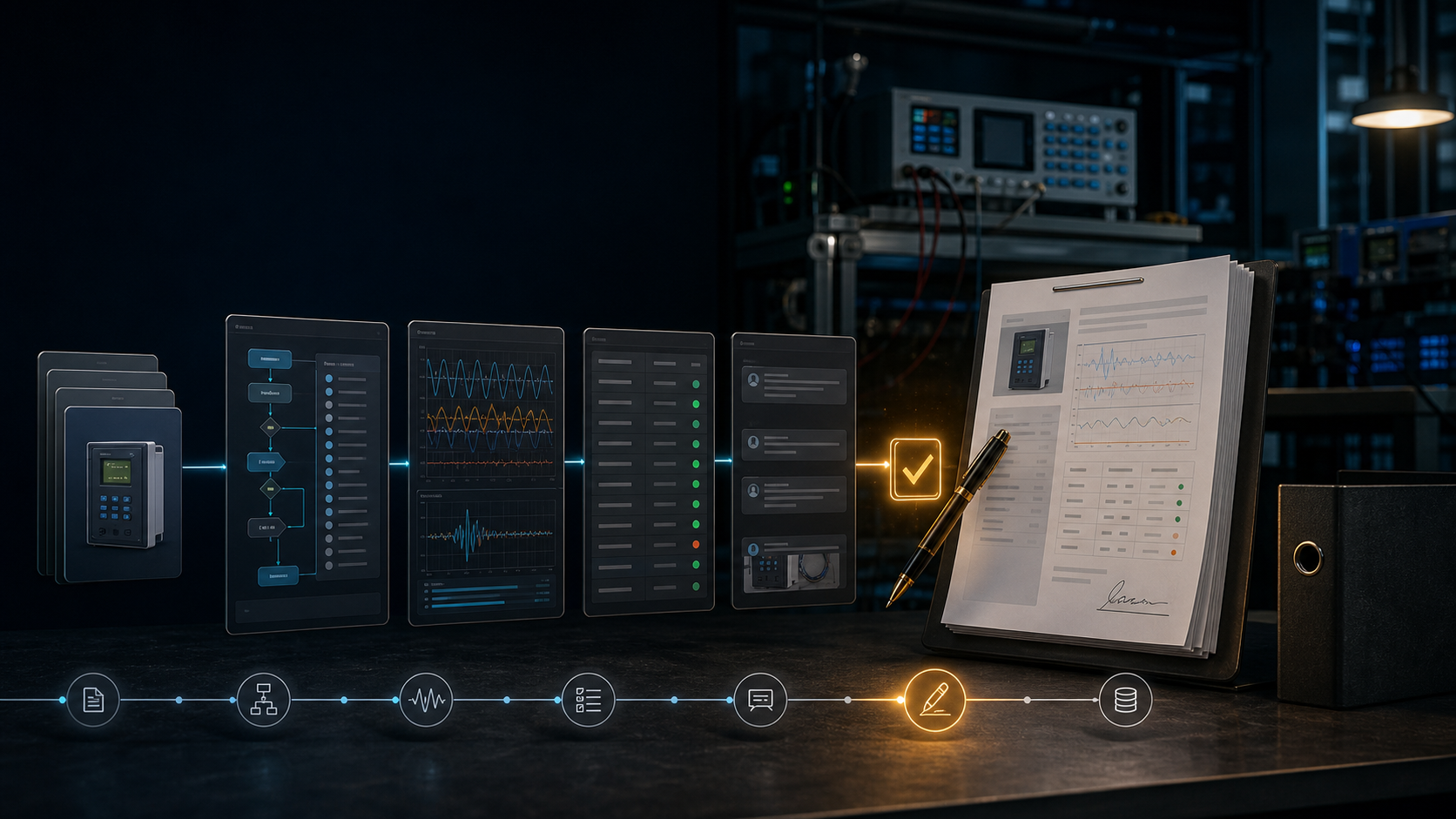
Intake and identify. Resolve the transformer against the system of record before interpreting the signal. Record the source, timestamp, time zone, units, data quality notes, and any duplicate or superseded record. If the identity cannot be resolved, stop at an investigation item.
-
Correlate and frame. Join the trigger to relevant condition, event, loading, inspection, protection, and maintenance context. A rising gas value, for example, should not be described without sample provenance, recent oil work, loading conditions, and the applicable engineering method. Link the source records rather than pasting an uncited conclusion.
-
Draft the work package. State the observation, the bounded interpretation, the proposed task, required isolation or access assumptions, acceptance evidence, and unresolved questions. Use a neutral status such as “requires engineering review” when the evidence does not support a work decision.
-
Approve before creation. The asset engineer, maintenance planner, protection reviewer, and operations or safety reviewer should see the same evidence boundary. The approver should be able to edit, reject, defer, or request more evidence. Approval should record the package version and the source versions used.
-
Execute and return evidence. The crew closes the task with the measurements and observations defined in the handoff. New test files, photos, settings exports, samples, and exceptions should be attached to the same asset and linked back to the original trigger. If the finding was not confirmed, preserve that outcome; a negative result is valuable maintenance evidence.
Commissioning, maintenance, and relay context
For commissioning or protection-related work, a task should carry the approved settings revision, test procedure, as-found/as-left distinction, and the record of who reviewed the result. The Bureau of Reclamation’s FIST 6-4 is a useful public example of why relay-setting management depends on controlled records and review. IEEE 1686 adds a cybersecurity lens for IED access, configuration, firmware revision, and data retrieval. These sources do not turn a CMMS into a protection system; they show why the handoff must preserve configuration and authority boundaries.
The AI transformer maintenance work-package builder and sample evidence pack illustrate the kind of source-linked output a pilot can test. GridAPM’s pilot workflow and data handling pages provide the surrounding scope for approved data and reviewer roles.
Where ProtectionAI and AgenticGrid Pro fit
ProtectionAI is Windows desktop protective-relay testing software with an agentic AI copilot. In a governed handoff, it can help organize relay settings, test plans, COMTRADE or configuration evidence, and reports within its documented scope. It does not drive physical test sets, provide on-network GOOSE or Sampled Values control, or replace qualified protection engineers or physical test equipment.
AgenticGrid Pro is the power-transformer APM workbench. It can support source-linked condition, maintenance, and review workflows, but it does not approve work, dispatch crews, issue OT commands, or make a final transformer diagnosis without qualified review. The CMMS or EAM remains the system of record for the authorized task, while the evidence pack preserves why that task exists.
The practical rule is simple: let the task system manage execution, and let the evidence model preserve meaning. Final work scope, isolation, protection changes, and OT actions remain engineer-approved.
References
- Institute of Electrical and Electronics Engineers. (2022). IEEE standard for intelligent electronic devices cybersecurity capabilities (IEEE Std 1686-2022). https://standards.ieee.org/ieee/1686/7207/
- Institute of Electrical and Electronics Engineers. (2021). IEEE standard model process for addressing ethical concerns during system design (IEEE Std 7000-2021). https://standards.ieee.org/ieee/7000/6781/
- National Institute of Standards and Technology. (2023). Guide to operational technology (OT) security (NIST Special Publication 800-82 Rev. 3). https://csrc.nist.gov/pubs/sp/800/82/r3/final
- National Institute of Standards and Technology. (2023). Artificial intelligence risk management framework (AI RMF 1.0). https://www.nist.gov/itl/ai-risk-management-framework
- North American Electric Reliability Corporation. (n.d.). PRC: Protection and control reliability standards. https://www.nerc.com/standards/reliability-standards/prc
- U.S. Department of the Interior, Bureau of Reclamation. (2022). Management of protective relay settings (FIST 6-4). https://www.usbr.gov/power/data/fist/FIST_6-4_%281-2022%29.pdf
References
- NIST AI RMF NIST AI Risk Management Framework
- NIST SP 800-82 Rev. 3 — Guide to Operational Technology Security
- IEEE 7000 IEEE 7000-2021 — Model Process for Addressing Ethical Concerns During System Design
- IEEE 1686 IEEE 1686-2022 — Intelligent Electronic Devices Cybersecurity Capabilities
- NERC — Protection and Control Reliability Standards
- U.S. Bureau of Reclamation — FIST 6-4, Management of Protective Relay Settings
Questions engineers ask
What should travel from transformer APM into a CMMS or EAM record?
Carry the asset identity, evidence references, timestamps, condition context, assumptions, uncertainty, proposed scope, reviewer decisions, approvals, attachments, and the expected closeout evidence. A short task description alone is not a defensible handoff.
Should AI create or dispatch a transformer work order?
No. AI may draft a work package or suggest missing fields, but a qualified maintenance or asset engineer should approve the scope, and the utility's existing CMMS or EAM authority should create and dispatch the task.
What happens when the evidence is incomplete?
Keep the gap visible. Route the record to clarification, inspection, sampling, or engineering review rather than converting an uncertain recommendation into an apparently complete maintenance task.