Climate-Aware Transformer Maintenance Decisions: Heat, Loading, and Evidence
A climate-aware transformer maintenance workflow for connecting ambient heat, loading, cooling, thermal evidence, and maintenance action without treating a forecast as a diagnosis.
On this page
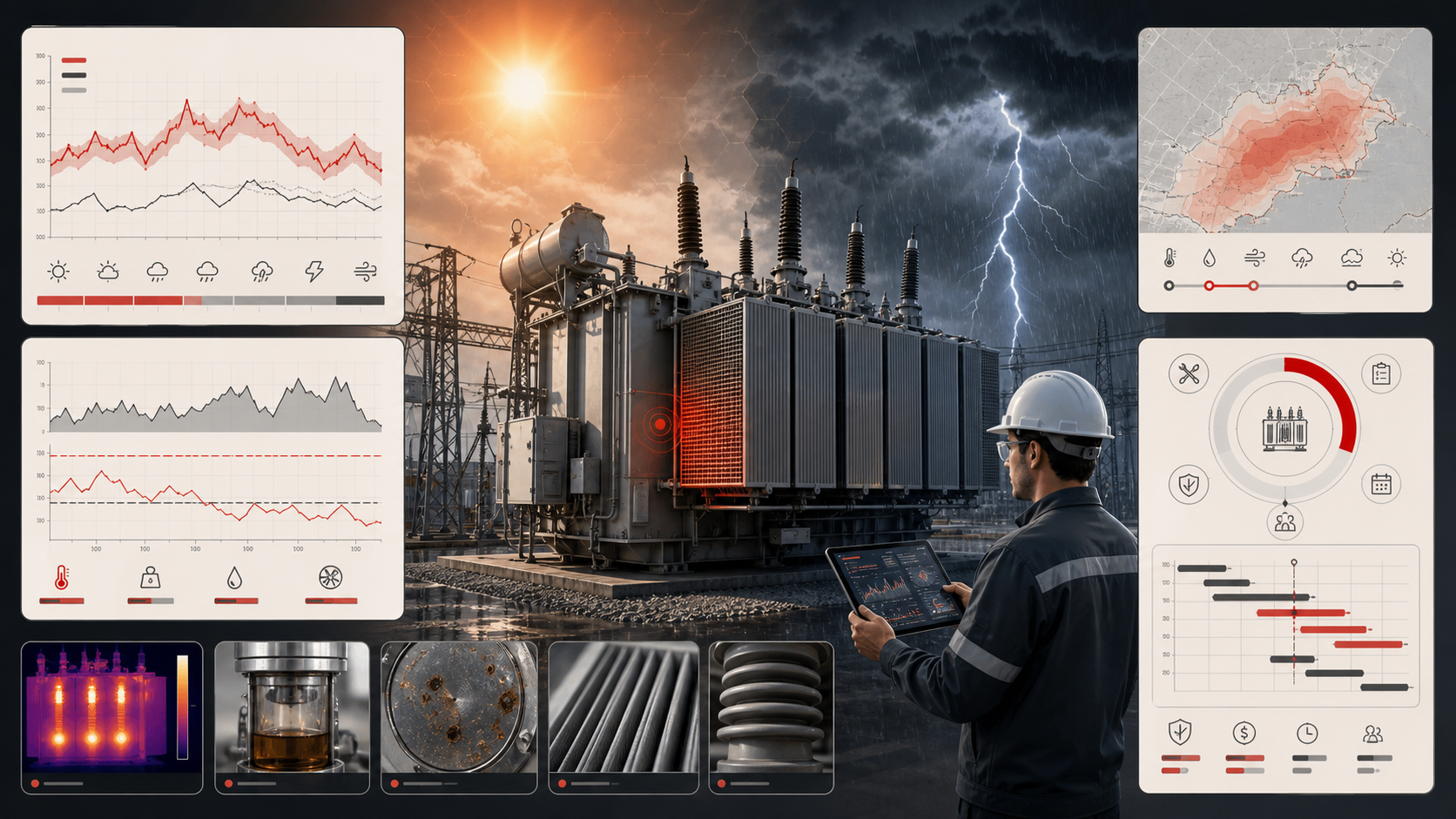
Climate-aware transformer maintenance is not a request to predict the future with false precision. It is a discipline for making heat and loading assumptions visible before they become maintenance surprises. The practical unit of work is an evidence pack that links local ambient conditions, actual loading, cooling performance, thermal measurements, insulation indicators, and the action an engineer is being asked to approve.
Separate climate scenarios from equipment evidence
Start with two layers. The first is the scenario layer: historical ambient data, heat-wave frequency, projected temperature ranges, load-growth cases, water or air-cooling constraints, and the planning horizon. The second is the equipment layer: nameplate, design temperature rise, top-oil and winding or hot-spot indications, fan and pump status, oil condition, DGA, moisture, inspection findings, and maintenance history.
The layers should be linked, not blended. A climate scenario can change the stress case; it does not prove that a particular transformer has degraded. Likewise, a high temperature alarm is evidence of an operating condition, not by itself a root-cause diagnosis. IEEE C57.91-2025 provides the loading context for considering ambient temperature, cooling, temperature criteria, and above-nameplate scenarios.
Establish the baseline during commissioning
Commissioning should capture the information needed for later seasonal comparisons. Preserve the transformer design basis, sensor locations, calibration records, cooling-control logic, alarm and trip settings, tap position, load conditions, ambient temperature, oil level, and test configuration. If a thermal model estimates winding hot-spot temperature, keep the model version and inputs with the record.
During controlled energization and load increase, record when fans or pumps stage in, how the top-oil indication responds, whether the observed response is plausible for the design, and whether any alarms appear early or late. This is not a license to exceed approved loading. It is a way to create an as-commissioned reference that can be compared with later hot-weather observations.
The U.S. Bureau of Reclamation transformer guide is a useful reminder that manufacturer information, equipment-specific conditions, and engineering judgment belong in the diagnostic record. A generic limit copied from another transformer is not a commissioning baseline.
Use a seasonal maintenance loop
Before the hot season, review cooling availability, fan and pump inspection results, radiator cleanliness, control power, temperature sensors, oil leaks, bushings, tap changers, and outstanding corrective work. Refresh the load scenarios with the planning and operations teams. Confirm which evidence is current and which is being carried forward as an assumption.
During a heat event, preserve time-aligned loading, ambient, top-oil, hot-spot estimate, cooling state, alarms, tap position, and system configuration. Do not rely on a screenshot without the source timestamp. If the unit operates close to an approved limit, an engineer should review whether load transfer, cooling repair, temporary operating restrictions, additional sampling, or an outage is appropriate.
After the event, compare the observed response with the baseline. Investigate persistent changes, repeated alarms, abnormal oil or DGA results, fan or pump failures, and differences between redundant sensors. The result may be no action, a targeted repair, a revised inspection interval, a model review, or a broader asset-management decision. The evidence should show why.
Treat research as a scenario input
Research on regional climate and transformer loadability, including Bicen and Aras, shows why ambient-temperature profiles belong in lifecycle analysis. MIT research on heat-wave modeling likewise illustrates why the timing and persistence of hot conditions matter for large transformers. These studies support scenario design; they do not establish a universal temperature threshold or a guaranteed life outcome for a utility’s fleet.
The DOE large power transformer resilience report places heat, aging, cooling, and resilience in a broader equipment context. A maintenance program can use that context to ask better questions: which units face the most coupled heat-and-load exposure, which cooling systems are single points of failure, which sensors are unverified, and which planned outages would reduce uncertainty?
Where the GridAPM products fit
AgenticGrid Pro can organize dated weather scenarios, loading history, thermal records, cooling work orders, DGA, PRPD, SFRA, and inspection evidence into a source-linked transformer review. It can draft a maintenance narrative and surface missing assumptions, but a named engineer remains responsible for diagnosis, limits, and work approval.
ProtectionAI is a separate relay-testing workbench. Its bounded simulator and reporting workflow can support protection commissioning evidence, but it does not calculate a transformer’s climate exposure or authorize a loading, cooling, switching, or maintenance action. Both products are decision-support tools; neither replaces qualified engineers or physical test equipment.
Use the condition-based maintenance guide and transformer evidence-readiness checklist to turn the seasonal loop into a controlled pilot.
References
Bicen, Y., & Aras, F. (2014). Loadability of power transformer under regional climate conditions: The case of Turkey. Electrical Engineering, 96, 347–358. https://doi.org/10.1007/s00202-014-0301-6
Institute of Electrical and Electronics Engineers. (2025). IEEE guide for loading mineral-oil-immersed transformers and step-voltage regulators (IEEE C57.91-2025). https://standards.ieee.org/ieee/C57.91/7163/
International Council on Large Electric Systems. (2025). Guide for transformer maintenance (Technical Brochure 962). https://www.e-cigre.org/publications/detail/962-guide-for-transformer-maintenance.html
Massachusetts Institute of Technology Joint Program on the Science and Policy of Global Change. (2017). Application of the analogue method to modeling heat waves: A case study with power transformers (Report 317). https://globalchange.mit.edu/sites/default/files/MITJPSPGC_Rpt317.pdf
National Institute of Standards and Technology. (2023). Artificial intelligence risk management framework (AI RMF 1.0). https://www.nist.gov/itl/ai-risk-management-framework
U.S. Bureau of Reclamation. (2005). Transformers: Basics, maintenance, and diagnostics. https://www.usbr.gov/tsc/techreferences/mands/mands-pdfs/Trnsfrmr.pdf
U.S. Department of Energy. (2024, July). Large power transformer resilience. https://www.energy.gov/sites/default/files/2024-10/EXEC-2022-001242%20-%20Large%20Power%20Transformer%20Resilience%20Report%20signed%20by%20Secretary%20Granholm%20on%207-10-24.pdf
References
- IEEE C57.91 IEEE C57.91-2025, Guide for Loading Mineral-Oil-Immersed Transformers
- U.S. Department of Energy, Large Power Transformer Resilience Report
- CIGRE Technical Brochure 962, Guide for Transformer Maintenance
- MIT Joint Program, Application of the Analogue Method to Modeling Heat Waves
- Bicen and Aras, Loadability of Power Transformer under Regional Climate Conditions
- U.S. Bureau of Reclamation, Transformers: Basics, Maintenance, and Diagnostics
- NIST AI RMF NIST AI Risk Management Framework
Questions engineers ask
What makes transformer maintenance climate-aware?
It connects local ambient-temperature and weather scenarios to actual loading, cooling availability, hotspot or top-oil evidence, insulation indicators, and maintenance triggers rather than relying on a generic climate label.
Does a hotter forecast automatically require transformer replacement?
No. A forecast is a planning input. Engineers must review design assumptions, measured response, cooling condition, loading alternatives, uncertainty, and the consequences of each maintenance or replacement option.
How can AI support climate-aware transformer maintenance?
A bounded workflow can assemble dated weather, loading, thermal, inspection, and maintenance records, surface missing evidence, and draft review questions. It should not change loading, cooling, switching, or maintenance state autonomously.


