Data-Center Transformer Evidence Packs: Linking Load Growth, Thermal Margin, and Maintenance
A practical workflow for connecting data-center load growth, transformer thermal margin, commissioning records, and maintenance evidence in a human-reviewed decision pack.
On this page
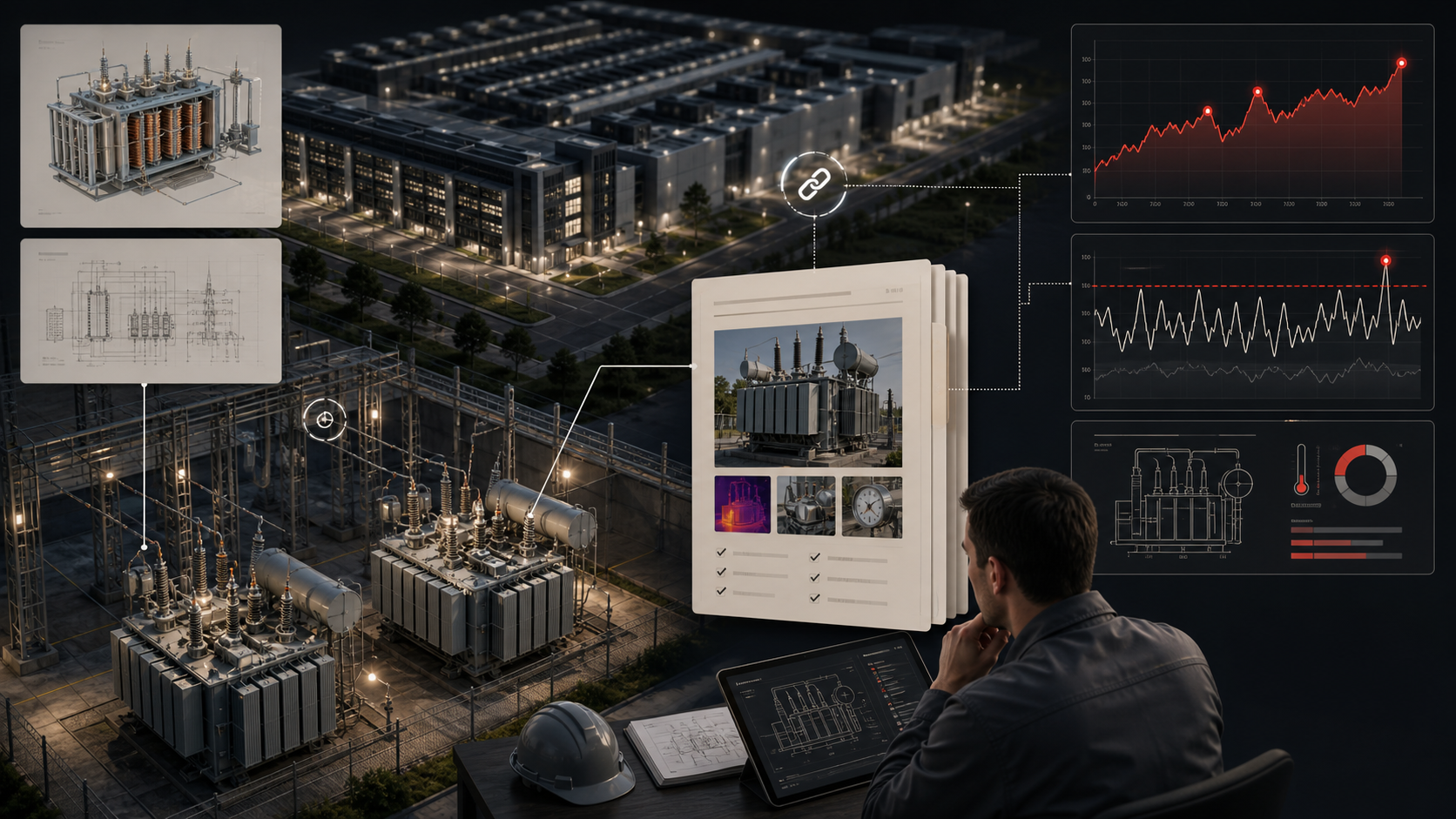
Data-center expansion changes a transformer question from “what is the rating?” to “what evidence supports the next loading scenario?” A useful evidence pack connects the forecast, the design basis, the commissioning record, the measured thermal response, and the maintenance history. It gives the responsible engineer one place to inspect assumptions before approving an operating or capital decision.
Start with the load-growth question
The first page should define the load being evaluated, not just a nameplate total. Record the data-center phases, expected energization dates, coincident demand, power factor, harmonic profile, cooling-mode assumptions, redundancy arrangement, and any staged ramp. Identify which values are measured, which are contractual, and which are forecasts. A load forecast without a timestamp, owner, or scenario label is not yet decision evidence.
Link that forecast to the transformer population affected. The pack should identify the unit, voltage class, MVA rating, cooling designation, tap range, impedance, age, and network role. Include the contingency or transfer assumptions used by planning. The large-load transformer planning guide and computational-load evidence pack provide useful internal starting points for defining this boundary.
Build the commissioning evidence chain
Commissioning is where a future maintenance record begins. Preserve the approved single-line diagram, nameplate and factory data, transformer ratio and winding-resistance results, insulation and oil records, protection and control settings, cooling-control checks, alarm and trip tests, and the as-left configuration. Record test equipment identifiers, calibration status, test date, tap position, temperature, connection method, and reviewer.
For a new large load, add a controlled load-ramp record. Note when each cooling stage started, how top-oil and winding or hot-spot indications responded, whether fans and pumps were available, and whether the measured response matched the design model. The purpose is not to manufacture a universal margin number. It is to establish a traceable baseline that later maintenance teams can compare with actual service conditions.
Physical testing, energization, switching, and acceptance remain the responsibility of qualified commissioning and protection personnel. An evidence system can flag a missing calibration certificate or an unexplained alarm, but it cannot turn an incomplete test into acceptance.
Treat thermal margin as a scenario
IEEE C57.91 describes loading effects, ambient-temperature variation, cooling, and temperature criteria. In practice, the evidence pack should show the inputs behind every thermal conclusion: ambient temperature, current or MVA, phase balance, top-oil measurement, winding or hot-spot estimate, cooling stage, fan or pump availability, tap position, harmonics, and duration.
Separate at least three statements:
- The transformer’s nameplate rating under its specified design conditions.
- The expected thermal response for the stated load and ambient scenario.
- The remaining maintenance or operational margin after measurement quality and equipment availability are considered.
This distinction matters for data centers because the highest load may coincide with high ambient temperature or degraded cooling availability. A pack should show the scenario range and the evidence gap, not compress every uncertainty into a green status.
Connect maintenance evidence to the load decision
Maintenance context can change the interpretation of a loading request. Bring in DGA results under the methods described by IEEE C57.104 and IEC 60599, oil quality, bushing and tap-changer findings, cooling-system work orders, alarm history, inspections, and prior thermal events. Keep source files linked and retain the original measurement; a summary should never overwrite it.
A practical review cycle is:
- Before a load phase: refresh the forecast, verify the thermal model inputs, inspect cooling readiness, and identify overdue tests.
- During commissioning or ramp: capture measured loading, ambient, temperatures, alarms, and control-state changes with timestamps.
- After the ramp: compare expected and observed response, document deviations, and route follow-up work to the responsible engineer.
- During service: review trends at an agreed cadence and reopen the evidence pack when loading, climate, maintenance, or network configuration changes.
The transformer CBM evidence checklist can help teams decide whether the evidence is ready for that review.
Where the GridAPM products fit
AgenticGrid Pro is GridAPM’s local-first transformer APM workbench. Within an approved data boundary, it can organize load, thermal, DGA, PRPD, SFRA, nameplate, and maintenance records, apply quality gates, surface missing evidence, draft reasoning, and produce a source-linked evidence pack. A named engineer must edit, approve, reject, or escalate the assessment.
ProtectionAI is a separate Windows protective-relay testing application with a bounded copilot and built-in simulator. It can support relay-test planning and reporting; it is not a transformer thermal model, a commissioning acceptance authority, or a substitute for qualified physical test equipment.
References
International Electrotechnical Commission. (2022). Mineral oil-filled electrical equipment in service—Guidance on the interpretation of dissolved and free gases analysis (IEC 60599:2022). https://webstore.iec.ch/en/publication/66491
Institute of Electrical and Electronics Engineers. (2025). IEEE guide for loading mineral-oil-immersed transformers and step-voltage regulators (IEEE C57.91-2025). https://standards.ieee.org/ieee/C57.91/7163/
Institute of Electrical and Electronics Engineers. (2019). IEEE guide for the interpretation of gases generated in mineral oil-immersed transformers (IEEE C57.104-2019). https://standards.ieee.org/ieee/C57.104/7476/
National Institute of Standards and Technology. (2023). Artificial intelligence risk management framework (AI RMF 1.0). https://www.nist.gov/itl/ai-risk-management-framework
U.S. Bureau of Reclamation. (2005). Transformers: Basics, maintenance, and diagnostics. https://www.usbr.gov/tsc/techreferences/mands/mands-pdfs/Trnsfrmr.pdf
U.S. Department of Energy. (2024, July). Large power transformer resilience. https://www.energy.gov/sites/default/files/2024-10/EXEC-2022-001242%20-%20Large%20Power%20Transformer%20Resilience%20Report%20signed%20by%20Secretary%20Granholm%20on%207-10-24.pdf
International Council on Large Electric Systems. (2025). Guide for transformer maintenance (Technical Brochure 962). https://www.e-cigre.org/publications/detail/962-guide-for-transformer-maintenance.html
References
- U.S. Department of Energy, Large Power Transformer Resilience Report
- IEEE C57.91 IEEE C57.91-2025, Guide for Loading Mineral-Oil-Immersed Transformers
- IEEE C57.104 IEEE C57.104-2019, Guide for the Interpretation of Gases
- IEC 60599 IEC 60599:2022, Dissolved and Free Gases Analysis
- CIGRE Technical Brochure 962, Guide for Transformer Maintenance
- NIST AI RMF NIST AI Risk Management Framework
- U.S. Bureau of Reclamation, Transformers: Basics, Maintenance, and Diagnostics
Questions engineers ask
What belongs in a data-center transformer evidence pack?
The pack should connect the staged load forecast, transformer and cooling design basis, commissioning and test records, actual loading and temperature evidence, maintenance history, data-quality notes, assumptions, and engineer approval state.
Does thermal margin mean a transformer can accept any future data-center load?
No. Thermal margin is scenario-specific. It depends on ambient conditions, load profile, cooling availability, harmonics, tap position, design assumptions, and the quality of the measurements and model used.
Can AgenticGrid Pro or ProtectionAI approve a transformer operating decision?
No. AgenticGrid Pro can organize approved transformer evidence and draft a review package. ProtectionAI is a separate relay-testing workbench. Final diagnosis, commissioning acceptance, maintenance, loading, and OT decisions remain engineer-approved.

