AI-Assisted Relay Function Testing: Overcurrent, Distance, Differential, and Frequency
A function-by-function guide to using bounded AI assistance around relay test planning while deterministic curves, phasor calculations, tolerances, and engineer approval remain authoritative.
On this page
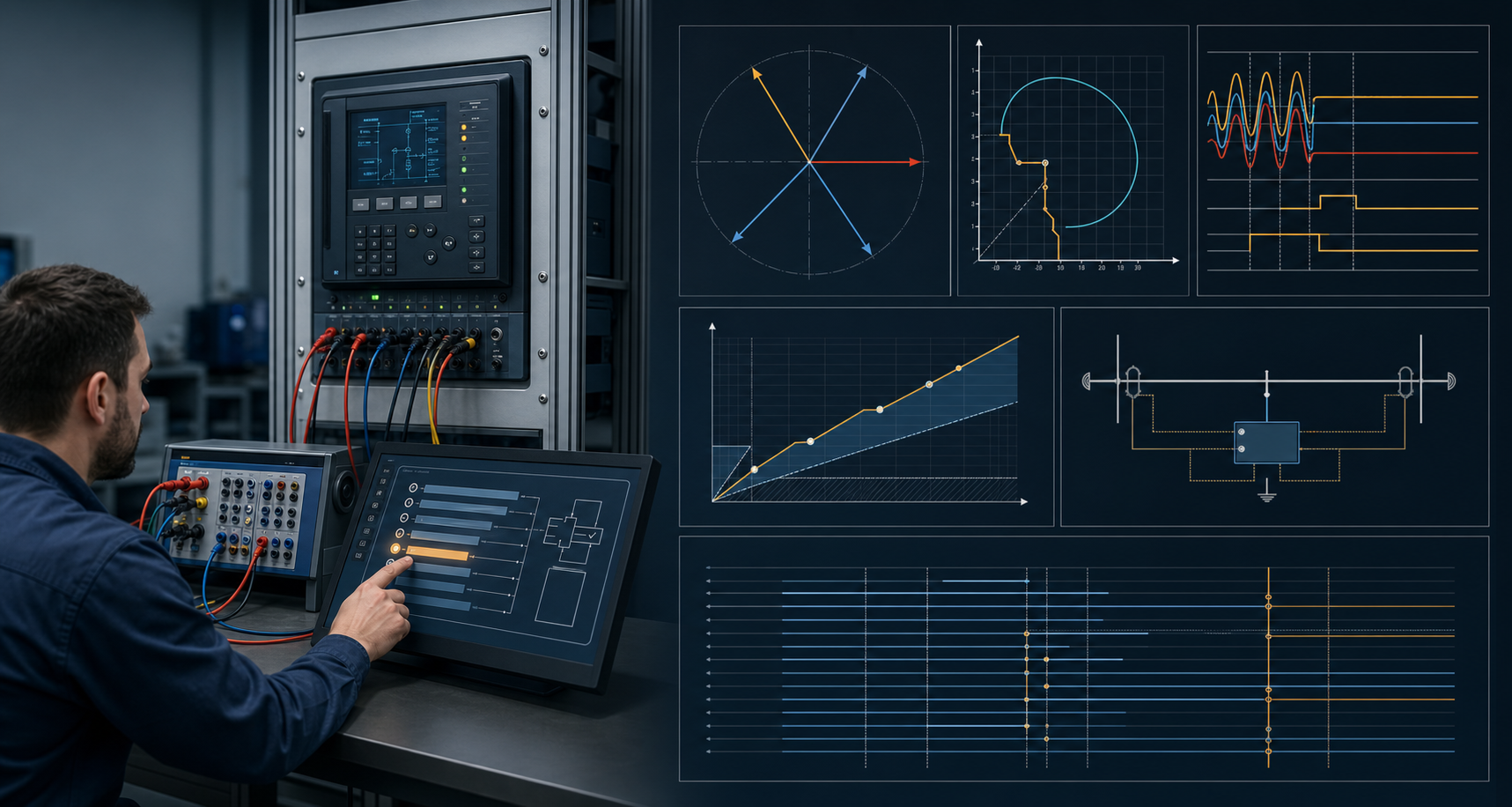
“Relay testing” is not one test. Overcurrent timing, distance reach, transformer differential restraint, underfrequency operation, breaker-failure logic, and communications-assisted schemes each have different expected behavior and different ways for a plan to be wrong.
An agentic copilot is most useful when it helps an engineer choose and organize the right test evidence for the function in scope. It should not flatten every function into a generic prompt or hide the calculation behind natural language.
Overcurrent: curves, ramps, and reset
For an overcurrent element, the plan may include pickup, dropout, reset ratio, timing at defined multiples, curve sweep, instantaneous operation, phase and earth elements, and logic blocking. IEC 60255-151 and IEEE C37.112 provide different but related contexts for inverse-time characteristics. The test record should name the curve family, constants, pickup, time multiplier, minimum time, tolerance, ramp rate, and reset behavior.
An assistant can:
- identify which settings drive the expected curve;
- retrieve the manufacturer-specific definition;
- propose points that cover the operating range;
- flag a mismatch between the settings and the selected curve;
- draft a table of expected versus measured values.
Deterministic code should calculate the curve and verdict. If the model uses the wrong exponent, the assistant’s fluent explanation is irrelevant; the expected-value calculation must make the error observable.
Distance: the characteristic is more than a reach number
Distance testing may involve zone reach, resistive reach, directional polarization, memory voltage, load encroachment, power swing blocking, fault type, source impedance, and line angle. A simple point inside the R-X characteristic is not a complete proof of scheme behavior.
The distance relay reach guide explains why the test should distinguish characteristic geometry from dynamic behavior. AI can help connect a line model, relay settings, and prior test points, and can ask whether the case covers a blinders or load-encroachment boundary. It must not substitute a model-generated “looks right” for a defined injection and measured trip time.
Differential: restraint, inrush, and external faults
Differential testing is a relationship test. The engineer needs to consider current direction, ratio and phase compensation, vector group, restraint characteristic, minimum operate current, harmonic blocking or restraint, CT saturation, external-fault stability, and internal-fault operation. A test that checks only one internal fault point can miss a stability failure.
An assistant can retrieve the transformer or bus differential manual, compare the settings to the test plan, and assemble a case matrix that separates internal and external faults. It can highlight that inrush or CT saturation was not covered. The engineer still decides whether the cases are sufficient and the test set or simulator still provides the defined signals.
Frequency and logic functions
Underfrequency, overfrequency, rate-of-change-of-frequency, voltage, breaker-failure, reclosing, and intertrip functions often depend on sequence and timers. A single steady-state point may confirm pickup but not the logic state after a disturbance. The test plan should name initial state, transition, timer, blocking condition, output, reset, and expected waveform or binary response.
An agentic workflow can turn a narrative procedure into a checklist of states and transitions, then mark which items lack a test case. That can be valuable in commissioning because the missing test is often a missing transition rather than a missing analog value.
The common AI failure: applying the wrong template
A language model can recognize the words “distance relay” and still retrieve a manual for a different relay family, firmware, or setting convention. It can recognize “differential” and omit a vector-group or restraint parameter. It can produce a very plausible overcurrent curve with a wrong time multiplier.
The control is not to ask the model to be more confident. The control is to require:
- exact asset and firmware identity;
- source-linked manual passages;
- explicit units and phase/reference conventions;
- deterministic expected-value calculations;
- a visible missing-data state;
- engineer review before a plan is finalized.
ProtectionAI’s role
ProtectionAI is GridAPM’s protective-relay testing workbench with an agentic copilot. The published product description supports a workflow around settings, test modules, simulation, manual retrieval, and report drafting. Its public limitations should remain visible: simulator-first operation and any physical test-set integration are distinct validation scopes.
The software can help a team prepare a function-specific test matrix and explain the evidence around a failed point. It should not be marketed as a universal protection oracle or as a replacement for the test-set manufacturer’s qualified modules. Existing products such as OMICRON Test Universe, Doble RTS, Megger RTMS, and EuroSMC’s software have mature hardware-linked workflows that remain central to physical testing.
A function-specific review card
For each function, record:
- the element and settings group;
- the input quantities, units, and reference angle;
- the expected characteristic or state machine;
- the test points and transitions;
- the tolerance and calibration basis;
- the physical equipment or simulation mode;
- the actual result and raw evidence;
- the engineer’s disposition.
If an AI assistant cannot fill a field from a named source, it should leave it open. That behavior is a feature in a safety-relevant discipline.
References
- CIGRE Working Group B5/WG 34.04. (1986). Evaluation of characteristics and performance of power system protection relays and protective systems (Technical Brochure No. 011). https://www.e-cigre.org/publications/detail/011-evaluation-of-characteristics-and-performance-of-power-system-protection-relays-and-protective-systems.html
- Institute of Electrical and Electronics Engineers. (2014). IEEE standard inverse-time characteristic equations for overcurrent relays (IEEE Std C37.112-2014). https://standards.ieee.org/ieee/C37.112/7009/
- Institute of Electrical and Electronics Engineers. (2023). IEEE guide for power system protection testing (IEEE Std C37.233-2023). https://standards.ieee.org/ieee/C37.233/6676/
- International Electrotechnical Commission. (2009). Measuring relays and protection equipment—Part 151: Functional requirements for over/under current protection (IEC 60255-151:2009). https://webstore.iec.ch/en/publication/1166
- Porawagamage, G., Dharmapala, K., Chaves, J. S., Villegas, D., & Rajapakse, A. (2024). A review of machine learning applications in power system protection and emergency control. Frontiers in Smart Grids, 3, Article 1371153. https://doi.org/10.3389/frsgr.2024.1371153
References
- IEC 60255-151 IEC 60255-151 — Functional requirements for over/under current protection
- IEEE C37.112 IEEE C37.112 — Inverse-time characteristic equations for overcurrent relays
- IEEE C37.233 IEEE C37.233-2023 — Guide for Power System Protection Testing
- CIGRE Technical Brochure 011 — Evaluation of protection relay characteristics and performance
- Frontiers review — Machine learning in power system protection
Questions engineers ask
Can one AI test template cover every relay function?
No. Overcurrent, distance, differential, frequency, logic, and breaker-failure functions have different models, inputs, sequences, and failure modes; templates must be tied to the actual relay and procedure.
What should AI do with an ambiguous relay manual?
Retrieve and cite the relevant passage, identify the ambiguity or firmware dependency, and ask for engineer resolution instead of inventing a parameter.
Does a simulator validate a distance relay's real-world reach?
It validates the modeled characteristic under defined assumptions; physical reach, wiring, instrument, and system behavior still require the appropriate qualified test.

